The SaaS desk
Tracking SaaS, seat-based pricing, net revenue retention + 10 more
- SaaS — The category conversation: who says it is dying, who says it is fine, and on what evidence.
- seat-based pricing — The pricing argument AI forces — per-seat, per-usage, per-outcome.
- net revenue retention — The number operators actually run on, and what is happening to it.
- churn — Retention pressure: who is losing customers and to what.
- vertical SaaS — Where software money is moving as horizontal tools commoditise.
- AI-native software — The challengers rebuilding categories, and how incumbents answer.
- ARR — The growth number operators benchmark against, and what is happening to it.
- The Official SaaStr Podcast: SaaS | Founders | Investors
- Lenny's Podcast: Product | Growth | Career
- The SaaS Podcast - SaaS, Startups, Growth Hacking
- Run the Numbers
- The SaaS CFO
- SaaS District
AI-native models and enterprise revenue scale rapidly














~37 hrs of podcasts, listened to for you. This is the 2-minute version.
312 search results → 71 episodes scanned → 8 made it in · 8 analyzed in full
The market is rapidly decoupling from traditional per-seat SaaS metrics, as high-growth AI infrastructure firms like Eleven Labs and Deep Seek demonstrate that massive scale is now achievable through enterprise-heavy API models. While yesterday's briefing highlighted the shift toward usage-based pricing, today's data shows the next evolution: a move toward outcome-based hiring and operations that render traditional seat-based licenses obsolete. You are seeing a clear bifurcation between legacy software appending AI and AI-native architectures that compound value through proprietary data, fundamentally altering how you should view your own retention and margin targets.

The Twenty Minute VC (20VC): Venture Capital | Startup Funding | The Pitch
Sep 24 · 81 min · Top 100 business
OpenAI projects massive ARR growth to $350B
- OpenAI is forecasting growth from 35 billion in ARR to 350 billion in three to four years.
- Legora announced they have reached 200 million in ARR, prompting discussion on their valuation and margins.
- The panel notes that Anthropic grew 10x in one year, making a 10x forecast over four years modest.
Why this matters to you
The massive scale of these ARR projections highlights the extreme capital intensity and revenue expectations required for frontier AI companies to justify current valuations.
There's actually three numbers that matter, not two. They're forecasting growing from 35 in ARR end of this year to 350, I think in three or four years.”
— Rory O'Driscoll
Listen Deep dive
ARR
2 episodes · 2 of 23 mentions
Meta Unveils Muse Charm and Gemini Can Call for YouEleven Labs hits $600M ARR · Open AI · Listen
Eleven Labs reached $600 million in ARR with a $22 billion valuation, with enterprise clients accounting for 55% of revenue.

SaaS
3 episodes · 3 of 19 mentions
Sep 24 · 52 min
AI-native OS shifts SaaS margin and defensibility
- Eric Bidinger describes Luca as an AI-native operating system designed to ingest company data and provide real-time business advice.▶ 00:15:32
- Bidinger claims that AI-native software allows a team to be one-tenth the size of a traditional company five years ago.▶ 00:24:15
- The company differentiates itself by building persistent business memory from customer documents, workflows, and conversational history to increase switching costs.▶ 00:26:45
Why this matters to you
This highlights how AI-native architectures fundamentally shift SaaS operating margins and defensibility by compounding value through proprietary customer data rather than just feature sets.
“I think there's a clear divide between legacy software that is now appending AI as a bolt-on, because they have to, because everyone wants AI, versus an AI native experience on the other side.”
— Eric Bidinger, at 00:16:45
Listen Deep dive

Sep 24 · 60 min
Findem pivots to outcome-based hiring solutions
- Findem transitioned from selling per-seat SaaS tools to recruiters to delivering outcome-based hiring solutions for businesses.
- The company leverages a proprietary labeled data asset of one billion people to power AI-native recruiting agents.
- Kolam claims AI-first companies achieve superior revenue trajectories by scaling on outcomes rather than traditional software licensing.
Why this matters to you
Shifting from per-seat pricing to outcome-based models validates the viability of SaaS businesses as AI agents increasingly automate manual recruiter workflows and tasks.
Also mentioned

Inside Atlassian and the The $100m House Next DoorAtlassian struggles with AI-driven valuation shifts · In The Blink of AI with Georgie Healy · Listen
Atlassian's share price halved as the market struggles to apply traditional profit multiples to SaaS businesses navigating AI integration.
churn
3 episodes · 3 of 8 mentions
Behind Gym Doors | A Fitness Business Podcast
Sep 24 · 35 min
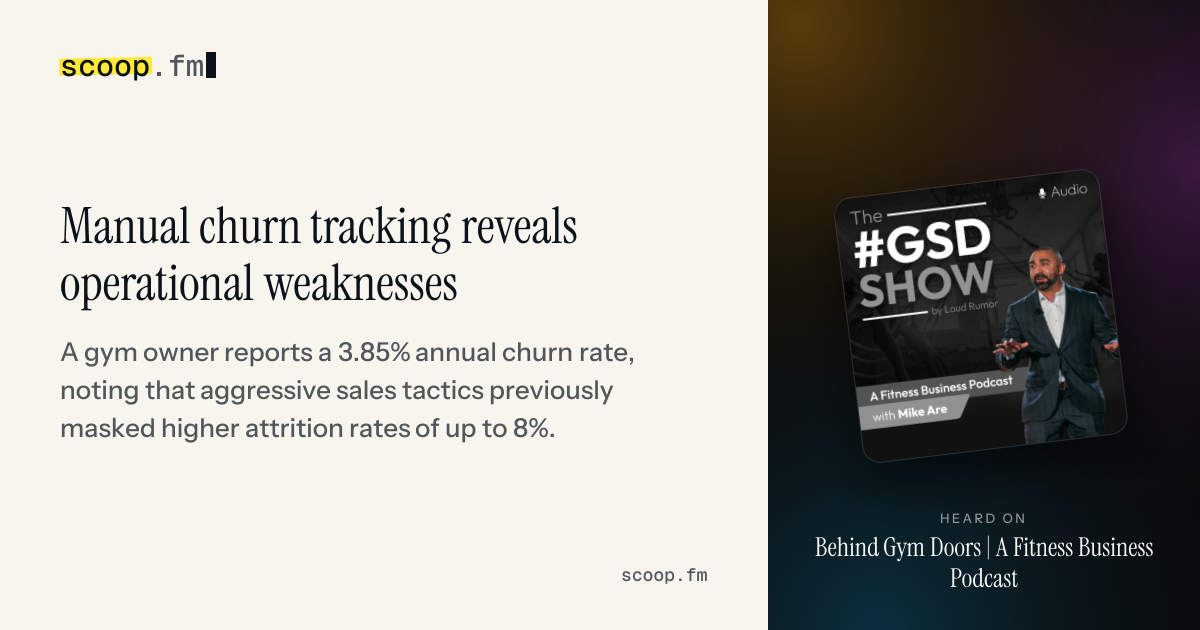
Manual churn tracking reveals operational weaknesses
- Trevor reports his current annual churn rate is 3.85%, which he tracks manually via a weekly scorecard.
- The gym's churn rate previously reached high seven to eight percent when focusing solely on aggressive sales.
- The owner identifies churn by comparing the number of members at the start and end of months.
Why this matters to you
High-growth sales tactics can mask underlying product weaknesses, leading to unsustainable attrition that requires a shift toward retention-focused operational systems and standards.

Chain of Thought | AI Agents, Infrastructure & Engineering
Sep 24 · 83 min
LLMs struggle with custom churn definitions
- The speaker identifies churn as a critical business metric that requires specific organizational context to be accurately interpreted by AI models.
- Wisdom AI uses a learning loop to detect context drift, noting that churn definitions can change based on evolving business strategy.
- The platform highlights that without explicit context, LLMs struggle to define churn consistently, leading to potential inaccuracies in business-critical analytics.
Why this matters to you
Understanding how to encode custom churn definitions into AI context layers prevents hallucination and ensures automated analytics align with internal business logic.
“There is no way that out of the box, LLM would know what the definition of the ARR is for that company or the definition of churn for that company.”
— Kapil Chhabra
Listen Deep dive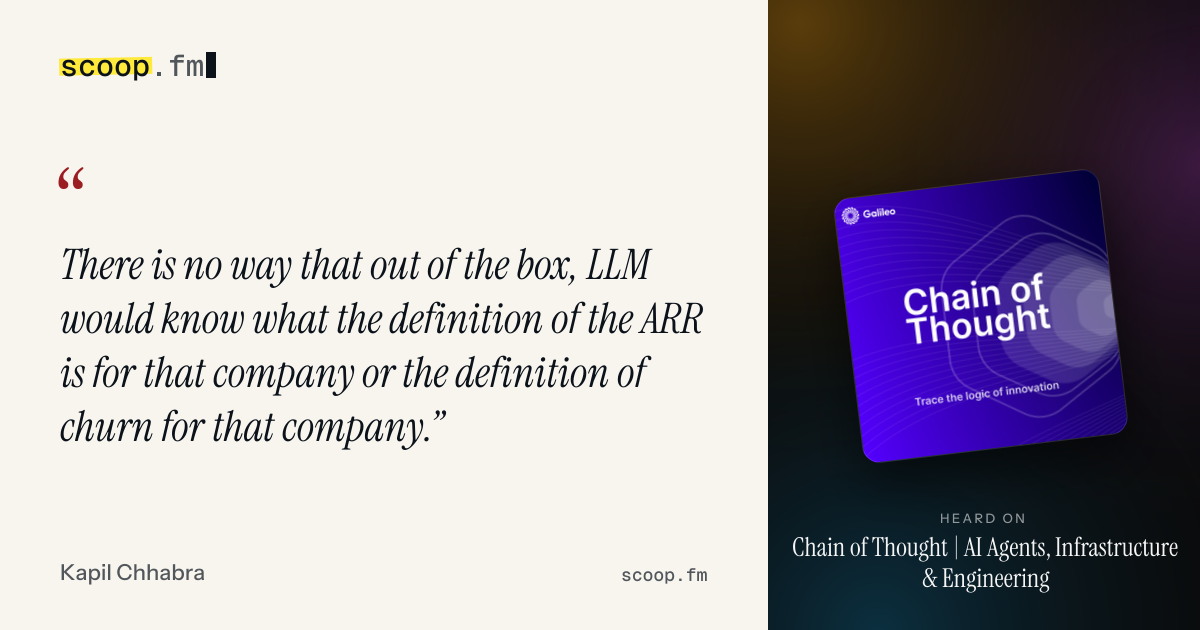

Sep 24 · 27 min
The mathematical impact of churn on LTV
- The speaker defines churn as the percentage of customers who leave, directly impacting the lifetime gross profit calculation.
- A Facebook ads agency example shows how 20% churn reduces a $10,000 lifetime value to $2,000 per customer.
- The speaker explains that calculating lifetime value involves dividing the monthly price by the monthly churn percentage rate.
Why this matters to you
Understanding the mathematical relationship between churn and lifetime value is essential for accurately assessing the economic viability of a SaaS business model.
“In other words, they had 20% churn. So you take the price divided by churn, which is 20% equals $10,000.”
— Alex Hormozi
Listen Deep dive
Make it yours
Start from these trackers
Copy its trackers, shows and tone into a page of your own. Change anything — this page isn’t touched.
Make it mine