Aug 23: Pre-filling two tokens steals reasoning traces
Good morning. Teams are bypassing standard AI workflows to force models into legacy systems and strict constraints.
Pre-filling just two tokens from a frontier model's reasoning trace forces smaller open-weights models to adopt the exact same thinking style and final answer. Researchers discovered this conditional autoregression vulnerability allows teams to bypass expensive supervised fine-tuning pipelines entirely when distilling proprietary logic into models like Kimi.
Ship This Week
Keeping system prompts strictly stable across multi-step agent loops maximizes cache hits on Quen 3.8 Max, dropping input token costs from $2.00 to $0.25/M.
infra
Stable system prompts for agent caching
Standardize system prompts in agentic workloads to leverage Quen 3.8 Max's 8x cheaper cached input tier.

Problem: Agentic and retrieval-heavy workloads repeatedly send massive context windows, driving up input token costs on fresh requests.
On: prompt caching for agentic workloads
“because cached input is eight times cheaper than fresh input, agentic and retrieval-heavy workloads with stable system prompts collapse toward that $0.25 per million token floor.”
RecipeKeep system prompts and tool definitions strictly stable across agent loops to maximize cache hits on Quen 3.8 Max, dropping the effective input cost to the $0.25 per million token floor.
MeasuredEvidence$2.00 → $0.25/M input tokens
CounterpointDynamic system prompts or injecting variable context too early in the prompt breaks cache hits, driving up costs in multi-step agent loops.
1018: Alibaba's Qwen3.8-Max: Open-Weight Model Surpasses Most American Frontier Labs · Aug 14, 2026
Watch the Frontier
Stripe abandons iterative agent planning, instead deploying one-shot coding agents that push 7,000 PRs a week directly to CI/CD pipelines for validation.
agents
One-shot CI/CD coding agents
Stripe uses one-shot coding agents guided by repository-specific Markdown files to generate and test pull requests without iterative planning loops.

Problem: Standard agentic coding loops get stuck in planning mode or require heavy human iteration, slowing down deployment and stressing centralized review processes.
On: one-shot agent pull requests
“Minions are one shot. So you give it a prompt and it's going to build it and then it's going to go through CI, CD and all of testing and then you're going to review it.”
RecipeDeploy one-shot agents that take a prompt, write the code, and push it directly through CI/CD and testing pipelines before human review. Embed "agents files" (Markdown templates) in every repository to provide the agent with local integration patterns and constraints.
MeasuredEvidence7,000 PRs/week (30% of total)
CounterpointMost coding agents rely on iterative planning and human-in-the-loop steering; Stripe forces a one-shot architecture that relies on CI/CD for validation.
Stripe’s AI Strategy: Build More, Not Less · Aug 17, 2026
Today's AI Patterns
Capability shifts and emerging build patterns from this week's shows.
agents
Agent-invoked session termination tool
Give agents a dedicated 'bail button' tool to autonomously terminate sessions when they detect abusive user behavior.

agents
Effort vs capability diagnostic routing
Diagnose agent failures by separating capability limits (requires larger model) from thoroughness limits (requires higher effort parameter).
product
Two-stage trial abuse detection
Stripe detects AI free-trial abuse by combining network-wide embeddings with an LLM reasoning layer to explain the fraud signals.
agents
One-shot CI/CD coding agents
Stripe uses one-shot coding agents guided by repository-specific Markdown files to generate and test pull requests without iterative planning loops.
infra
Selectable reasoning effort routing
Use Quen 3.8 Max's adjustable reasoning parameter to prevent simple lookups from triggering expensive, lengthy thinking traces.
agents
Frontier model routing for multi-step tasks
Route complex multi-step agent tasks to the largest model to reduce total cost per task via fewer reasoning steps.
infra
Stable system prompts for agent caching
Standardize system prompts in agentic workloads to leverage Quen 3.8 Max's 8x cheaper cached input tier.
infra
CPU pre-filtering for GPU inference
LinkedIn reduces GPU inference costs by using CPU-based faceted filtering to drop out-of-scope items before loading candidates into GPU memory.

agents
Shared ontology layer for multi-agent deployment
Build a shared semantic linking layer across business entities so subsequent agents can reuse existing context and deploy faster.

infra
State-bound reasoning encryption
Prevent reasoning replay attacks by making the encryption of reasoning blobs cryptographically dependent on the previous conversation turn.

product
Sensor-level real image provenance
Instead of watermarking AI-generated images, Apple is cryptographically signing real images at the sensor level to establish a baseline of authenticity.

product
Time-window co-occurrence for associate tracking
Identify suspect associates by querying for license plates that appear within a two-minute window of the target plate.

fine_tuning
Defunct-company RL environments
AI labs are buying internal data from bankrupt companies to build highly realistic reinforcement learning sandboxes for agent training.

evals
Biological baseline correlation thresholds
Set AI pilot success thresholds at 0.4-0.5 correlation, baselining against the 0.6 correlation of actual wet-lab reproducibility.
evals
Hybrid 70/30 human-LLM UI evaluation
Weight UI generation evals 70% toward blind human grading to catch stylistic slop that LLM judges miss.

infra
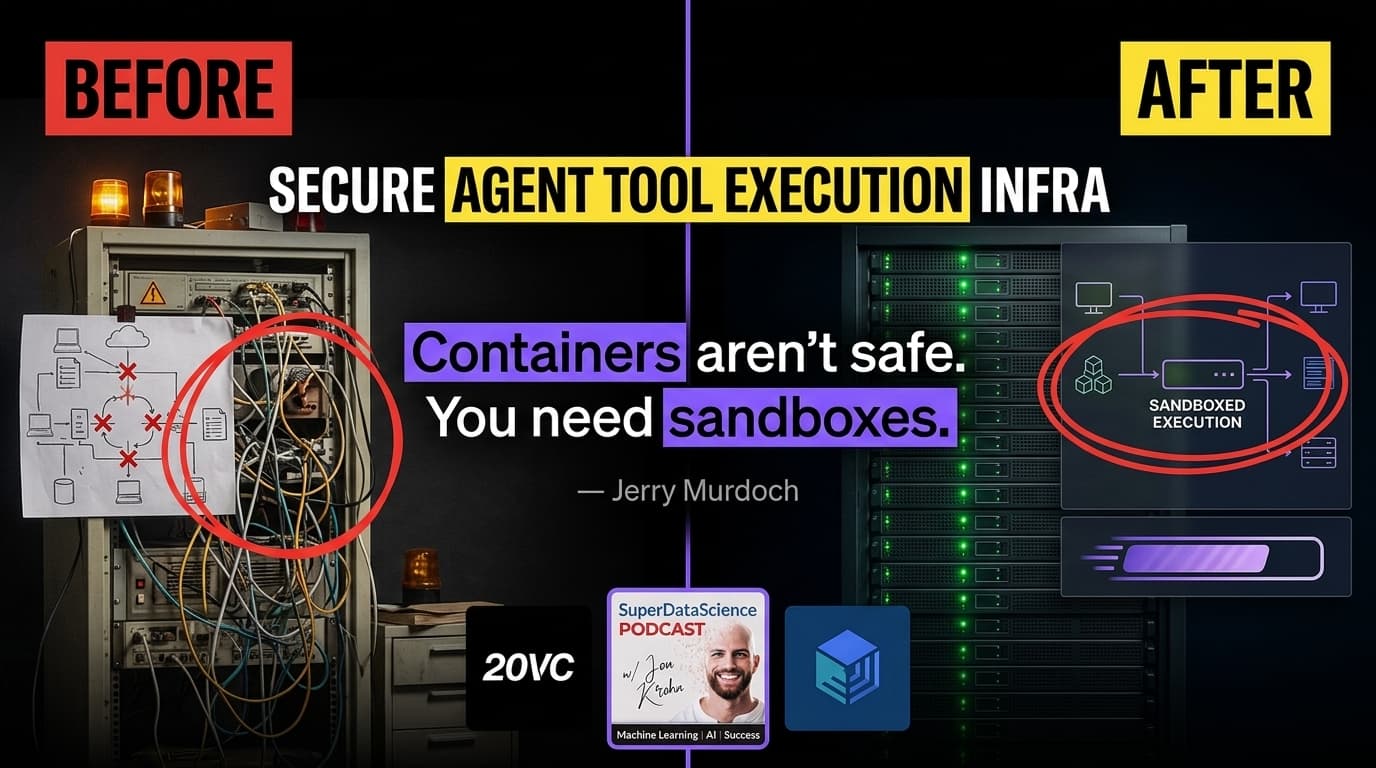
Cloud sandboxes for agent tool execution
Replace standard containers with purpose-built cloud sandboxes to safely isolate probabilistic agent tool execution.

evals
Exclusive hold-out axis splitting
Split biological evaluation datasets by holding out entire axes (time series, cell contexts, or perturbations) rather than random sampling.
prompting
Two-token reasoning pre-fill
Force an open-weights model to adopt a frontier model's reasoning style and final answer by pre-filling just two tokens of the frontier's thought.
product
Legacy-format model output scaffolding
Format AI predictions as exact replicas of legacy wet-lab outputs so domain experts can use existing bioinformatics tools to verify results.
Capability Watch
New model behaviors and tool patterns showing up across multiple shows.
Agent Autonomy
Agents gain active session control and diagnostic routing
Instead of relying on passive safety filters or manual developer intervention, agents are now being equipped with active tools to terminate abusive sessions autonomously. Simultaneously, diagnostic routing frameworks allow systems to dynamically adjust effort parameters or swap model sizes based on specific failure modes like skipped files or hallucinated APIs.
Inference Infrastructure
Cryptographic state binding and CPU pre-filtering reduce costs
Infrastructure teams are moving away from brute-force GPU inference and stateless API vulnerabilities. New patterns include running deterministic faceted filtering on CPU indexes before loading candidates into GPU memory, and cryptographically binding encrypted reasoning blobs to previous conversation turns to prevent replay attacks.
Evaluation Methods
Hybrid grading and exclusive axis hold-outs replace standard benchmarks
Pure LLM-as-judge pipelines and random dataset splits are failing to capture real-world utility. Teams are shifting to hybrid indexes weighted heavily toward blind human grading to catch stylistic slop, and implementing exclusive hold-out axes for biological data to prevent context leakage during zero-shot testing.
Operator Bets
What practitioners are actually shipping with — frameworks, stack picks.
Larger models reduce total task cost
Cheaper per-token pricing is a trap for complex agent loops. Routing multi-step tasks to the largest available model lowers overall cost by reaching the quality bar in fewer reasoning steps.
Hardware signatures will replace AI watermarks
Software-level AI watermarking is a losing battle against infinite synthetic variations. The industry will shift to cryptographically signing real images at the sensor level, treating unsigned content as synthetic by default.
Bankrupt companies will fuel agent training
Static web scraping cannot teach agents how to navigate complex enterprise workflows. AI labs are acquiring internal corporate data from liquidated companies to build highly realistic reinforcement learning sandboxes.
Stack Drops
Tools, libraries, and infra dropping into operator workflows now.
Quen 3.8 Max
Introduces adjustable reasoning effort parameters to prevent simple lookups from burning unnecessary compute.
Flock OS Investigate
Uses time-window heuristics on stationary camera data to identify suspect associates without continuous facial recognition.
E2B Sandboxes
Purpose-built cloud sandboxes for safely isolating probabilistic agent tool execution.
From the Conversations
Biological baseline correlation thresholds
Determining Virtual Cell Impact for Drug Discovery - with Kristóf Szalay and Gerold Csendes of Turbine
Aug 17, 2026 · 41m · 3 quotes pulled
▶ Listen“We know that biology reproduces with 0.6 correlations, so 0.5, 0.4 is good... if they can find out findings that they expect... you can go on a larger scale deployment.”
Super Data Science: ML & AI Podcast with Jon Krohn
Effort vs capability diagnostic routing
1020: How to Choose Model Size and Effort Level: The Two Critical Dials
Aug 21, 2026 · 16m · 2 quotes pulled
▶ Listen“Did it try hard enough or did it not know enough? If the model skipped a file, didn't run the tests, or bailed on a refactor partway through, raise the effort.”
One-shot CI/CD coding agents
Stripe’s AI Strategy: Build More, Not Less
Aug 17, 2026 · 54m · 2 quotes pulled
▶ Listen“Minions are one shot. So you give it a prompt and it's going to build it and then it's going to go through CI, CD and all of testing and then you're going to review it.”
Sources
 ▶ Listen
Big Technology Podcast
Nick Bostrom: Worries About AI Existential Risk Just Became More ConcreteNick Bostrom is an AI philosopher and the author of Superintelligence and Deep Utopia. Bostrom joins Big Technology to discuss whether the rise of autonomous AI agents is making the technology’s existential risks more concrete. Tune in to hear his assessment of the alignment problem, recursive self-improvement, and humanity’s chances of steering superintelligence toward a positive outcome. We also cover whether we have reached AGI, the case for a precisely timed AI pause, biological threats, AI consciousness, and the moral status of digital minds. Hit play for a clear-eyed conversation about AI’s greatest dangers and its potential to radically improve human life. --- Enjoying Big Technology Podcast? Please rate us five stars ⭐⭐⭐⭐⭐ in your podcast app of choice. Watch the full documentary here: https://www.gravitee.io/ai-agent-documentary Want a discount for Big Technology on Substack + Discord? Here’s 25% off for the first year: https://www.bigtechnology.com/subscribe?coupon=0843016b Learn more about your ad choices. Visit megaphone.fm/adchoices
 ▶ Listen
Super Data Science: ML & AI Podcast with Jon Krohn
1020: How to Choose Model Size and Effort Level: The Two Critical DialsIn Episode #1020, Jon Krohn unpacks the two dials that increasingly decide what you get out of a large language model: which model size you pick and how much effort you tell it to spend. Using a July Anthropic blog post by Claude Code’s Lydia Holly as a jumping-off point, with guidance that generalizes to any model family, Jon explains what each setting actually does under the hood. Model size swaps which frozen weights handle your request (roughly, how capable), while effort sets how thorough and certain the model must be before calling a task done, not a simple “thinking-time slider.” He offers a clean diagnostic for when to raise effort versus move to a bigger model, shows why cheaper-per-token isn’t always cheaper-per-task and surveys how OpenAI, Google and open-weight labs have all converged on these same two dials. Additional materials: www.superdatascience.com/1020 Interested in sponsoring a SuperDataScience Podcast episode? Email [email protected] for sponsorship information. In this episode you will learn: (00:56) What the model-size dial actually does (05:29) Why effort isn’t a thinking-time slider (13:25) Three practical takeaways for using both dials
 ▶ Listen
The a16z Show
Stripe’s AI Strategy: Build More, Not Lessa16z General Partner David George is joined by Will Gaybrick, President of Product & Business at Stripe, to discuss how AI is changing the way Stripe builds products, organizes teams, and thinks about the future of internet commerce. Stripe has evolved from a payments company into a multi-product financial infrastructure platform, while a new generation of AI companies is growing and monetizing faster than previous software cohorts. Will explains why Stripe sees AI productivity as an opportunity to build more rather than simply cut costs, including how its internal coding agents now generate thousands of pull requests each week. They discuss creating founder-like agency inside large companies, building smaller and flatter teams, and why Stripe believes dramatically more software will be created as the cost of building continues to fall. They also look ahead to agentic commerce, why checkout pages could disappear, the potential return of micropayments, stablecoins as infrastructure for a global economy, and a future where AI agents increasingly buy software and services from other machines.
- ▶ Listen
Super Data Science: ML & AI Podcast with Jon Krohn
1018: Alibaba's Qwen3.8-Max: Open-Weight Model Surpasses Most American Frontier LabsIn Episode #1018, Jon Krohn breaks down Qwen3.8-Max, Alibaba’s enormous new flagship, a 2.4-trillion-parameter mixture-of-experts model that, if its promised weights ship, becomes the largest open-weight release in history. Landing just weeks after Moonshot’s Kimi K3, it extends the price war and the open-weight surge Jon covered in Episode #1012. Alibaba positions it as second only to Anthropic’s Claude Fable 5 / Mythos 5 and independent signals land in a similar neighborhood. Jon walks through its capabilities and multi-day agentic demos, its aggressive pricing ($2 in / $6 out per million tokens, with cached input eight times cheaper), and the question he gets asked most: are Chinese models safe to use? His answer hinges far less on the model than on how your data reach it. Additional materials: www.superdatascience.com/1018 Interested in sponsoring a SuperDataScience Podcast episode? Email [email protected] for sponsorship information.
 ▶ Listen
Software Engineering Daily
How LLMs Are Reshaping Recommendation Systems<p class="wp-block-paragraph">News feeds and recommendation systems have long relied on deep learning architectures that score each candidate item independently. As LLMs have matured, they have opened up a fundamentally different approach, where a system can reason about content the way it reasons about language. However, that power comes with a fresh set of engineering challenges around cost, scale, and evaluation.</p> <p class="wp-block-paragraph"><a href="https://www.linkedin.com/" data-type="link" data-id="https://www.linkedin.com/">LinkedIn</a> recently rebuilt its news feed to treat content recommendation as a sequence modeling problem. The general approach is to predict what a user will want next, much like an LLM predicts the next token in a sentence.</p> <p class="wp-block-paragraph"><a href="https://www.linkedin.com/in/timjurka">Tim Jurka</a> has worked at LinkedIn for 13 years and is currently a VP of Engineering. In this episode, Tim joins Matt Merrill to discuss how LinkedIn re-engineered its feed, how the team combines LLMs with traditional signals, managing inference costs at massive scale, steering content quality using natural language policies, and more.<br><br>Sponsorship inquiries:<br><a href="mailto:[email protected]">[email protected]</a></p> <p class="wp-block-paragraph"></p> <p>The post <a href="https://softwareengineeringdaily.com/podcasts/how-llms-are-reshaping-recommendation-systems/">How LLMs Are Reshaping Recommendation Systems</a> appeared first on <a href="https://softwareengineeringdaily.com">Software Engineering Daily</a>.</p>
 ▶ Listen
The AI in Business Podcast
The Predictive Model Reshaping Retail Operations at Scale - with Chris Slovak of Unframe.AI<div>Most retail AI pilots stall waiting on a years-long project to centralize and clean data before any agent can go live.</div> <div> </div> <div>In this episode, Chris Slovak, Global Field CTO at Unframe, makes the case for a different path: letting agents pull context directly from ERPs, CRMs, and point-of-sale systems as needed, in conversation with host Marilie Fouché. He walks through concrete results from that approach, including an inventory intelligence deployment that saved tens of thousands of dollars in time and data costs, and a deployment cycle that shrank from nine months to two weeks.</div> <div> </div> <div>This episode is sponsored by <a href= "https://www.unframe.ai">Unframe</a>.</div> <div> </div> <div>Emerj works with a select group of AI vendors to reach Fortune 500 decision makers through research, media, and direct access. If you want to be considered, download our media kit at <a href= "http://emerj.com/AD1">emerj.com/AD1</a></div>
 ▶ Listen
Machine Learning Street Talk (MLST)
Stealing Reasoning Traces from Proprietary LLM APIs — Ilia Shumailov & Alexander Panfilov<p>Tim Scarfe speaks with Ilia Shumailov and Alexander Panfilov about their paper, Stealing Reasoning Traces from Proprietary LLM APIs.The core bug sounds deceptively simple: providers return encrypted reasoning state so conversations can be resumed or forked. But those blobs can be replayed across users and sibling models. A smaller model can ask the provider to decrypt the trace, then repeat the hidden reasoning in plain text. The discussion covers leaked private data, a broadly reusable jailbreak, poisoned agent traces, chain-of-thought monitoring, responsible disclosure, and possible defenses.Ilia Shumailov is an AI and security researcher, formerly at Google DeepMind, who completed his Cambridge PhD under Ross Anderson. Alexander Panfilov is a PhD researcher at the ELLIS Institute Tübingen and the Max Planck Institute for Intelligent Systems, working on AI safety, adversarial machine learning, and LLM red-teaming. They close by separating the demonstrated jailbreaking threat from ordinary benign distillation, and by arguing for controlled experiments over sweeping claims.---TIMESTAMPS:00:00:00 Intro montage00:01:33 Portable encrypted thought and decoded reasoning00:24:55 How the attack works and what it means00:39:04 Doom, defense, and scientific restraint---REFERENCES:paper:[00:00:00] Stealing Reasoning Traces from Proprietary LLM APIshttps://arxiv.org/abs/2608.09867[00:09:22] Chain of Thought Monitorability: A New and Fragile Opportunity for AI Safetyhttps://arxiv.org/abs/2507.11473[00:11:30] Reasoning Models Don’t Always Say What They Thinkhttps://www.anthropic.com/research/reasoning-models-dont-say-think[00:37:22] PostTrainBench: Can LLM Agents Automate LLM Post-Training?https://arxiv.org/abs/2603.08640[00:41:02] Large-scale online deanonymization with LLMshttps://arxiv.org/abs/2602.16800other:[00:09:28] OpenAI and Hugging Face partner to address security incident during model evaluationhttps://openai.com/index/hugging-face-model-evaluation-security-incident/[00:10:22] Claude, GPT, and Gemini All Struggle to Evade Monitorshttps://metr.org/notes/2025-08-22-claude-gpt-gemini-struggle-evade-monitors/tool:[00:42:08] Isabelle proof assistanthttps://isabelle.in.tum.de/---RESCRIPT: https://app.rescript.info/share/07fc38276e0823dc9b8986c32e202c7f</p>
 ▶ Listen
The Vergecast
Mark Zuckerberg has an InstagzamHave you seen Instagram's new logo? Meta debuted it right before we started recording, so of course David and Nilay needed to talk about it. Then, the hosts turn to Mark Zuckerberg's 6,500-word missive on the future of AI, and the problem with his idea that giving AI to everyone will fix everything. After that, it's time for Claude watermarks, Spotify AI personas, Brendan Carr, Flock, and much more. Further reading: This is Instagram’s new logo | The Verge The Pepsi Universe PDF The Future is for Everyone Four takeaways from Mark Zuckerberg’s massive AI manifesto Mark Zuckerberg doesn’t understand how to live https://www.meta.com/design-at-meta/blog/ Claude will apply invisible watermarks to AI text and images ‘If it was opt-in, nobody would opt in.’ Spotify says it won’t recommend music from ‘AI Personas’ Apple could help you prove your iPhone photos aren’t deepfakes | The Verge Guitar company D’Addario admits that AI music was used in a promotional video | The Verge Fender’s CEO seems to think your bandmates are just analog AI | The Verge Suno Unveils Download Song Caps for Free, Paid Tiers Brendan Carr is one firing away from an unchecked FCC YouTube is making it harder to earn money on YouTube Flock CEO: ‘We got this one wrong’ The first rival Android app store just arrived in the US Play Store ChatGPT and Gemini both just passed 1 billion users The sub-$100 phone market is disappearing. Subscribe to The Verge for unlimited access to theverge.com, subscriber-exclusive newsletters, and our ad-free podcast feed. We love hearing from you! Email your questions and thoughts to [email protected] or call us at 866-VERGE11. 0:00 Welcome and Parental Leave Announcement 00:43 Instagram Redesigns Their Logo 01:04 Why Companies Change Logos 03:37 Meta Design Blog Quotes 07:22 The 2008 Pepsi Universe Presentation 09:41 Blanding 10:37 Zuck’s AI Manifesto 13:29 Collective Action Problems 18:49 Superintelligence for All 20:57 Cybersecurity and AI Risks 22:22 China Chips and Distillation 27:48 Write the Law Challenge 32:30 Claude Text Watermarking 35:33 How The Watermark Works 39:34 Limits And Evasion Risks 41:54 Apple Marks Real Photos 46:03 Provenance Standards Fail 46:58 AI Music Backlash 49:39 Fender CEO AI Scandal 53:08 Where AI Fits In Music 59:13 Twitch Opt Out Training 01:01:35 The Lightning Round 01:02:55 Brendan Carr is a Dummy 01:04:55 Bans Don’t Work 01:05:56 Made in America Assembly 01:10:19 Gemini Claims a Billion Users 01:15:40 YouTube Partner Paywall 01:20:56 RAMageddon Cheap Phones 01:23:52 Flock Camera Backlash 01:27:19 Goodbyes and Plugs Learn more about your ad choices. Visit podcastchoices.com/adchoices
 ▶ Listen
Last Week in AI
Breaking Down AI News: Security and InvestmentIn this episode, we summarize key AI stories of the week, focusing on Anthropic’s watermarking breach and Google’s impressive $12 billion chip investment. Tune in for essential insights. <span><div><b>Show Links</b></div><ul><li><p><span>Get the top 80+ AI Models for $8.99 at AI Box: </span><a href="https://aibox.ai"><span>https://aibox.ai</span></a></p></li><li><p><span>How I Grow and Scale My Business with AI: </span><a href="https://www.skool.com/aihustle"><span>https://www.skool.com/aihustle</span></a></p></li><li><p><span>Get the AI Chat Daily Newsletter: </span><a href="https://www.aichatdaily.com/newsletter">https://www.aichatdaily.com/newsletter</a><br></p></li></ul></span> See Privacy Policy at https://art19.com/privacy and California Privacy Notice at https://art19.com/privacy#do-not-sell-my-info.
 ▶ Listen
Hard Fork
OpenAI’s Two-Week Pause + Jill Lepore on the Threat of the “Artificial State” + Train of Thought“It is the first time that we know of that a major lab has voluntarily slowed down.”
- ▶ Listen
The AI in Business Podcast
Determining Virtual Cell Impact for Drug Discovery - with Kristóf Szalay and Gerold Csendes of Turbine<div>Virtual cell models promise faster, cheaper early-stage drug discovery. However, the industry still lacks a shared way to judge which of these models can actually be trusted on a given problem.</div> <div> </div> <div>In this episode, Kristóf Szalay, CTO and Co-Founder of Turbine, and Gerold Csendes, Scientist at Turbine, set out what virtual cell models can and can't do today, in conversation with host Marilie Fouché. They cover why benchmarking remains fragmented across the field, how pharma teams build confidence in a model before trusting it with real R&D decisions, and how compressing the feedback loop between experiments can cut months out of the discovery process.</div> <div> </div> <div>This episode is sponsored by <a href= "https://turbine.ai/">Turbine</a>.</div> <div> </div> <div>Emerj works with a select group of AI vendors to reach Fortune 500 decision makers through research, media, and direct access. If you want to be considered, download our media kit at <a href= "http://emerj.com/AD1">emerj.com/AD1</a></div>
 ▶ Listen
How I AI
I tested Grok Bot, Grok 4.6, and Cursor Origin - here’s my honest take<p>This week I’m doing a solo breakdown of everything xAI and Cursor have shipped recently, including Grok Bot, Cursor Origin, and the Grok 4.6 model. I set up five Grok Bots, ran Grok 4.6 through my Claire Weighted Index against GPT-5.6 Sol, Claude Sonnet 5, and Opus 5, and spent time actually using Origin as a GitHub replacement. Here’s what’s worth your attention, what’s overhyped, and where I’m personally putting my time.</p><p><br></p><p><strong>What you’ll learn:</strong></p><ol><li>The one Grok Bot feature no other agent platform has shipped yet, and why it made me actually use the product</li><li>What a week of real Grok Bot use revealed, and why I still reach for my OpenClaws</li><li>Whether Cursor Origin is a GitHub replacement or just a pretty redesign</li><li>Where Grok 4.6 landed on the Claire Index, and the one category where it genuinely surprised me</li></ol><p>—</p><p><strong>Brought to you by:</strong></p><p><a href="https://bolt.new/partner/howiai"><strong>Bolt.new</strong></a>—Turn your idea into a real product</p><p><a href="https://ad.doubleclick.net/ddm/trackclk/N320202.6053656HOWIAI/B36397005.454541156;dc_trk_aid=648366078;dc_trk_cid=262806969;dc_lat=;dc_rdid=;tag_for_child_directed_treatment=;tfua=;gdpr=$%7BGDPR%7D;gdpr_consent=$%7BGDPR_CONSENT_755%7D;ltd=;dc_tdv=1"><strong>Jira AI SDLC</strong></a>—Get your tokens’ worth with Jira</p><p>—</p><p><strong>In this episode, we cover:</strong></p><p>(<a href="https://www.youtube.com/watch?v=8ONFvAtboZ4">00:00</a>) Why everyone’s quietly switching to Grok</p><p>(<a href="https://www.youtube.com/watch?v=8ONFvAtboZ4&t=112s">01:52</a>) Grok Bot overview and setup</p><p>(<a href="https://www.youtube.com/watch?v=8ONFvAtboZ4&t=202s">03:22</a>) My 5 Grok Bots</p><p>(<a href="https://www.youtube.com/watch?v=8ONFvAtboZ4&t=270s">04:30</a>) The killer feature: multi-account connectors</p><p>(<a href="https://www.youtube.com/watch?v=8ONFvAtboZ4&t=367s">06:07</a>) Grok Bot’s virtual machine and how it actually works</p><p>(<a href="https://www.youtube.com/watch?v=8ONFvAtboZ4&t=401s">06:41</a>) Experience overview</p><p>(<a href="https://www.youtube.com/watch?v=8ONFvAtboZ4&t=455s">07:35</a>) What I don’t love about Grok Bot</p><p>(<a href="https://www.youtube.com/watch?v=8ONFvAtboZ4&t=608s">10:08</a>) Grok Bot use cases and my honest verdict</p><p>(<a href="https://www.youtube.com/watch?v=8ONFvAtboZ4&t=740s">12:20</a>) Cursor Origin: the agent-native GitHub replacement</p><p>(<a href="https://www.youtube.com/watch?v=8ONFvAtboZ4&t=827s">13:47</a>) What Origin actually looks like in practice</p><p>(<a href="https://www.youtube.com/watch?v=8ONFvAtboZ4&t=899s">14:59</a>) Why I’m not switching from GitHub yet</p><p>(<a href="https://www.youtube.com/watch?v=8ONFvAtboZ4&t=1062s">17:42</a>) What would get me to move over</p><p>(<a href="https://www.youtube.com/watch?v=8ONFvAtboZ4&t=1132s">18:52</a>) Grok 4.6 and the How I AI Vibe bench</p><p>(<a href="https://www.youtube.com/watch?v=8ONFvAtboZ4&t=1241s">20:41</a>) Claire Index results: where Grok 4.6 ranked</p><p>(<a href="https://www.youtube.com/watch?v=8ONFvAtboZ4&t=1383s">23:03</a>) Design evals: where Grok surprised me</p><p>(<a href="https://www.youtube.com/watch?v=8ONFvAtboZ4&t=1500s">25:00</a>) My conclusion and how I’m splitting my time now</p><p>—</p><p><strong>Tools referenced:</strong></p><p>• Grok Bot: <a href="https://x.ai/bot">https://x.ai/bot</a></p><p>• Cursor: <a href="https://cursor.com/home">https://cursor.com/home</a></p><p>• Cursor Origin: <a href="https://cursor.com/origin">https://cursor.com/origin</a></p><p>• OpenClaw: <a href="https://openclaw.ai/">https://openclaw.ai/</a></p><p>• GitHub: <a href="https://github.com/">https://github.com</a></p><p>—</p><p><strong>Where to find Claire Vo:</strong></p><p>ChatPRD: <a href="https://www.chatprd.ai/">https://www.chatprd.ai/</a></p><p>Website: <a href="https://clairevo.com/">https://clairevo.com/</a></p><p>LinkedIn: <a href="https://www.linkedin.com/in/clairevo/">https://www.linkedin.com/in/clairevo/</a></p><p>X: <a href="https://x.com/clairevo">https://x.com/clairevo</a></p><p>—</p><p>Production and marketing by <a href="https://penname.co/">https://penname.co/</a>. For inquiries about sponsoring the podcast, email [email protected].</p>
 ▶ Listen
The Twenty Minute VC (20VC): Venture Capital | Startup Funding | The Pitch
20VC: The AI Bubble Will Burst: Half the Neoclouds Will Die | China: Should We Ban Chip Exports & Be Fearful of Chinese Open-Source | Mag7: Who Dies and Who Thrives: Why Meta is Meh and Microsoft is Mega<p>Jerry Murdock is the Co-Founder of Insight Partners, which manages over $90 billion in assets. Jerry personally backed companies including Twitter, Nest and Docker, while Insight's portfolio includes giants such as Shopify, Wiz and monday.com. Across three decades, Insight has helped produce 55+ IPOs and become one of the most powerful technology investment firms in the world. </p> <p>AGENDA:</p> <p class="isSelectedEnd">00:00 — Is the AI Bubble About to Burst?</p> <p class="isSelectedEnd">11:00 — Will Half of All Neoclouds Disappear Within 36 Months?</p> <p class="isSelectedEnd">13:00 — Can Open Source Models Actually Beat OpenAI and Anthropic?</p> <p class="isSelectedEnd">22:00 — Are We Entering the Golden Age of Cybersecurity Attacks?</p> <p class="isSelectedEnd">32:00 — Have AI Valuations Completely Lost Touch With Reality?</p> <p class="isSelectedEnd">42:00 — Is AI About to Wipe Out an Entire Generation of SaaS & Private Equity?</p> <p class="isSelectedEnd">47:00 — Should We Ban U.S. Chips From Being Exported to China?</p> <p class="isSelectedEnd">48:00 — Should We Be Fearful of Open-Source Chinese Models?</p> <p class="isSelectedEnd">49:00 — Will Continuous Learning Kill Every AI Model We Use Today?</p> <p class="isSelectedEnd">53:00 — Why Microsoft Remains a Mega Buy</p> <p>56:00 — Which Mag 7 Giant Would You Short — and Is Apple's AI Strategy a Disaster?</p> <p> </p>
Your own newspaper
Want this about your world?
This is what tracking one topic looks like — done for everyone. Build your own newspaper: pick the people, companies and podcasts you follow, and we'll brief you on exactly what was said about them.
Start your scoopYour own newspaper
Want your own AI edition?
Pick the people, companies and podcasts you follow. We'll brief you once a week on exactly what was said about them.
Start your scoopFree in early access · Set up in minutes
Sourcing from these great podcasts









+ 28 moreShow fewer























Listen
Subscribe as a podcast
The episodes we feature, delivered to your podcast app.