The whiteboard trick for airport departures
Good morning. Visual backward-planning turns a chaotic morning rush into a collaborative math problem.
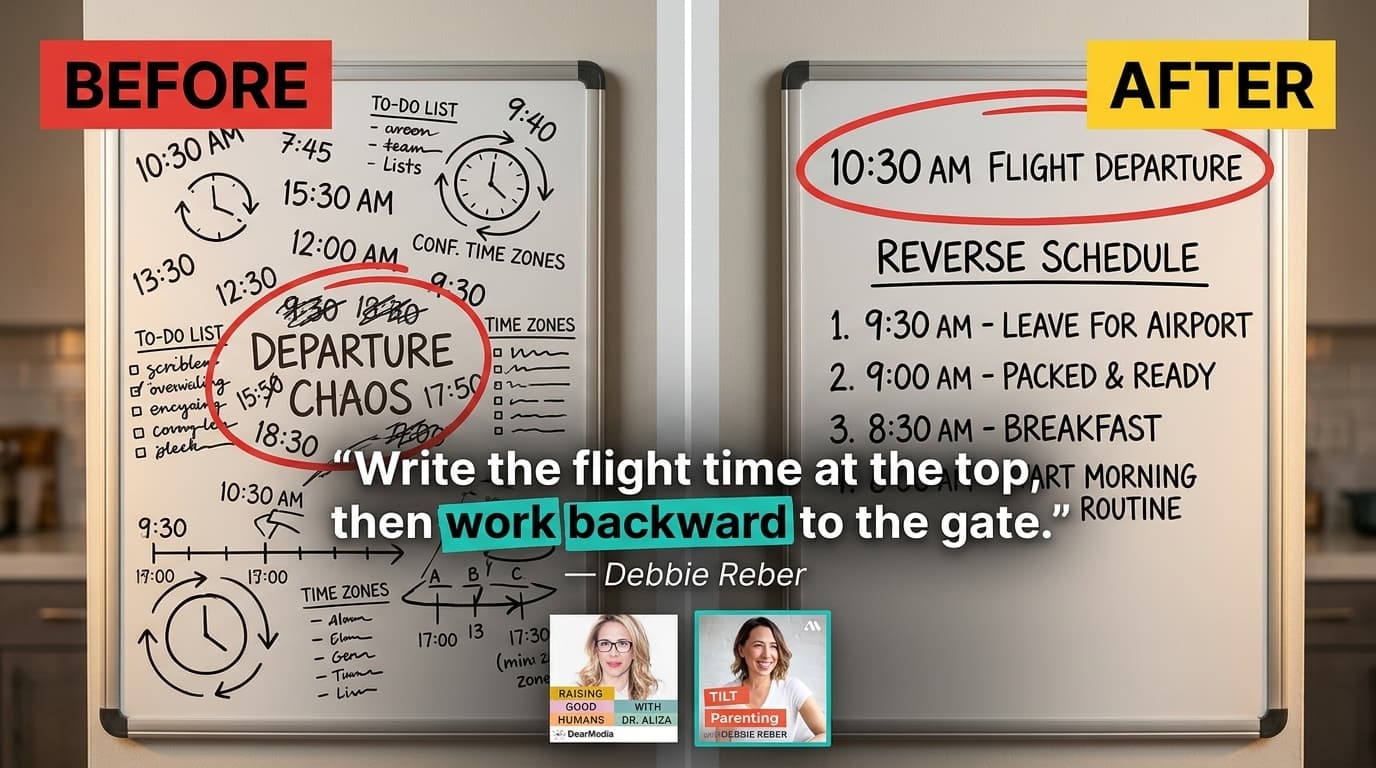
Rushing out the door spikes cortisol for everyone, but Debbie Reber found a workaround for stressful travel mornings. By writing the flight time at the top of a whiteboard and working backward to estimate each step with her child, she replaced the chaotic departure rush with shared expectations and executive function building.
Little kids pick
This visual, backward-planning strategy builds executive function and secures your child's buy-in during stressful transitions, preventing morning meltdowns.
Communication
Reverse-engineered departure schedules
Use a whiteboard to write your flight time at the top, then work backward with your child to estimate and schedule each departure step.
Why it matters: Rushing out the door spikes cortisol for the whole family; visual backward-planning creates shared expectations.

For: Parents managing stressful travel departure mornings with children
“I would write at the top what time, for example, the plane was leaving. And then I would write down below that, what time do we need to be at the gate? And I would do this with Asher.”
ApproachCollaboratively estimating travel times builds executive function skills while securing the child's buy-in for a stressful transition.
TPP 375a: How Can Our Family Navigate Vacations When They Throw Off My Child's Need for Routine · May 22, 2026
Big kids pick
Clinical advice to swap face-to-face dinners for side-by-side drives, lowering a defensive teen's guard by removing the pressure of direct eye contact.
Communication
Low-Pressure Reconnection Venues
When trying to rebuild a relationship with an older child, suggest a walk or a drive rather than dinner to remove eye-contact pressure.
Why it matters: Traditional sit-down dinners can backfire when tension is high, causing teens to withdraw further.

For: Parents experiencing conflict or distance with older teens or young adults
“A lot of kids don't like the dinner table or the restaurant table because you have to stare at each other. They'd rather talk in the dark... They'd rather drive because they can't make eye contact.”
ApproachDirect eye contact can feel confrontational to a defensive teen; side-by-side activities lower their guard and encourage vulnerability.
Episode 377: The Power of Family and Staying Connected Through Adulthood with Dr. Kathy Koch · May 21, 2026
Today's Parenting Tips
Actionable advice distilled from this week's parenting podcasts.
Health & Wellness
Bedroom Device Removal Strategy
Remove charging stations from your teenager's bedroom and replace their phone with a traditional alarm clock to protect their sleep.
Why it matters: Teens are chronically sleep-deprived, which impairs decision-making and increases the likelihood of late-night scrolling.
Communication
Low-Pressure Reconnection Venues
When trying to rebuild a relationship with an older child, suggest a walk or a drive rather than dinner to remove eye-contact pressure.
Why it matters: Traditional sit-down dinners can backfire when tension is high, causing teens to withdraw further.
Communication
Pre-teen pornography discussions
Address pornography before age 14 with a brief, shame-free conversation explaining that it represents real sex no more than Spider-Man represents real crime-fighting.
Why it matters: Age 14 is when most kids begin intentionally searching for pornography online.

Emotional Regulation
Pre-trip stressor brainstorming
Ask your child about specific travel worries—like unfamiliar bathrooms or strange food—and look up hotel menus or pack specific comforts together.
Why it matters: Addressing specific sensory and environmental concerns before a trip prevents meltdowns upon arrival.
Emotional Regulation
Vacation downtime acceptance
If your child needs to spend half a vacation day in the hotel playing video games to stay regulated, let them do it.
Why it matters: Releasing the pressure to constantly sightsee reduces family conflict and honors a neurodivergent child's limits.
Emotional Regulation
Morning physical regulation routines
Establish a predictable physical routine on vacation, like a morning walk or a daily visit to a nearby playground, to help ground your child.
Why it matters: Physical movement is a highly effective, accessible tool for emotional regulation in unfamiliar environments.
Emotional Regulation
The Mom Guilt Equation
When you feel guilt, use Dr. Jennifer Reed's equation—subtract your actual behavior from your situational expectations—to pinpoint exactly where the feeling originates.
Why it matters: Understanding the gap between expectation and reality helps depersonalize the guilt so you can address the root cause instead of spiraling.

Relationships
The Guinea Pig Admission
Diffuse tension over past parenting mistakes by acknowledging to your older child that they were your guinea pig and you did your best.
Why it matters: Parents often judge their past decisions using their current wisdom, leading to unnecessary guilt and defensive communication.
Communication
Reverse-engineered departure schedules
Use a whiteboard to write your flight time at the top, then work backward with your child to estimate and schedule each departure step.
Why it matters: Rushing out the door spikes cortisol for the whole family; visual backward-planning creates shared expectations.
Communication
The BRIEF conversation framework
When discussing sensitive topics with tweens, use the BRIEF method: Begin peacefully, Relate, Interview for data, Echo what you hear, and provide Feedback last.
Why it matters: Tweens are separating from parents and developing their own language, requiring a shift from lecturing to collaborative communication.
Emotional Regulation
The Three-Question Yelling Audit
Audit your yelling by asking three questions after an outburst: when did it happen, what story did I tell myself, and what do I need?
Why it matters: Willpower fails in the moment because yelling is an amygdala-driven threat response; you must identify the underlying pattern to change the behavior.
Health & Wellness
Frictionless tween hygiene habits
Instead of lecturing a middle schooler about body odor, buy six deodorants and leave them in high-traffic areas like the kitchen and car.
Why it matters: Early adolescence introduces new self-care requirements that overwhelm kids who are rushing to socialize.
Relationships
The Guest Phone Basket Rule
When hosting friends, establish a rule where everyone places their phones on silent in a basket the moment the final guest arrives.
Why it matters: Constant connectivity is eroding teens' ability to maintain real-world, eye-to-eye relationships.
Communication
Problem-Centric Career Questions
Instead of asking teenagers what they want to be, ask what problems they want to solve and what people they want to serve.
Why it matters: Research suggests young adults will have six or seven careers, making adaptability more important than a single job title.
Relationships
Modeling physical boundary setting
Teach tweens consent by vocalizing your own physical boundaries, such as asking them to sit side-by-side instead of resting heavy legs on you.
Why it matters: Middle schoolers experience spikes in touch hunger but need to learn how to ask for consent and respect personal space.
Communication
Discussing the risk of nudes
When warning middle schoolers about sending explicit photos, use a third-party example rather than asking about their own experiences to prevent immediate defensiveness.
Why it matters: Middle schoolers are frequently asked for explicit photos and often comply due to impulsivity or a desire to stop being badgered.
Relationships
Middle school dating safety
Allow tweens to go on supervised one-on-one dates rather than large group outings, which often lead to peer pressure and uncomfortable dares.
Why it matters: Middle schoolers are highly susceptible to peer pressure and the desire to appear normal to their tribe.
By Stage
What each age group needs this week — patterns across multiple shows.
Emotional Regulation
De-escalating Travel Anxiety
Experts are shifting away from rigid vacation itineraries toward flexible sensory management. Instead of forcing children through packed sightseeing schedules, parents are advised to integrate morning physical routines and accept hotel downtime to maintain baseline stability.
Communication
Bypassing Tween Defensiveness
Direct confrontation fails with middle schoolers due to their heightened sensitivity to criticism. Effective dialogue now relies on third-party examples, brief interactions, and problem-centric questions that remove personal shame from sensitive topics like digital safety and future planning.
Relationships
Engineering Physical Boundaries
Whether managing a middle schooler's touch hunger or a teenager's smartphone addiction, structured physical limits are essential. From vocalizing personal space needs during couch time to utilizing guest phone baskets, establishing clear environmental rules preserves interpersonal connection.
Expert Corner
When the psychologists and pediatricians weigh in with specifics.
The Guilt Equation
Clinical psychologist Dr. Jennifer Reed defines parental guilt as a simple mathematical formula: situational expectations minus actual behavior. By quantifying this gap, caregivers can depersonalize their feelings and address the root cause rather than spiraling into shame.
The BRIEF Conversation Framework
When tackling sensitive subjects with adolescents, structure the dialogue using five steps: Begin peacefully, Relate, Interview for data, Echo what you hear, and provide Feedback last. This collaborative approach replaces outdated lecturing models that trigger immediate withdrawal.
Real Talk
Honest moments from the mic — the stuff that made us nod along.
The Firstborn Apology
Acknowledging to your oldest child that they served as the experimental test subject diffuses years of built-up resentment. Owning your early inexperience validates their lived reality without requiring you to carry inappropriate ongoing regret.
Auditing the Outburst
Willpower cannot stop an amygdala-driven threat response in the heat of the moment. Instead of promising never to raise your voice again, ask yourself what story you internally constructed about the trigger right before snapping.
From the Conversations

Pre-teen pornography discussions
Deodorant, Porn, and Nudes: How to Actually Talk to Your Tween About the Hard Stuff
May 22, 2026 · 44m · 6 quotes pulled
▶ Listen“you want them to know right off the bat that it's not representative of real sex any more than like, spider-man is representative of crime fighting right so like it is an entertainment thing”
“Age 14 is when most kids begin intentionally searching for pornography online.”

Bedroom Device Removal Strategy
Episode 377: The Power of Family and Staying Connected Through Adulthood with Dr. Kathy Koch
May 21, 2026 · 39m · 5 quotes pulled
▶ Listen“get devices out of bedrooms... They shouldn't have charging stations in their bedrooms. They shouldn't be allowed to sleep with their phone, buy them an alarm clock.”
“Teens are chronically sleep-deprived, which impairs decision-making and increases the likelihood of late-night scrolling.”

Reverse-engineered departure schedules
TPP 375a: How Can Our Family Navigate Vacations When They Throw Off My Child's Need for Routine
May 22, 2026 · 23m · 4 quotes pulled
▶ Listen“I would write at the top what time, for example, the plane was leaving. And then I would write down below that, what time do we need to be at the gate? And I would do this with Asher.”
“Rushing out the door spikes cortisol for the whole family; visual backward-planning creates shared expectations.”
Sources
 ▶ Listen
Raising Boys & Girls
Episode 377: The Power of Family and Staying Connected Through Adulthood with Dr. Kathy KochDr. Kathy Koch joins Sissy Goff and David Thomas to discuss the growing challenges facing today’s young adults and families, especially around resilience, identity, technology, and relationships between parents and adult children. Dr. Kathy explains how overparenting, screen dependence, fear of failure, and endless choices have contributed to anxiety, lack of perseverance, and “failure to launch” struggles, while also offering hope through intentional connection, healthy boundaries, faith, and small relational repairs. She encourages parents to stop leading from guilt, help kids practice making decisions and asking for help, create healthier technology rhythms, and focus on rebuilding trust and communication one step at a time. Resources mentioned: Celebrate Kids Resolve Conflict and Find Peace and Hope with Adult Children: Strategies and Conversations that Work by Dr. Kathy Koch Five to Thrive: How to Determine If Your Core Needs Are Being Met (and What to Do When They're Not) by Dr. Kathy Koch Resilient Kids: Raising Them to Embrace Life with Confidence by Dr. Kathy Koch 8 Great Smarts: Discover and Nurture Your Child's Intelligences by Dr. Kathy Koch Summit Ministries Impact 360 Institute . . . . . . Sign up to receive the bi-monthly newsletter to keep up to date with where David and Sissy are speaking, where they are taco'ing, PLUS conversation starters for you and your family to share! Pre-order our new book, Capable and grab tickets for Capable - The Book Tour here! See our speaking dates, purchase books and check out our courses here.. . . . . . If you would like to partner with Raising Boys and Girls as a podcast sponsor, fill out our Advertise With Us form. QUINCE: Go to Quince.com/rbg for free shipping on your order and three hundred and sixty-five -day returns. BOLL & BRANCH: Get 15% off plus free shipping on your first set of sheets at Bollandbranch.com/rbg. Exclusions apply. SHOPIFY: Go to https://tinyurl.com/RBGShopify to learn more about Shopify! LEGACY BOX: Legacybox is running their Mother’s Day sale and they’re also offering an additional $10 off your order. Visit Legacybox.com and use discount code: RBG GO MINNO: Visit GoMinno.com to get a one month FREE TRIAL using code: RBG WAYFAIR: Get organized, refreshed, and ready for the holidays for way less. Head to Wayfair.com right now to shop all things home. CASPER: Save up to 30% on mattresses and up to 35% on everything else when you go to casper.com. Learn more about your ad choices. Visit megaphone.fm/adchoices
 ▶ Listen
Raising Good Humans
Deodorant, Porn, and Nudes: How to Actually Talk to Your Tween About the Hard StuffWhat if the reason the hardest conversations with your middle schooler keep going badly isn't the topic — it's that we keep starting them like a lecture? This episode is for any parent who has braced themselves to "have the talk" about porn, dating, nudes, or consent and watched their kid mentally exit the room before the second sentence. I'm joined by Michele Icard, parenting expert and author of Fourteen Talks by Age Fourteen: The Essential Conversations You Need to Have with Your Kids Before They Start High School. What you'll learn: Why most thorny conversations go wrong before they start, and the BRIEF model that fixes it. Why shame is the wrong tool. What you might be missing about middle school dating, consent, and touch hunger. The throughline of the whole conversation is practice. These aren't talks you nail on the first try, and the goal isn't a single perfect conversation — it's becoming fluent enough at curiosity that you stop needing an agenda at all. Great Wolf Lodge: Bring your pack together at a Lodge near you. Learn more at GreatWolf.com Tumble: Machine Washable Rugs, Made Better. For a limited time only, our listeners get 10% off + free shipping at Tumbleliving.com/HUMANS Merit Beauty: It's time for your makeup and skincare to meet the reality of your daily routine with Merit Beauty.comMyPhone by Ooma: Safe calling with parental controls. Go to ooma.com/myphone to shop phones and learn more.
 ▶ Listen
Full-Tilt Parenting: Strategies, Insights, and Connection for Parents Raising Neurodivergent Children
TPP 375a: How Can Our Family Navigate Vacations When They Throw Off My Child's Need for RoutineIn this Parent Lean-In episode, Debbie answers a listener’s question about how to travel and navigate vacations with a child who is tied to routines. Debbie shares her past experiences and offers tips for pre-trip planning, addressing concerns ahead of time, establishing new routines while traveling, being flexible, using visual aids, and getting the child active and moving, and more. Resources Mentioned Debbie and 11-year-old Asher on Successful Vacations for Differently Wired Kids (Tilt Parenting podcast) Download a PDF of our Family Goals Worksheet Download a PDF of our Vacation Concerns Worksheet Download a PDF of our Daily Vacation Planner Worksheet Look at our Departure Plan whiteboard Learn more about your ad choices. Visit podcastchoices.com/adchoices
 ▶ Listen
No Guilt Mom | Overcoming Mom Guilt, Parenting Tips, & Self Care for Moms
Why You Keep Yelling Even When You Promised Yourself You’d StopNew here? Start with our Start Here playlist — five episodes that will change how you think about motherhood This is Part 1 of the Yelling Series — three episodes all about why you yell, how to stop it in the moment, and what to do after it happens. You promised yourself today would be different. And then it happened again. If you’re stuck in the yelling cycle — the yell, the guilt, the promise to do better, repeat — this episode is for you. JoAnn breaks down what’s actually driving the yelling (hint: it’s not anger, and it’s not a character flaw) and gives you the first tool in breaking the pattern for good. What you’ll learn: Why knowing better is never enough to stop yelling The meaning problem: what your brain is actually reacting to in the moment Why the guilt spiral after yelling makes the pattern worse, not better How to identify your personal yelling triggers — and what they’re really telling you The 3-question Yelling Audit to do after this episode Next week: Part 2 — the body reset tools you can use in under 60 seconds, even when you can’t leave the room. Remember: the best mom is a happy mom. Take care of you. Learn more about your ad choices. Visit podcastchoices.com/adchoices
Your own newspaper
Want this about your world?
This is what tracking one topic looks like — done for everyone. Build your own newspaper: pick the people, companies and podcasts you follow, and we'll brief you on exactly what was said about them.
Start your scoopYour own newspaper
Want your own Parenting edition?
Pick the people, companies and podcasts you follow. We'll brief you once a week on exactly what was said about them.
Start your scoopFree in early access · Set up in minutes
Sourcing from these great podcasts












+ 8 moreShow fewer








Listen
Subscribe as a podcast
The episodes we feature, delivered to your podcast app.