The micro-choice that ends screen friction
Good morning. Offering a micro-choice restores autonomy without compromising the boundary.
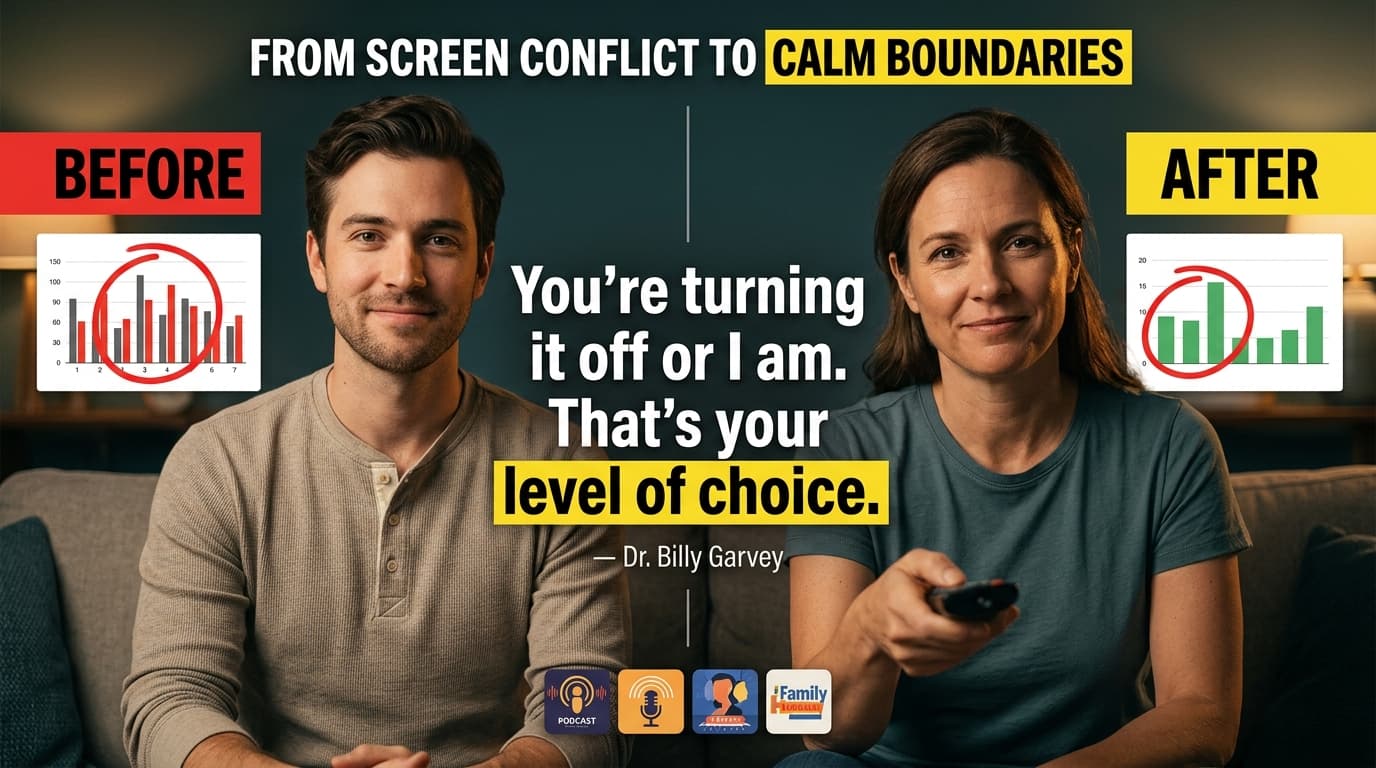
Dr. Billy Garvey argues that the hardest part of ending screen time isn't the loss of the show, but the loss of control. By asking, "Are you turning it off, or am I?" parents can offer a micro-choice that satisfies the need for autonomy while holding a firm boundary.
Little kids pick
This clinical micro-choice satisfies a young child's need for autonomy while maintaining your firm boundary around the daily screen time transition.
Discipline
Autonomy in screen time transitions
To reduce resistance when screen time ends, offer a choice within a firm boundary by asking, 'Are you turning it off, or am I?'
Why it matters: Transitions trigger a loss of control; offering a micro-choice restores autonomy and reduces the likelihood of a power struggle.

For: Parents of children who struggle with screen time transitions.
“you're turning it off or I'm turning it off. That's your level of choice. It's not, we'll watch it for another 10 minutes... That's a boundary.”
ApproachGiving a child the physical control of the off button satisfies their need for autonomy while maintaining the parent's boundary.
Episode 137: Anger reflection · Aug 16, 2026
Big kids pick
This communication script respects a teenager's need for processing time, preventing them from shutting down when you try to rescue them from negative emotions.
Communication
The consent-to-share communication strategy
When your teenager faces a disappointment, ask "I have some things I want to say—do you want to hear them now, or need space?"
Why it matters: Teens often shut down when parents immediately try to rescue them from negative emotions.

For: Parents of teenagers navigating academic or social disappointments.
“I came into the front seat and just was like, I have some things I want to say. Do you want to hear them or do you need some space and talk about it later? She's like, later.”
ApproachParents often rush to fix a child's disappointment to soothe their own anxiety; asking for permission to share advice respects the teen's need for processing time.
Why You Snap Before You Even Realize It with Cassidy Freitas · Aug 18, 2026
Today's Parenting Tips
Actionable advice distilled from this week's parenting podcasts.
Discipline
Autonomy in screen time transitions
To reduce resistance when screen time ends, offer a choice within a firm boundary by asking, 'Are you turning it off, or am I?'
Why it matters: Transitions trigger a loss of control; offering a micro-choice restores autonomy and reduces the likelihood of a power struggle.
Communication
The consent-to-share communication strategy
When your teenager faces a disappointment, ask "I have some things I want to say—do you want to hear them now, or need space?"
Why it matters: Teens often shut down when parents immediately try to rescue them from negative emotions.
Communication
Emergency exit emoji code
Establish a specific emoji your teen can text you for a no-questions-asked, punishment-free pickup if a party gets out of hand.
Why it matters: Teens often stay in dangerous situations because they fear the punishment or interrogation that comes with calling a parent for help.

Emotional Regulation
Reframe Startled Reactions
When a toddler reacts to a loud noise, avoid labeling them as 'scared'—which amplifies fear—and instead ask if they were 'surprised' or 'startled.'
Why it matters: Toddlers have an immature prefrontal cortex and an active amygdala, making them easily overwhelmed by novelty and surprises.

Emotional Regulation
Avoid Rescuing from Harmless Triggers
If a safe household noise upsets your child, acknowledge their discomfort but do not immediately pick them up or turn off the appliance.
Why it matters: Rescuing a child from a non-threatening situation reinforces their anxiety and exhausts the parent.
Communication
Interpret Toddler Emotion Words Loosely
When a two-year-old uses words like 'scared' or 'angry,' recognize they are often testing powerful vocabulary rather than accurately diagnosing their internal state.
Why it matters: Taking a toddler's emotional vocabulary too literally can cause parents to overreact to minor developmental bumps.
Special Needs
Stop debating contamination fears
When your child claims an object is contaminated, do not try to rationalize or debate the logic with them, as this reinforces the OCD cycle.
Why it matters: Parents often waste energy trying to logically explain why an object is safe, which inadvertently validates the OCD's premise.

Emotional Regulation
Trigger-based memory retrieval
If you cannot recall your childhood, analyze your intense reactions to your child's tantrums as physical data revealing how your parents handled those behaviors.
Why it matters: Understanding that triggers are implicit memories helps parents replace self-blame with curiosity.

Emotional Regulation
Act as an emotional thermostat
When your child's anxiety escalates, act as a "thermostat" rather than a "thermometer" by actively lowering your own emotional temperature to model regulation.
Why it matters: Anxiety in children has spiked significantly, making parental co-regulation a critical daily skill.

Health & Wellness
Unstructured afternoon recovery time
Protect your child's emotional margin during the first weeks of school by leaving at least one afternoon completely open with no agenda.
Why it matters: Research shows unstructured downtime directly improves a child's ability to regulate their emotions.

Emotional Regulation
Practice body awareness during regulated play
Practice noticing physical sensations during moments of play or routine, like washing hands, rather than trying to build body awareness while a child is dysregulated.
Why it matters: Attempting to teach body awareness during a crisis often escalates the situation; proactive practice during calm moments is clinically proven to be more effective.

Emotional Regulation
Post-school meltdown reframing
When your child melts down after school, replace 'why are you upset' with 'I wonder if your feelings are finally catching up with you.'
Why it matters: The start of the school year requires immense emotional regulation from kids, leading to after-school exhaustion.
Discipline
Structure over warmth for better outcomes
When enforcing rules, prioritize clear expectations over keeping the peace, as research shows structured environments produce better outcomes than warm but chaotic ones.
Why it matters: Research shows structure is the critical fallback when you cannot maintain both warmth and rules.

Relationships
Weekday date night shift
Move your date nights to Wednesdays once your kids hit high school, as weekend nights will be consumed by party drop-offs and monitoring.
Why it matters: The transition to the teen years requires a complete restructuring of parental free time to accommodate late-night supervision.
Communication
Capability evidence collection
Replace 'how was your day' with specific questions like 'what felt easier than yesterday' to help anxious kids notice their own progress.
Why it matters: Research shows children grow when they notice their own effort and progress rather than perfection.
Discipline
Linking privileges to household responsibilities
If your child lacks internal motivation for chores, explicitly tie their daily privileges, like video game access or allowance, to completing specific household tasks.
Why it matters: Kids rarely have intrinsic motivation for chores; treating the family like an organization with linked privileges and duties reflects real-world systems.
Discipline
The complain-but-comply chore policy
Stop demanding that your teenager do chores with a positive attitude; instead, permit grumbling and complaining as long as the task actually gets done.
Why it matters: Teenagers naturally seek friction; allowing them to complain about chores provides a safe outlet for noncompliance.
Communication
Reliability-based chore framing
Instead of framing chores as a mandate, tell your teenager explicitly that the family is counting on them to complete their specific tasks.
Why it matters: UCLA research shows that a sense of purpose for teens comes from feeling relied upon by others.
Emotional Regulation
Replace emotion labeling with curiosity
Instead of telling a child "you look frustrated," which can cause them to doubt their internal signals, use open-ended "I wonder" statements.
Why it matters: Interoception is emerging as a critical missing link in understanding why traditional emotional regulation strategies fail for some children.
Health & Wellness
The Eight-Exposure Food Rule
When your child rejects a healthy meal, keep offering it; pediatricians note it takes about eight separate exposures before a child develops a taste.
Why it matters: Reduces mealtime frustration by setting realistic expectations for how long it takes to build healthy eating habits.

Communication
Avoid logic for nine-year-old anxiety
Stop trying to logic your nine-year-old out of school anxiety; they lack the abstract reasoning required to realize past positive outcomes guarantee future safety.
Why it matters: Parents waste energy arguing with anxious kids instead of addressing the somatic and emotional roots.
Discipline
Physical prevention of subsequent toddler hits
When a toddler hits, say no and immediately physically block or remove them to prevent a second strike, rather than just repeating verbal corrections.
Why it matters: Toddlers lack impulse control, making verbal warnings ineffective without immediate physical boundaries.

By Stage
What each age group needs this week — patterns across multiple shows.
Toddlers
De-escalating Toddler Fears
Experts are advising parents to stop projecting adult anxiety onto toddler reactions. By interpreting emotion words loosely and avoiding rescuing children from harmless triggers, caregivers can prevent mild surprises from escalating into genuine phobias.
School-Age
Managing Back-to-School Exhaustion
The transition back to the classroom requires immense emotional regulation, leading to after-school meltdowns. Clinicians recommend leaving afternoons unstructured and prompting kids to collect evidence of their own daily progress to rebuild emotional margin.
Teens
Rethinking Adolescent Chores
Psychologists are shifting away from demanding positive attitudes during household tasks. Instead, they suggest allowing teens to complain while complying, explicitly linking privileges to responsibilities, and framing chores as essential contributions the family relies upon.
Expert Corner
When the psychologists and pediatricians weigh in with specifics.
OCD thrives on rational debate
Child therapist Natasha Daniels warns that attempting to outsmart or problem-solve a child's contamination fears inadvertently validates the premise of the obsession.
Structure outpaces warmth in developmental outcomes
Dr. Lisa Damour points to research showing that families prioritizing clear expectations over keeping the peace produce better results than warm but chaotic environments.
The risk of mislabeling neurodivergent emotions
Occupational Therapist Kelly Mahler cautions that incorrectly naming a neurodivergent child's feelings can lead to long-term body mistrust, recommending open-ended curiosity instead.
Real Talk
Honest moments from the mic — the stuff that made us nod along.
Your triggers map your childhood
Dr. Becky notes that intense reactions to whining or tantrums are often implicit physical memories revealing exactly how your own parents handled those behaviors.
Reclaiming the Wednesday date night
Dr. Aliza Pressman suggests moving adult time to weeknights once kids hit high school, as weekends inevitably become consumed by party drop-offs and safety monitoring.
From the Conversations
Ask Lisa: The Psychology of Raising Tweens & Teens
Structure over warmth for better outcomes
285: ENCORE: How Do I Help My Kid Develop a Work Ethic?
Aug 18, 2026 · 33m · 4 quotes pulled
▶ Listen“when we have studied this and we've studied this 14 ways, the families that have structure but not warmth, their kids do okay. Their kids do okay and they do better than families where they have warmth but not structure.”
“Research shows structure is the critical fallback when you cannot maintain both warmth and rules.”

Respectful Parenting: Janet Lansbury Unruffled
Reframe Startled Reactions
My Toddler Is Scared of Everything
Aug 18, 2026 · 34m · 3 quotes pulled
▶ Listen“I've noticed that as parents, we often are the ones that jump to scared when we don't really know. In fact, oftentimes our child is just startled, surprised.”
“Toddlers have an immature prefrontal cortex and an active amygdala, making them easily overwhelmed by novelty and surprises.”

Post-school meltdown reframing
Episode 402: Our 5 Favorite Tips for Navigating Emotions in the School Year with David and Sissy
Aug 18, 2026 · 16m · 3 quotes pulled
▶ Listen“Instead of saying, why are you so upset? Try saying, you have worked really hard today. I wonder if your feelings are finally catching up with you.”
“The start of the school year requires immense emotional regulation from kids, leading to after-school exhaustion.”
Sources
 ▶ Listen
Pop Culture Parenting
Episode 137: Anger reflectionThe response to our anger episode was one of the most moving we have ever received. In this reflection we hear from parents who grew up around anger they couldn't name and are working hard not to repeat those patterns, from a dad who recognised himself in his own mother's rage during the most vulnerable weeks of early parenthood, from someone who works with young people in custody for whom anger became the only language they knew, and from a listener whose message stopped us in our tracks. An occupational therapist shares some powerful practices for going slow and meeting our kids where they are. We are also reminded in our closing that anger and love often live much closer together than we think. Thank you for your extraordinary honesty and courage in sharing. We hope this one helps.
 ▶ Listen
No Guilt Mom | Overcoming Mom Guilt, Parenting Tips, & Self Care for Moms
Why You Snap Before You Even Realize It with Cassidy FreitasEver snap at your kid and then wonder where that even came from? Dr. Cassidy Freitas, licensed marriage and family therapist and author of Mom Needs a Moment, joins JoAnn to break down what's actually happening in your nervous system in the seconds before you react. In this episode, you'll learn: How to catch a "ping," the body, thought, feeling, and behavior signals that show up right before you react Why calm can actually feel unsafe to your nervous system, and what to do about it How the "little t" traumas from your own childhood are still shaping your triggers today A simple phrase to use with your kids that creates space without shutting them out Why protecting your margin, not optimizing every moment, is what actually calms your nervous system Resources mentioned in this episode: Dr. Cassidy Freitas's website Mom Needs a Moment by Dr. Cassidy Freitas Dr. Cassidy on Instagram The Happy Mom Reset, a free class Ready to stop reacting and start responding? Sign up for The Happy Mom Reset, a free class, and get started today. Learn more about your ad choices. Visit podcastchoices.com/adchoices
 ▶ Listen
Raising Good Humans
Here's the Talk to Have Before Your Teen's First PartySending your teen to their first party? In this solo episode, developmental psychologist Dr. Aliza Pressman walks parents through exactly how to talk to teenagers about parties before the car ride there. From the alcohol and drug conversation to setting a code word and exit plan, this episode is a practical guide for parenting teenagers through one of the most anxiety-provoking adolescent milestones. What you’ll learn: ● Curiosity-first scripts for the "parties, alcohol, and drugs" conversation with your teenager ● Setting a code word and no-questions-asked exit plan for teen safety ● How to vet a party: supervision, location, and when privacy isn't up for negotiation ● Talking about consent and physical safety before parties become a factor ● What to say (and not say) when you pick your teen up afterward ● Navigating a friend's secret without breaking your teen's trust in you 🔗 RESOURCES & LINKS: Buy Dr. Aliza Pressman's Book: 📖Order "The 5 Principles of Parenting" by Dr. Aliza Pressman: https://www.simonandschuster.com/books/The-5-Principles-of-Parenting/Aliza-Pressman/9781668014547 Follow Raising Good Humans: 📱 Instagram: https://www.instagram.com/raisinggoodhumanspodcast/ 🎙️ Podcast: https://podcasts.apple.com/us/podcast/raising-good-humans/id1473072044 Subscribe on Substack for weekly articles and exclusive LIVE Q&As: 📧 https://dralizapressman.substack.com/ 🔔 New episodes every week — subscribe and turn on notifications so you never miss a conversation on raising healthy, resilient humans. This episode is brought to you by: Great Wolf Lodge: With 22 lodges across the country, you’re always only a short drive away from adventure. Learn more at GreatWolf.com and strengthen the pack. Boar’s Head: For lunchtime inspiration visit: boarshead.com/backtoschool. For Boar’s Head, head to your local deli counter. Kodiak: Feel good about snack choices with Kodiak Bars. Find them at kodiakcakes.com or your local grocery store. They’re the ones with the bear on the box. Wayfair: Join Wayfair Rewards today to get 5% back on every purchase and start saving on your next home upgrade. Head to Wayfair.com to shop all things home. Wayfair. Every Style. Every Home. OneSkin: Born from over 10 years of longevity research, OneSkin is helping you unlock your healthiest skin now and as you age. For a limited time, try OneSkin with 15% off using code RGH at oneskin.co/RGH. Tell them we sent you. Learn more about your ad choices. Visit podcastchoices.com/adchoices
 ▶ Listen
Respectful Parenting: Janet Lansbury Unruffled
My Toddler Is Scared of EverythingA two-and-a-half-year-old has become increasingly anxious and fearful. She often becomes overwhelmed but can't explain what's wrong beyond saying she's scared, and she wants to be picked up or removed from the situation. Her mom wonders where comfort ends and reinforcing the fear begins: “How do we give her the comfort and security she clearly needs while helping her learn that she can feel scared and still be safe?” Janet explores what may really be going on and how parents can respond in a way that respects the feelings without exacerbating them. Janet's "No Bad Kids Master Course" is available at NoBadKidsCourse.com and JanetLansbury.com. Please support our sponsors! Learn more about your ad choices. Visit podcastchoices.com/adchoices
 ▶ Listen
AT Parenting Survival | Raising Kids with OCD & Anxiety
When OCD Makes Your Child’s Thoughts Feel Contaminated<p>Most people think contamination OCD is about germs, chemicals, or bodily fluids. But what happens when your child feels like a thought, memory, word, person, or experience has become contaminated?</p><p>In this episode of the AT Parenting Survival Podcast, Natasha Daniels explores <strong>mental contamination OCD</strong>—a lesser-known but surprisingly common form of OCD that can leave children feeling like something is dirty, ruined, tainted, or unsafe, even though nothing has physically changed.</p><p>You’ll learn how OCD can convince kids that contamination spreads through intrusive thoughts, memories, emotions, people, places, and even words, leading them to avoid objects, throw things away, mentally “erase” thoughts, or start over in an attempt to feel clean again.</p><p>In this episode, you’ll discover:</p><p><br></p><ul><li>What mental contamination OCD is and why it differs from traditional contamination fears</li><li>Common ways thoughts, memories, people, and experiences become “contaminated”</li><li>Why neutral objects, places, and activities can suddenly feel unsafe</li><li>The compulsions kids use to try to get rid of the contamination</li><li>Why reassurance and logic often backfire</li><li>How Exposure and Response Prevention (ERP) helps children break free from the cycle</li></ul><p>If your child suddenly refuses to wear certain clothes, avoids places that “feel wrong,” throws away perfectly good belongings, or believes a thought has somehow contaminated an object, this episode will help you understand what’s happening, and what actually helps.</p><p><strong>Want more support?</strong></p><p>Learn practical, evidence-based strategies to help your child overcome OCD inside my online courses at<a href="http://atparentingsurvivalschool.com/" rel="noopener noreferrer" target="_blank"> <strong>ATParentingSurvivalSchool.com</strong></a>.</p><p><strong>Free Podcast Handout</strong></p><p>Download the companion handout for this episode at:</p><p><a href="http://natashadaniels.com/handouts" rel="noopener noreferrer" target="_blank"> <strong>NatashaDaniels.com/handouts</strong></a></p><br><p><strong>Videos on Contamination OCD</strong></p><br><p><a href="https://youtu.be/ALikQ05XkEw?si=NCPrBKpH0hPXX8yP" rel="noopener noreferrer" target="_blank">How to Handle Your Contamination OCD </a></p><br><p><a href="https://youtu.be/4az4YGFG5VE?si=0PHMkykChp78-26x" rel="noopener noreferrer" target="_blank">Trying to Beat Contamination? OCD Doesn’t Play Fair.</a></p><br><p>This podcast episode is sponsored by NOCD. NOCD provides online OCD therapy in the US, UK, Australia and Canada. To schedule your free 15 minute consultation to see if NOCD is a right fit for you and your child, go to</p><p><a href="https://go.treatmyocd.com/at_parenting" rel="noopener noreferrer" target="_blank">https://go.treatmyocd.com/at_parenting</a></p><br><p>***</p><p>This podcast is for informational purposes only and should not be used to replace the guidance of a qualified professional.</p><br><p>Parents, do you need more support? </p><br><p>🌸 Here’s are resources I offer parents 👇🏻❤️</p><br><p>Online classes for parents raising kids with anxiety and OCD:</p><p><a href="https://atparentingsurvivalschool.com/" rel="noopener noreferrer" target="_blank">https://atparentingsurvivalschool.com</a></p><br><p>Join the AT Parenting Community (A membership designed to support parents raising kids with anxiety or OCD):</p><p><a href="https://atparentingcommunity.com/" rel="noopener noreferrer" target="_blank">https://atparentingcommunity.com</a></p><br><p>Take one of my FREE webinars:</p><p><a href="https://www.natashadaniels.com/webinars" rel="noopener noreferrer" target="_blank">www.Natashadaniels.com/webinars</a></p><br><p>Check out my books: </p><p><a href="https://www.natashadaniels.com/books" rel="noopener noreferrer" target="_blank">www.Natashadaniels.com/books</a></p><br><p><strong>🌸 Other social places I hang out:</strong></p><br><p><a href="http://www.facebook.com/ATparentingSurvival" rel="noopener noreferrer" target="_blank">http://www.facebook.com/ATp</a></p><br><p><br></p><p><a href="https://youtu.be/bfq99bkzM1Y?si=rAEqFVMPuw5XAR8h" rel="noopener noreferrer" target="_blank">Understanding Your Ground Zero in Contamination OCD</a></p><br><p>***</p><hr><p style='color:grey; font-size:0.75em;'> Hosted on Acast. See <a style='color:grey;' target='_blank' rel='noopener noreferrer' href='https://acast.com/privacy'>acast.com/privacy</a> for more information.</p>
 ▶ Listen
Good Inside with Dr. Becky
When Our Nervous Systems Hijack Our Parenting - RevisitDr. Becky breaks down the science behind yelling, snapping, and shutting down. She explains why our bodies react before our brains can catch up – and how understanding this will help you pause, reset, and reconnect.
 ▶ Listen
Play Therapy Parenting Podcast
S4E11 - How Do I Help My Child With School Anxiety?<p>In this episode, I answer a question from a mom whose 9-year-old daughter experiences intense anxiety every morning before school—even though she does well once she gets there and usually comes home saying she had a good day. I explain why this pattern often points to anticipatory anxiety: the fear of what might happen becomes far more overwhelming than what actually happens. Over time, children can even begin to fear the physical feelings of anxiety themselves, creating a cycle of stomach aches, tears, worry, and resistance every morning.</p> <p>I also share what parents can do to help break that cycle. Rather than focusing solely on getting the morning behavior to stop, I explain why we need to address the anxiety underneath it by staying calm ourselves, reflecting our child's feelings, and building their confidence in their own ability to handle difficult things. Combined with child-centered play therapy, these simple shifts can help children develop the emotional vocabulary, self-esteem, and regulation they need so anxiety no longer controls their daily lives.</p> <p><strong>Ask Me Questions:</strong> Call <a href= "tel:18138125525">(813) 812-5525</a>, or email: <a href= "mailto:[email protected]">[email protected]</a></p> <p><strong>My New Book! Parent Companion for Play Therapy:</strong> Want to go deeper into the concepts discussed in this series? Check out Parent Companion for Play Therapy, created to help parents better understand their child, the play therapy process, and how lasting emotional growth takes place.<br /> <a href= "https://www.amazon.com/Parent-Companion-Play-Therapy-Understanding/dp/B0H2D98F18/" target="_blank" rel= "noopener">https://www.amazon.com/Parent-Companion-Play-Therapy-Understanding/dp/B0H2D98F18/</a></p> <p><strong>My First Book:</strong> Device Detox: A Parent's Guide To Reducing Usage, Preventing Tantrums, And Raising Happier Kids<br /> <a href="https://a.co/d/bThnKH9" target="_blank" rel= "noopener">https://a.co/d/bThnKH9</a></p> <p><strong>Podcast HQ:</strong><br /> <a href="https://www.playtherapyparenting.com/" target="_blank" rel="noopener">https://www.playtherapyparenting.com/</a></p> <p><strong>My Newsletter Signup:</strong><br /> <a href="https://www.playtherapyparenting.com/newsletter/" target= "_blank" rel= "noopener">https://www.playtherapyparenting.com/newsletter/</a></p> <p><strong>My Podcast Partner, Gabb Wireless:</strong><br /> <a href="https://www.playtherapyparenting.com/gabb/" target= "_blank" rel= "noopener">https://www.playtherapyparenting.com/gabb/</a></p> <p><strong>Common References:</strong><br /> Landreth, G.L. (2023). Play Therapy: The Art of the Relationship (4th ed.). Routledge.<br /> Landreth, G.L., & Bratton, S.C. (2019). Child-Parent Relationship Therapy (CPRT): An Evidence-Based 10-Session Filial Therapy Model (2nd ed.). Routledge.</p>
 ▶ Listen
Raising Boys & Girls
Episode 402: Our 5 Favorite Tips for Navigating Emotions in the School Year with David and SissyAs kids head back to school, Sissy Goff and David Thomas share five practical ways parents can help them navigate the big emotions that often come with transition. They encourage parents to expect heightened feelings, lend kids their confidence, let feelings “ride but not drive,” protect margin for rest, and help kids collect evidence of their own capability. With simple scripts and questions parents can use at home, Sissy and David remind us that the goal isn’t for kids to become fearless—it’s for them to learn that they can feel nervous, overwhelmed, or uncertain and still move forward. Resources mentioned: I Am Capable by David Thomas and Sissy Goff . . . . . . Sign up to receive the bi-monthly newsletter to keep up to date with where David and Sissy are speaking, where they are taco'ing, PLUS conversation starters for you and your family to share! Order our new book, Capable, here!! See our speaking dates, purchase books and check out our courses here.. . . . . . If you would like to partner with Raising Boys and Girls as a podcast sponsor, fill out our Advertise With Us form. ADVENTURE BIBLE: Get an Adventure Bible for your child and begin reading and exploring it together to build confidence and curiosity in God’s Word https://tinyurl.com/RBGAdventureBible. CHRISTIAN HEALTHSHARE MINISTRIES: Take charge of your healthcare by visiting chministries.org/solution. BOLL & BRANCH: Get 15% off plus free shipping on your first set of sheets at Bollandbranch.com/rbg. Exclusions apply. QUINCE: Go to Quince.com/rbg for free shipping on your order and three hundred and sixty-five -day returns. GO MINNO: Visit GoMinno.com and use code RBG to get a one-month free trial. HIYA HEALTH: Visit hiyahealth.com/RBG to get 50% off your first order. OUR PLACE: Stop cooking with toxic cookware, and upgrade to Our Place today. Visit fromourplace.com/RBG and use code RBG for 10% off sitewide. WAYFAIR: Get organized, refreshed, and ready for the holidays for way less. Head to Wayfair.com right now to shop all things home. Learn more about your ad choices. Visit megaphone.fm/adchoices
 ▶ Listen
Full-Tilt Parenting: Strategies, Insights, and Connection for Parents Raising Neurodivergent Children
TPP 352a: Occupational Therapist Kelly Mahler on the Power in Understanding & Supporting Neurodivergent Kids' Interoception ExperienceI wanted to explore this concept of interoception and differently wired kids more deeply for the show, so I reached out to Kelly Mahler, an occupational therapist who specializes in interoception and is a co-principal investigator in several research projects pertaining to topics such as interoception, self-regulation, trauma, and autism. Kelly answered my big questions about interoception, including how it relates to sensory processing differences or SPD, why it’s essential that we help our children get to know their bodies’ unique language, and the relationship between ADHD, autism, and interoception. We also talked about what happens in our kids’ brains when they increase their interoceptive awareness, and effective strategies for helping our kids develop in this area. Things you'll learn from this episode: * What interoception is and how it relates to sensory processing differences * What the spectrum of interoception awareness is and how extremes may manifest * The relationship between ADHD, autism, and interoception challenges * How to support a child with poor interoception awareness to become more tuned in to their body’s internal experience * What happens in our brains when we start to increase our interoception awareness * How to help older kids who’ve been on the receiving end of compliance-based strategies to reconnect with and trust their bodies Learn more about your ad choices. Visit podcastchoices.com/adchoices
 ▶ Listen
Ask Lisa: The Psychology of Raising Tweens & Teens
285: ENCORE: How Do I Help My Kid Develop a Work Ethic?If you've repeatedly asked your kid to help out and they still don’t follow through, this is the episode you’ve been waiting for. Dr. Lisa Damour breaks down why nagging doesn't build a work ethic — and what actually does. From linking privileges to responsibilities, to knowing exactly when to step back and let natural consequences do the teaching, this encore episode gives parents of tweens and teens a practical, guilt-free framework for raising kids who can be counted on, without turning every chore or assignment into a battle. 💡 YOU'LL LEARN: - Why structure matters more than warmth alone, and why holding the line on chores, even when kids are grumpy, is the right call - Why extrinsic motivation is perfectly valid, and how linking responsibilities to privileges mirrors the way the real world actually works - Why "complain but comply" is a completely reasonable goal, and how releasing the expectation of cheerful enthusiasm takes pressure off everyone - When to stop nagging about schoolwork and let natural consequences take over, and why middle school is the best time to do so - How framing chores as a contribution rather than punishment taps into something deeper than rewards alone ________________ GET DR. DAMOUR'S FREE WEEKLY NEWSLETTER Guidance, strategies, and tips delivered straight to your inbox → https://drlisadamour.com/sign-up-for-my-newsletter/ DR. DAMOUR'S BESTSELLING BOOKS - Untangled: Guiding Teenage Girls Through the Seven Transitions into Adulthood – https://bit.ly/UntangledBook - Under Pressure: Confronting the Epidemic of Stress and Anxiety in Girls – https://bit.ly/UnderPressuretheBook - The Emotional Lives of Teenagers: Raising Connected, Capable, and Compassionate Adolescents – https://a.co/d/cbOmTKp UNTANGLING 10TO20 MEMBERSHIP Premium courses & resources for teens and the adults who care for them → https://lnkd.in/gr52MB-F VISIT DR. LISA'S WEBSITE → https://drlisadamour.com/ ________________ Today's sponsors: Caraway: 10% off your next order with promo code ASKLISA at https://www.carawayhome.com/asklisa Hero: Use promo code ASKLISA for 10% off your order at https://www.hero.co. OneSkin: Use the code ASKLISA for 15% off your next purchase at https://www.oneskin.co/ASKLISA. Skylight: Get $30 off your 15-inch calendar at www://www.MySkylight.com/ASKLISA ________________ Ask Lisa: The Psychology of Raising Tweens & Teens is the essential podcast for parents seeking expert guidance, tested strategies, and psychological insights on raising kids, especially tweens and teens. Join renowned clinical psychologist Dr. Lisa Damour and former journalist and mom of two Reena Ninan as they explore real-life parenting challenges. Looking to learn more about how to boost kids’ resilience, build their confidence, or support their emotional well-being? Dr. Lisa and Reena have got you covered! Together they address listener questions about stress, anxiety, social media concerns, school pressures, and challenges in peer relationships. Each episode provides practical advice and science-backed solutions to help parents raise resilient, confident, and emotionally healthy kids. Tune in every week for the latest topics in parenting, child psychology, and family wellness. Get answers to your most pressing parenting questions. New episodes drop every Tuesday. ________________ Episode keywords: how to build work ethic in kids, unmotivated child chores, kid refuses chores what to do, tween lacks motivation school, intrinsic vs extrinsic motivation kids, how to get kids to help at home, child won’t do homework without nagging, parenting middle school motivation, consequences vs nagging parenting, link chores to privileges kids, teach responsibility tweens, why kids don’t take initiative, 11 year old lazy or normal, complain but comply parenting, structure vs warmth parenting Podcast keywords: ask lisa podcast, dr lisa damour, reena ninan, psychology, parenting, podcast, teens, tweens, parenting teens, parenting tweens, teen parenting, tween parenting, parenting tips, parenting advice, positive parenting, parenting podcast, teen behavior, tween challenges, raising tweens, raising teens, parenting hacks, parenting help, family dynamics, kids podcast, mental health, teen mental health, attachment styles, emotional intelligence Learn more about your ad choices. Visit podcastchoices.com/adchoices
 ▶ Listen
The PedsDocTalk Podcast: Child Health, Development & Parenting—From a Pediatrician Mom
Food, Policy and What Families Deserve: A Conversation with Dr. Rich Besser, President and CEO of the Robert Wood Johnson FoundationHave you ever stood in the fresh produce aisle, looking at the price tags, and felt a wave of frustration because eating "real food" feels like a financial punishment? Families are being bombarded with constant advice to eat better and healthier, but how are they supposed to keep up when national nutrition programs and rising grocery costs are moving in completely opposite directions? In this episode, I connect with Dr. Rich Besser, former acting director of the CDC and current President and CEO of the Robert Wood Johnson Foundation, to explore the deep divide in American food access and affordability. Dr. Besser shares insights from his decades-long pediatric career, explains how the politicization of public health has eroded parental trust, and provides a powerful blueprint for how everyday parents can fight back against broken systems. The Morality of the Noise: How modern nutrition advice has created an exhausting landscape of parental guilt over basic food choices. Navigating the Expert Divide: How to find evidence-based public health guidance at a time when institutional trust is fractured. The Evolution of Medical Science: Why changing nutritional guidelines represent advancing scientific progress rather than medical waffling. The Power of WIC and SNAP: How expanding federal assistance programs directly combats childhood hunger and why bureaucratic barriers are threatening access. Reclaiming the Cafeteria: How parents can leverage local school boards to demand fresh, less-processed school lunch programs that support kids over big agriculture. Why Food Deserts are Everyone's Problem: The moral, ethical, and societal reasons we must all care about nutritional affordability, even if our own households aren't feeling the pinch. Democracy as a Health Metric: The surprising, direct link between local voting, ballot initiatives, civil rights, and the physical well-being of our families. Our podcasts are also now on YouTube. If you prefer a video podcast with closed captioning, check us out there and subscribe to PedsDocTalk. Get trusted pediatric advice, relatable parenting insights, and evidence-based tips delivered straight to your inbox—join thousands of parents who rely on the PDT newsletter to stay informed, supported, and confident. Join the newsletter! Shop Dr. Mona’s favorite products: https://shopmy.us/shop/pedsdoctalk (paid link) And don’t forget to follow @pedsdoctalkpodcast on Instagram—our new space just for parents looking for real talk and real support. We love the sponsors that make this show possible! You can always find all the special deals and codes for all our current sponsors on the PedsDocTalk Podcast Sponsorships page of the website. Learn more about your ad choices. Visit podcastchoices.com/adchoices
 ▶ Listen
BratBusters Parenting Podcast
How to Deal With Wild Toddler Behaviour#201 In this episode, Lisa discusses her thoughts on wild toddler behaviour. She covers what age she considers to be a toddler and why she believes some toddlers test boundaries while others don’t. Lastly, Lisa addresses eight listener questions, discussing how to manage a toddler screaming at a baby brother, what to do about a 2-year-old hitting everyone, ways to handle a toddler throwing food during meals, a 17-month-old biting others, how to handle a 23-month-old yelling "mine" at o...
Your own newspaper
Want this about your world?
This is what tracking one topic looks like — done for everyone. Build your own newspaper: pick the people, companies and podcasts you follow, and we'll brief you on exactly what was said about them.
Start your scoopYour own newspaper
Want your own Parenting edition?
Pick the people, companies and podcasts you follow. We'll brief you once a week on exactly what was said about them.
Start your scoopFree in early access · Set up in minutes
Sourcing from these great podcasts







+ 8 moreShow fewer








Listen
Subscribe as a podcast
The episodes we feature, delivered to your podcast app.