The SaaS desk
Tracking SaaS, seat-based pricing, net revenue retention + 10 more
- SaaS — The category conversation: who says it is dying, who says it is fine, and on what evidence.
- seat-based pricing — The pricing argument AI forces — per-seat, per-usage, per-outcome.
- net revenue retention — The number operators actually run on, and what is happening to it.
- churn — Retention pressure: who is losing customers and to what.
- vertical SaaS — Where software money is moving as horizontal tools commoditise.
- AI-native software — The challengers rebuilding categories, and how incumbents answer.
- ARR — The growth number operators benchmark against, and what is happening to it.
- The Official SaaStr Podcast: SaaS | Founders | Investors
- Lenny's Podcast: Product | Growth | Career
- The SaaS Podcast - SaaS, Startups, Growth Hacking
- Run the Numbers
- The SaaS CFO
- SaaS District
AI compute costs force SaaS margin and pricing pivots










~64 hrs of podcasts, listened to for you. This is the 2-minute version.
235 search results → 73 episodes scanned → 10 made it in · 12 analyzed in full
Yesterday's focus on methodology-driven SaaS is being stress-tested by runaway AI infrastructure costs and the reality of negative margins at scale. As you navigate the shift away from per-seat pricing, the data today shows that agentic workflows are fundamentally changing the cost of revenue, forcing founders to choose between subsidizing compute costs to defend churn or pivoting to outcome-based pricing models.
SaaS
4 episodes · 4 of 13 mentions
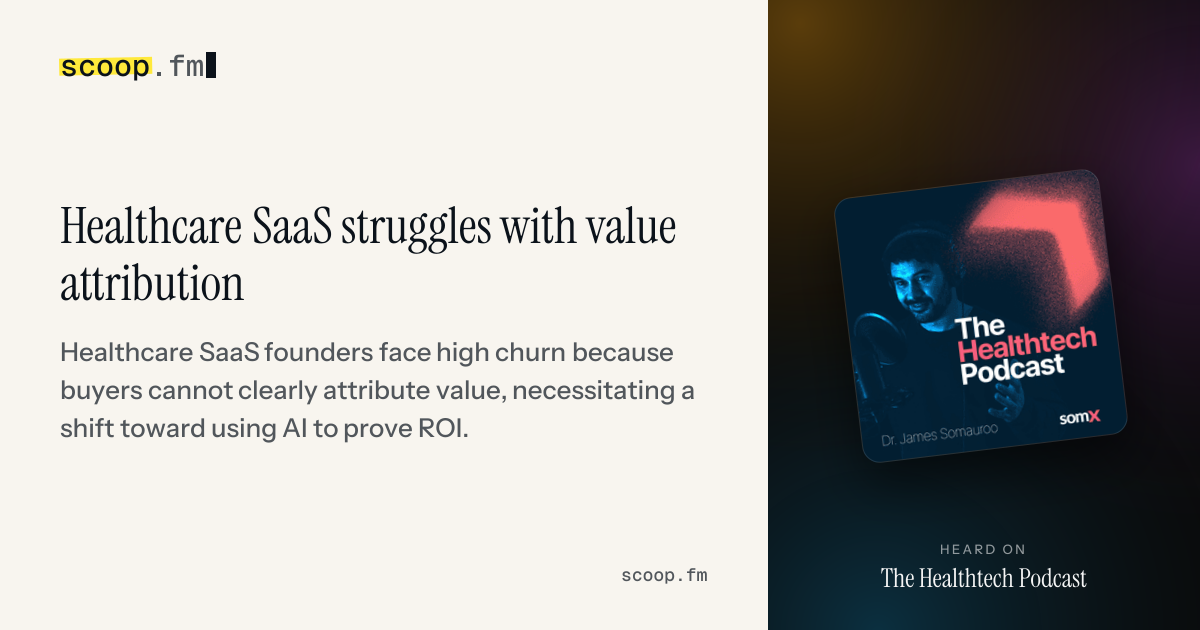
#464 Nobody in healthcare is thinking about your softwareHealthcare SaaS struggles with value attribution · The Healthtech Podcast · Listen
Healthcare SaaS founders face high churn because buyers cannot clearly attribute value, necessitating a shift toward using AI to prove ROI.
Why Selling Software Features is Costing You ClientsOutcome-based pricing replaces feature-based logins · The HighLevel Experience · Listen
Founders are shifting from selling software logins to selling specific business outcomes to maintain stable recurring revenue streams in an AI-driven market.

How TrackFlo Cut Track & Trace Staff 50%+Point solutions survive by offering deep expertise · The FreightCaviar Podcast · Listen
TrackFlow successfully reduced customer headcount by 50%, proving that specialized SaaS point solutions remain valuable when they offer deep expertise over generic AI.

I left Claude for months. Opus 5.5 is why I'm backClaude Opus 5.5 lowers agentic compute costs · How I AI · Listen
Anthropic's new Opus 5.5 model is 40% cheaper and 30% faster, directly improving the unit economics for SaaS operators building agentic workflows.
churn
2 episodes · 3 of 20 mentions
Sep 22 · 4 min
SaaS vendors subsidize AI compute to prevent churn
- B2B software providers are aggressively discounting generative AI tools to defend their core customer bases from market erosion.
- Vendors are absorbing high API compute costs from OpenAI and Anthropic specifically to prevent enterprise client churn.
- The strategy of subsidizing AI tools to maintain retention is currently creating significant margin compression across the SaaS sector.
Why this matters to you
SaaS operators face a direct trade-off between protecting customer retention and maintaining healthy profit margins while subsidizing expensive AI compute costs.
“Vendors are absorbing high API compute costs from OpenAI and Anthropic to prevent enterprise client churn, creating margin compression across the SaaS sector.”
— Brunson
Listen Deep diveAlso mentioned

He Built a 7-Figure Nearshoring AgencyTalent seniority as a churn lever · We Live to Build · Listen
An agency founder reduced churn by replacing junior virtual assistants with senior specialists, allowing him to raise prices and shed low-value contracts.
ARR
2 episodes · 3 of 10 mentions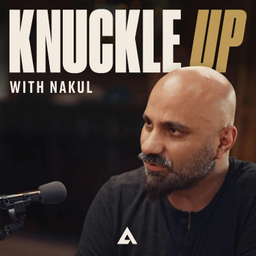
How Juicebox is building for the AI talent war | David Paffenholz (CEO)Juicebox scales ARR 10x with lean team · Knuckle Up with Nakul · Listen
Juicebox reached 1.5 million in ARR with a team of three, demonstrating the efficiency of AI-native recruiting tools against incumbents like LinkedIn.

The future of the CMO role w/ Zapier's CMO & Chief AI Transformation OfficerCMOs must anchor marketing to ARR and churn · Founder Brand with Finn Thormeier · Listen
Tomorrow.io's CMO tracks ARR, ACV, and churn weekly in a shared finance spreadsheet to ensure marketing remains a revenue-generating function.
seat-based pricing
1 episode · 1 of 2 mentions
Sep 22 · 135 min · Top 50 technology
Harvey scales to $400M ARR despite negative gross margins
- Harvey reached a $400 million ARR run rate while navigating a temporary dip to negative 50% gross margins.
- The company experienced margin pressure because AI token consumption increased 20-fold as lawyers shifted to agentic workflows.
- Harvey successfully improved gross margins back to positive levels in a single quarter through routing and model optimization.
Why this matters to you
Demonstrates how agentic AI usage can temporarily break traditional SaaS per-seat pricing models by inflating underlying infrastructure costs relative to revenue.
“They're growing ARR. We'll get into that. And token consumption increased 20x this year. So basically, they are feeling the reasoning era, the agentic era, one job, one process in Harvey is generating a lot more tokens.”
— Jordy
Listen Deep diveAI-native software
1 episode · 1 mention

AI-native fund operations replace headcount-heavy models
- Rajesh Gopi describes Zyve as an AI-native fund operating system that automates back-office work like compliance and reporting.
- The platform uses over 200 agents and 750 deterministic compliance checks to manage $6 billion in assets under management.
- Gopi claims that AI-native software allows one fund controller to manage 10 times more capital than traditional manual methods.
Why this matters to you
This demonstrates how AI-native infrastructure shifts fund management from manual, headcount-heavy operations to automated, agent-driven workflows that significantly increase capital-per-controller efficiency.
“For us, it is really foundationally, is there other agents doing all the work along the workflow? That's really how we look at it.”
— Rajesh Gopi
Listen Deep dive
Make it yours
Start from these trackers
Copy its trackers, shows and tone into a page of your own. Change anything — this page isn’t touched.
Make it mine