Sep 6: The $100 bet that closed a multimillion deal
Good morning. Reps are bypassing standard procurement hurdles by shifting the financial risk away from the buyer.
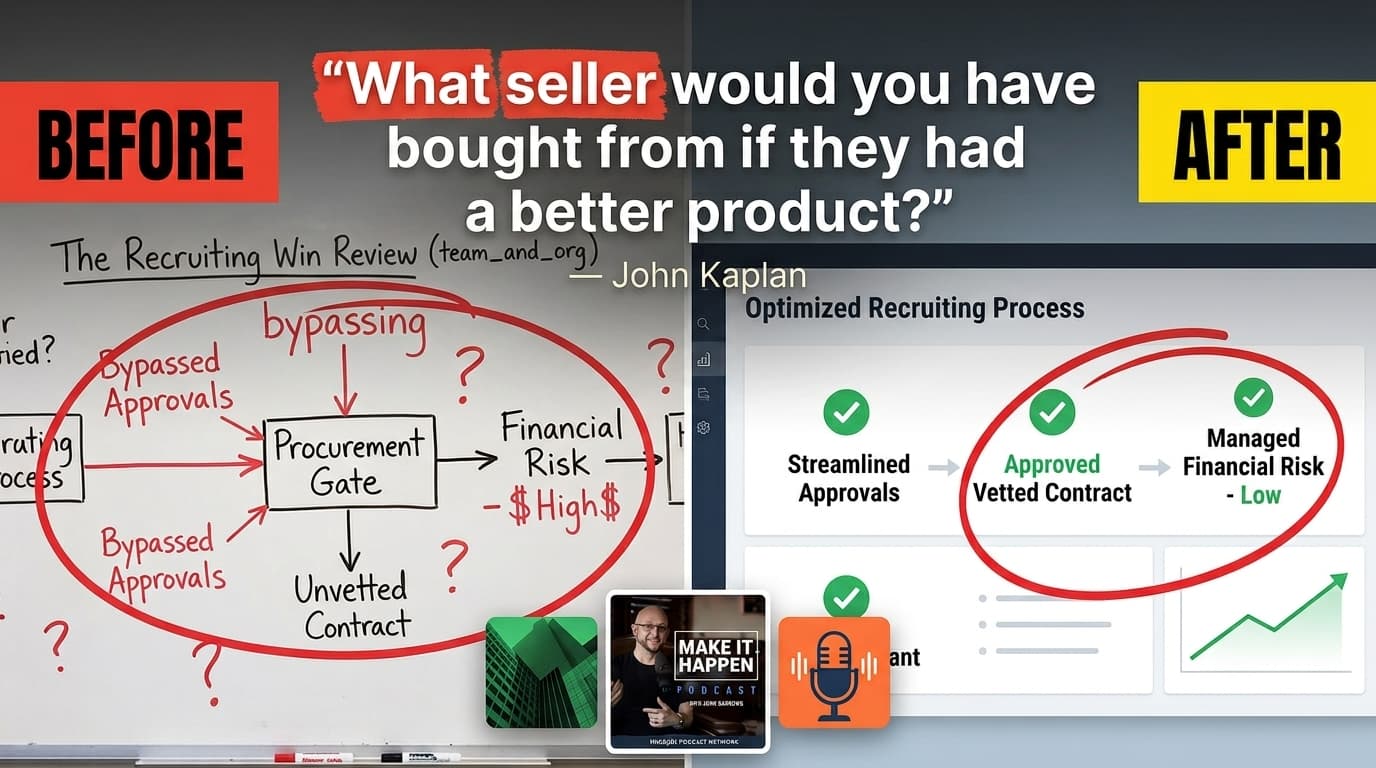
Smartling's CEO converted a skeptical enterprise prospect into a multimillion-dollar customer by making a $100 personal bet that his free proof of concept would hit promised metrics. When buyers call ROI claims impossible, defending the pitch fails. Putting your own money on the line breaks the tension.
Today's Sales Plays (22)
Tactical moves operators are running right now, with verbatim source.
outbound
EA-to-EA Peer Meeting Pitch
Pitch a peer-to-peer executive meeting directly to the prospect's executive assistant, CCing your own exec's EA to build credibility.

Discussing: Cold outbound to enterprise C-suite executives whose calendars are heavily guarded by EAs.
“I will send the EA a personalized outreach email... and then I will usually also CC in the EA to my executive. So it again, just adds even more credibility to this meeting proposal.”
MechanismFind the EA on LinkedIn. Email them proposing a meeting between their exec and your exec (e.g., CIO to Chief Data Officer). Include a 3-bullet agenda. CC your own executive's EA on the email. If you can't identify the exact EA, email the most senior one and ask, "Is it Jane or Mike?" to trigger a correction.
Outcome99% success rate getting time with the executive
CounterpointReps usually try to bypass EAs. Treating them as strategic partners and offering a peer-to-peer networking meeting gets you on the calendar.
#603 - How to Use Executive Assistants to Unlock Enterprise Deals | Laura McDonald · Aug 27, 2026
outbound
Channel partner social sourcing
Find end-users with public pain points, then prospect the channel partners engaging with their LinkedIn content.

Discussing: Sourcing pipeline when you sell exclusively through channel partners and cannot pitch end-users directly.
“She looked up the decision makers and what brokers were engaging with their content on LinkedIn. And then she ran campaigns to them that said... Do you think you might be a hero if we got connected?”
MechanismIdentify end-users experiencing a public trigger event, like a government organization with a budget deficit. Find which channel partners are engaging with those end-users' content on LinkedIn. Cold outreach the partner: 'I saw you might work with [End User]. We could save them $5M. Want to be a hero?'
OutcomeSourced multiple significant pipeline opportunities and thrilled brokers.
CounterpointInstead of pitching partners generically, you bring them a specific, high-value account they are already trying to win.
Why AI Will NEVER Replace Real Sales with Jeff Kirchick · Aug 31, 2026
team_and_org
Centralized AE Pipeline Loading
Stop making AEs self-source; have leadership load exactly 120 targeted accounts into their pipeline to maintain a 70/30 pre-to-post engagement ratio.

Discussing: Selling an education-heavy product to a finite TAM where AE self-sourcing leads to bloated, low-quality pipelines.
“Instead of them loading their own opportunities, we load those opportunities for them. We made sure that each AE for our business, we said around 120 opportunities is about the right size of the pipeline.”
MechanismStop requiring AEs to self-source. Instead, have sales and marketing leadership select and load target accounts directly into AE pipelines. Cap each AE at roughly 120 active opportunities. Maintain a strict ratio: 70% in 'pre-hand raiser' stages (active outbound cadences) and 30% in 'post-hand raiser' stages (active deal cycles). This ensures reps spend their week executing personalized touches rather than scrolling for leads.
Outcome2x close rate and 50% reduction in sales cycle
CounterpointDefies the standard expectation that AEs must self-source 30-50% of their pipeline, shifting the burden entirely to leadership for better account control.
How We 2x Sales Revenue & Reduce Sales Cycle By 50% | Pieter Leenhouts - 2032 · Aug 28, 2026
discovery
Multiple-choice menu of pain
Start outbound discovery calls by offering a multiple-choice list of common industry problems and asking the prospect to correct you.

Discussing: Running the first five minutes of an outbound-led discovery call where the prospect wasn't actively shopping.
“We want that correction because where they correct us, that's where the gold is... they are volunteering the information. Right. Because they are leaning forward.”
MechanismPresent a 'menu of pain' based on your research. Say: 'When I meet with [Title] from [Industry], they usually tell me [Pain 1], [Pain 2], or [Pain 3]. What did I miss that you guys are laser-focused on?' Let them correct your assumptions to reveal their actual deep pain.
OutcomeWhere they correct us, that's where the gold is.
CounterpointAvoids the interrogation feel of open-ended questions by giving the buyer something concrete to react to.
Tackling new territories, multi-threading, and more with Krysten Conner · Aug 31, 2026
discovery
Multiple-choice urgency check
Determine a prospect's actual timeline by giving them three multiple-choice options for why they took the call, including an 'education mode' out.
Discussing: Gauging true buying intent during an initial discovery call, especially for inbound leads who might just be tire-kicking.
“I'd never want to be the one to chase anything. I don't want to blow up your inbox. If today was education mode, a hundred percent fine. Gives them permission to say that hard [thing].”
MechanismAsk them to place themselves on a scale: 'There are 3 reasons people show up: 1) Education mode, just seeing what's out there. 2) Big problem, want it solved 6 months ago. 3) Problem exists but not on fire, maybe next year. Where would you place yourself? Education mode is 100% fine.'
OutcomeHelps us figure out should there even be a next meeting.
CounterpointGiving prospects explicit permission to say they are just browsing actually encourages them to reveal true urgency.
Tackling new territories, multi-threading, and more with Krysten Conner · Aug 31, 2026
outbound
The Blind Date Pitch
Pitch a meeting with an internal expert to discuss industry problems instead of pitching your product.
Discussing: Cold outbound to buyers who do not have an active, identified problem.
“The offer... will increase reply rates by up to 28% when you use it effectively. And asking for time at the end of a cold email will actually reduce your reply rates by up to 44%.”
MechanismInstead of asking for time to show a product, offer a meeting with an AE or SE positioned as an industry expert. Script: 'I want to set you up with Amanda. She has a decade working with Caterpillar. She's going to talk to you about how they're handling the labor shortage.'
OutcomeUp to 28% increase in reply rates
CounterpointYou are selling the internal expert's industry knowledge, not the software's features.
The Too Good To Ignore Outbound Methodology · Aug 24, 2026
demo
Dual-Executive POV Sign-Off
Require both the global SE leader and the CRO to sign off on every Proof of Value before it starts.

Discussing: Scaling a technical sales motion where reps rush into unstructured POVs to maintain deal momentum.
“The SE leader globally signs off on POVs as well as me. So if we don't put our hands in the middle and say we want to do it, then we're not going to do it.”
MechanismInstitute a hard gate for POVs. The rep must prove they have a tested champion, alignment with the Economic Buyer on a straw-man business case, and clear differentiation. If the global SE leader and the CRO do not both physically sign off on the criteria, the POV does not happen. No exceptions for fast-moving deals.
OutcomeMaintains a very high technical win rate and prevents wasted SE resources.
CounterpointReps will argue that slowing down for sign-off loses deals, but skipping this step usually results in losing anyway or landing a subpar contract.
Why Great CROs Stop Managing Numbers and Start Building Systems · Aug 27, 2026
team_and_org
The Recruiting Win Review
Use post-sale win reviews to uncover true differentiators and source top competitor sales talent.
Discussing: Loss reviews yield polite lies, and you need to source top-performing competitor reps.
“Who would you have bought from? What seller would you have bought from if they had a better product? And I have gotten some great names of some great sellers that were out there doing the right things.”
MechanismStop relying on loss reviews. Instead, interview customers who just bought from you. Ask four questions: 1) Why did you buy? 2) Where are we worse than we think? 3) Where are we better than we realize? 4) Which competitor's seller would you have bought from if their product was better?
OutcomeSourced names of top competitor sellers (speaker's word, not measured).
CounterpointLoss reviews are polite fiction. Win reviews get the truth because the buyer is now financially invested in your success.
Strategy That Teams Actually Execute with Dr. Chuck Bamford · Sep 3, 2026
outbound
Closed-Lost Revival Dial Block
Sit with reps to dial closed-lost deals from 6+ months ago using a direct re-engagement question.

Discussing: Reps are missing pipeline targets and complaining that cold outbound doesn't work.
“Call the closed loss from March. Call the closed loss from last year. Call people that you put into the pipeline and ghosted you... build the list for them, you hand it to them, and then you sit next to them.”
MechanismPull a list of 25 closed-lost deals from at least six months ago, or prospects who ghosted mid-pipeline. Hand the list to the rep and sit next to them while they dial. Use a direct script: 'Hey, you bought from us in the past. When do you think you're going to make your next purchase?'
Outcome11 dials yielded 10 answers and 4 pipeline opportunities in 20 minutes.
CounterpointReps naturally avoid closed-lost deals assuming the 'no' is permanent. Sitting with them forces the activity and proves the timing often changes.
How to Run a Sales Blitz and Revive Cold Leads (Ask Jeb) · Sep 2, 2026
demo
Demo Mind-Reading Prompt
Replace "Any questions?" with a 1-to-10 scale or a direct prompt about what they are thinking to avoid technical rabbit holes.
Discussing: Wrapping up a demo or presenting a pricing proposal to a mixed room of stakeholders.
“AEs will do a demo and then they'll say, so any questions? And it is such a waste of time because inevitably... some techie in the audience says a random question that's totally unrelated to anything of value.”
MechanismNever ask "Any questions?"—it invites random technical users to derail the meeting. Instead, ask: "What's going through your mind as you're watching this demo?" or "On a scale of 1 to 10, how do you feel this feature will solve the problem you just told us about?"
Outcomespeaker's word, not measured
Counterpoint"Any questions?" shifts control to the most pedantic person in the room. Targeted prompts keep the focus on business value.
#603 - How to Use Executive Assistants to Unlock Enterprise Deals | Laura McDonald · Aug 27, 2026
outbound
New leadership past-role mapping
Filter accounts for new leadership, then check their previous role's accomplishments to predict what they were hired to do.
Discussing: Identifying which executives within your target accounts are most likely to champion a new initiative.
“Salespeople get hired to reproduce their past success. Leaders are the same. And so even if they've had the new role for two days... go look at their prior role.”
MechanismUse Sales Navigator's 'new leadership in the past 3 months' toggle. When you find a new leader, look at their LinkedIn profile for their prior role. The accomplishments and responsibilities listed in their previous job are almost exactly what they were hired to reproduce in their new role.
OutcomeProbably the number one thing that indicates they may be open to doing something differently.
CounterpointDon't wait for them to update their current LinkedIn description; their past role is the blueprint for their new mandate.
Tackling new territories, multi-threading, and more with Krysten Conner · Aug 31, 2026
discovery
The 1-to-10 prospect disqualification question
Ask serial delayers to rate their likelihood of buying on a 1-to-10 scale to expose counterfeit interest.
Discussing: Prospect keeps delaying follow-ups with vague requests to call back later.
“One day I said, you know what? On a scale of one to 10, what's the likelihood of you ever doing business with me? He said, two... I said, OK, why don't I take you off my list? And he said, that would be a good idea.”
MechanismWhen a prospect repeatedly asks you to call back at a later date, stop the cycle. Ask directly: 'On a scale of 1 to 10, what's the likelihood of you ever doing business with me?' If they give a low number, follow up with: 'Why don't I take you off my list?'
OutcomeSuccessfully disqualified a time-wasting prospect.
CounterpointReps often accept endless delays to avoid friction; this forces the friction to save pipeline time.
Are You Too Nice to Close the Deal? | Connie Kadansky - 2031 · Aug 24, 2026
team_and_org
SDR coachability interview test
Test SDR coachability by having them rewrite a cold email and re-deliver a pitch based on your live feedback.
Discussing: Assessing SDR candidates for true coachability, not just polite acceptance of feedback.
“There's a difference between just handling the feedback well and actually then incorporating the feedback and coming back with a new draft that use the feedback.”
MechanismHave candidates write a cold email and deliver a 5-minute cold pitch on researched leads. Give direct feedback, then require them to rewrite the email and re-deliver the pitch. To prevent AI cheating on the email, require them to include a 'shared value' connecting their personal life to the buyer.
OutcomeSpeaker's word, separates candidates who just say thank you from those who actually incorporate feedback.
CounterpointMost candidates are trained to politely accept feedback; this forces them to actually apply it live.
Why AI Will NEVER Replace Real Sales with Jeff Kirchick · Aug 31, 2026
team_and_org
30-60-90 weakness slide
Force AE candidates to present a real professional weakness and their exact remediation plan during their 30-60-90 presentation.
Discussing: Vetting AE candidates during the interview process to see if they are genuinely self-aware and authentic.
“I explicitly call out, tell me something that is a professional development weakness of yours, how you identified it and what you're doing about it.”
MechanismRequire candidates to include a specific slide in their 30-60-90 presentation detailing a professional development weakness, how you identified it, and your exact steps to fix it. Reject candidates who give fake weaknesses like 'I work too hard'. Look for operational flaws like 'failing to implicate pain'.
OutcomeSpeaker's word, forces honesty and reveals if they can admit a real problem.
CounterpointCandidates usually hide weaknesses in interviews; making it a formal presentation requirement forces them to document a real flaw.
Why AI Will NEVER Replace Real Sales with Jeff Kirchick · Aug 31, 2026
forecasting
Time-bound pipeline exclusion
Exclude deals from your pipeline coverage ratio if they sit in a stage longer than your historical conversion window.
Discussing: Inflated pipeline coverage ratios caused by low-quality outbound deals that stall but remain open.
“What we found is that 80% of deals converted within a 14-day window. So what we started doing is if deals fell outside of that 14-day window, we excluded them from the coverage ratio.”
MechanismAnalyze historical win data to find the conversion window for a specific segment. If an active deal ages past that exact window, automatically exclude it from your coverage ratio calculations to prevent false confidence in your pipeline.
Outcome80% of deals converted within a 14-day window.
CounterpointInstead of relying on rep forecast categories, use historical time-to-close data to automatically disqualify stalled deals from coverage math.
#605 - How to Build a Cleaner Sales Pipeline in the Age of AI | Stevie Case · Sep 3, 2026
icp_and_segment
Where we win CRM report
Find your true ICP by running a CRM report on closed-won deals from the past two years to identify industry and company size patterns.
Discussing: Starting a new territory and needing to narrow down hundreds of accounts to a manageable, high-probability list.
“These are the people that have given us money. So this is what we should be looking for. So we start there and look for patterns.”
MechanismRun a CRM report on closed-won deals over the past two years. Filter by industry, employee count, and company age. Look for outliers—specific industries or sizes that buy big. Ignore marketing's ICP; focus strictly on the patterns of companies that have actually given you money.
OutcomeUsually there will be three, maybe four industries that stand out.
CounterpointMarketing's ICP often reflects aspirational targets; this relies strictly on historical closed-won data.
Tackling new territories, multi-threading, and more with Krysten Conner · Aug 31, 2026
icp_and_segment
5-Filter Account Segmentation
Layer one demographic and four firmographic filters to narrow broad territories into highly targeted lists with a specific why-now signal.
Discussing: Broad territory definitions resulting in generic, feature-led outbound messaging.
“just changing it from all business executives or for them, like all IT executives to just the CIO... I've seen this increase reply rates like 12 plus percent.”
MechanismBuild lists using exactly five filters: one demographic (e.g., CIO instead of 'IT executive') and four firmographics (e.g., US only, hospitals only, $100M-$1B revenue, customer service headcount >100). Finally, layer on one negative or positive signal (e.g., 'did not make the US News Best Hospitals list') to anchor the messaging on a specific business outcome rather than product features.
Outcome12%+ increase in reply rates just from the demographic filter shift.
CounterpointStarting with firmographics is easier because they live natively in the CRM, unlike complex intent signals.
Relevance | Leslie Venetz - 2033 · Aug 31, 2026
discovery
In-Person Persona Mapping
Interview department heads individually, then aggregate their quantified time-loss metrics into a single business case for the technical buyer.
Discussing: Landing an initial CTO meeting but needing to justify an enterprise-wide platform purchase over existing point solutions.
“We quantify each of those use cases. How long would it take you to do that today? ... We have all of these little quotes as well embedded into this with the metrics, which I think really amplified the business case.”
MechanismAsk the technical buyer for introductions to department leads. Meet each in person for one hour to map specific workflows. Quantify the hours lost to manual work or time-zone delays. Compile these department-level metrics and direct quotes into an aggregate business case to present back to the technical buyer.
OutcomeIdentified a $7-10M cost of inaction.
CounterpointFlying out in person for discovery is rare in modern SaaS, but it cuts through the noise of crowded outreach.
The ROI of Multi-Persona Selling with Daniel Simon · Aug 30, 2026
icp_and_segment
Outcome-based AI pricing model
Price AI tools based on the cost of the human workflow they replace, not per-seat software licenses.

Discussing: Monetizing AI products that complete end-to-end tasks rather than just assisting humans.
“Instead of selling a tool that can help you achieve an outcome, you can sell the outcome directly... effectively the AI is running the entire workflow end-to-end and is able to collect a fee from the outcome it's generating.”
MechanismCalculate the fully loaded cost of a human completing the task (e.g., $50 per resolved airline ticket). Price your AI product as a fraction of that outcome cost rather than charging an annual SaaS license. Bill only for the successfully completed end-to-end workflow.
Outcome$1 billion in ARR already generated in the autopilot customer support category.
CounterpointShifts the buyer's mental model from "software budget" (competing on $1) to "services/headcount budget" (competing on $6).
20VC: Inside Sequoia's Investment Committee: Lessons from Don Valentine, Doug Leone and Alfred Lin | How the SpaceX and Citadel Deals Went Down | What Sequoia Specifically Looks for in Founders with Julien Bek · Aug 24, 2026
closing
The $100 POC Conviction Bet
Bet skeptical enterprise buyers $100 that your free proof of concept will hit the exact metrics you promised.

Discussing: Enterprise buyers in traditional industries dismiss your product's ROI claims as "too good to be true."
“I remember having a funny conversation with a customer where I bet the customer 100 bucks that we could deliver what we said we could deliver. We did a proof of concept on our nickel, and we delivered, and now they're a multimillion-dollar customer.”
MechanismWhen a buyer calls your claims impossible, stop defending the pitch. Offer to run a proof of concept entirely on your own dime. To break the tension and signal absolute conviction, make a personal, low-stakes wager: bet the buyer $100 that the POC will deliver the exact outcomes you promised.
OutcomeConverted a skeptical prospect into a multimillion-dollar customer.
CounterpointA $100 personal bet shifts the dynamic from a vendor defending a pitch to a confident peer putting their own money on the line.
SPOTLIGHT: AI Isn't Just Faster Translation, It's a $40B Tug-of-War for Global Attention. | Bryan Murphy, CEO @ Smartling · Aug 27, 2026
team_and_org
Hiring PMs for AI post-sales
Hire product managers and pre-sales engineers for AI customer success roles, coaching them on account management rather than teaching technical depth to traditional CS reps.
Discussing: Building a post-sales team for highly technical AI products where traditional CS reps lack the workflow expertise to drive consumption.
“We've had success with a few product managers that have kind of made the shift to go to market... open to learning and being coached up on account management... Looking at pre-sales people... they just have to kind of grok the change.”
MechanismSource post-sales talent from product management, pre-sales engineering, and management consulting. For PMs, provide specific coaching on account management, exception handling, and competitive positioning. For pre-sales engineers, frame the role as "pre-sales in disguise" focused on post-signature workflow integration, paying them on par with core sales to remove the stigma of moving to CS.
OutcomeSpeaker notes success transitioning PMs and finding a lot of talent this way.
CounterpointInstead of teaching technical AI workflow discovery to traditional CS reps, hire technical roles (PMs, SEs) and teach them account management.
AI Selling Rewards Curiosity | Workflow Discovery with Seong Park · Aug 23, 2026
team_and_org
Top-down narrative pitch certification
Roll out a new company pitch by having the CEO and enablement leader grade every VP's pitch live.
Discussing: Realigning the company narrative and ensuring cross-departmental consistency.
“Starting with the CEO, we did a one-on-one recording of each executive giving the pitch... I participated in every single one with the CEO. We gave live feedback.”
MechanismStart the rollout at the executive level. Have the CEO record the new pitch first. Then, schedule mandatory 1:1 pitch sessions for every VP across the company. The CEO and enablement leader must attend every single session to provide live, immediate feedback.
OutcomeSpeaker notes it created complete alignment across finance, product, marketing, and sales.
CounterpointPitch certifications usually start with frontline reps; this forces the entire C-suite and VP layer to certify first with the CEO.
Your Sales Team Is Trading Curiosity for AI Shortcuts · Aug 28, 2026
From the Conversations
Multiple-choice menu of pain
Tackling new territories, multi-threading, and more with Krysten Conner
Aug 31, 2026 · 1h 12m · 4 quotes pulled
▶ Listen“We want that correction because where they correct us, that's where the gold is... they are volunteering the information. Right. Because they are leaning forward.”
Make It Happen Mondays - B2B Sales Talk with John Barrows
Channel partner social sourcing
Why AI Will NEVER Replace Real Sales with Jeff Kirchick
Aug 31, 2026 · 48m · 3 quotes pulled
▶ Listen“She looked up the decision makers and what brokers were engaging with their content on LinkedIn. And then she ran campaigns to them that said... Do you think you might be a hero if we got connected?”

30 Minutes to President's Club | No-Nonsense Sales
EA-to-EA Peer Meeting Pitch
#603 - How to Use Executive Assistants to Unlock Enterprise Deals | Laura McDonald
Aug 27, 2026 · 42m · 2 quotes pulled
▶ Listen“I will send the EA a personalized outreach email... and then I will usually also CC in the EA to my executive. So it again, just adds even more credibility to this meeting proposal.”
Sources
 ▶ Listen
30 Minutes to President's Club | No-Nonsense Sales
#603 - How to Use Executive Assistants to Unlock Enterprise Deals | Laura McDonaldLaura McDonald breaks down how to multithread enterprise deals, reach the C-suite, and build buying committee consensus without getting trapped with one champion. Learn how to leverage executive assistants, map the real power base, and neutralize blockers before they kill your deal. 🎙️ ACTIONABLE TAKEAWAYS: 🪑 Build the three-legged stool: Get every critical stakeholder group to “green” instead of treating enterprise deals like a linear sales process. 🤝 Sell the executive meeting: Broker peer-to-peer introductions between executives instead of asking the C-suite to meet with another salesperson. 🗺️ Map the real power base: Whiteboard the org with your champion to uncover who matters, who has influence, and who you still need to win over. 🚧 Neutralize blockers fast: Find out why they’re blocking, how much influence they have, and either win them over or build enough support around them to overpower their veto. You're one step closer to President's Club! 📝 The Ultimate Multi-Threading and Selling to the C-Suite Report 🏋 30MPC Training 🛠 Weekly Tactical Breakdowns 📚 Things you can steal and use today
 ▶ Listen
The Sales Evangelist
How We 2x Sales Revenue & Reduce Sales Cycle By 50% | Pieter Leenhouts - 2032<p>Imagine doubling your close rate and cutting your sales cycle in half. That's not a hypothetical. It's exactly what <u><a href="https://www.linkedin.com/in/pieterwleenhouts/" rel="noopener noreferrer" target="_blank">Pieter Leenhouts</a></u> and his team did at Tax Guard, a Cogency Global company that sells to banks and financial institutions. </p><p>Pieter walked me through exactly how they pulled it off, and it wasn't magic. It was math, structure, and a relentless focus on the front end of the pipeline.</p><p><strong>Why Their Sales Cycle Was So Long To Begin With</strong></p><ul><li>Tax Guard's solution was new to the financial institutions they sold to, so reps had to spend real time educating buyers before those buyers even understood why they needed it.</li><li>That education requirement, combined with deals that stalled out with the wrong contacts, created a long sales cycle and a lower close rate.</li><li>Fixing it started with the pipeline itself, not with pushing reps to work harder.</li></ul><br/><p><strong>Give Every Rep the Right Size Pipeline, Not Just More Deals</strong></p><ul><li>Pieter's team found that around 120 opportunities was the right pipeline size for most of their account executives, though the number flexes based on how efficient a rep is.</li><li>Instead of leaving reps to self source every opportunity, the team loads a portion of that pipeline for them, so reps spend more time working real opportunities and less time hunting for net new business.</li><li>Their market of five to ten thousand financial institutions is well defined, which makes it possible to plan pipeline size with real precision instead of guessing.</li></ul><br/><p><strong>Split the Pipeline: 70 Percent Pre-Handraiser, 30 Percent Post-Handraiser</strong></p><ul><li>Of those 120 opportunities, about 70 percent sit in the pre-handraiser stage, where reps are still working to connect with people.</li><li>The remaining 30 percent sit in the post-handraiser stage, where there's already an active, ongoing conversation with the customer.</li><li>That split keeps reps focused on outreach without starving the deals that are already moving.</li></ul><br/><p><strong>Marketing and Sales Load the Pipeline Together</strong></p><ul><li>Pieter is careful to point out that loading the pipeline isn't a sales-only effort. It's a collaboration between sales leadership and marketing leadership.</li><li>Marketing helps identify and prioritize which accounts and departments actually fit where Tax Guard's solution applies.</li><li>That partnership is part of why the team can hand reps a healthier mix of fast cycle and slow cycle opportunities instead of leaving it to chance.</li></ul><br/><p><strong>Why They Kept AEs on the Full Buyer Journey Instead of Handing Off to BDRs</strong></p><ul><li>Because their solution requires ongoing education, Pieter's team decided against using BDRs or SDRs to book appointments and hand off to AEs.</li><li>The same person a buyer starts talking to needs to stay with them as a trusted advisor through the entire education process.</li><li>Pieter is clear that this only makes sense because of how complex and unfamiliar their solution is. A more transactional sale can absolutely work with a BDR handoff.</li></ul><br/><p><strong>The Cadence: 17 Touches Over 70 Days</strong></p><ul><li>Each opportunity in the pipeline follows a defined cadence, roughly 17 touches over 70 days, with three to five contacts tied to each account.</li><li>That structure turns follow-up into a math exercise. Once you know the number of opportunities, steps, and contacts, you know almost exactly how many activities a rep needs to complete each day.</li><li>The cadence isn't automated. Reps still show up and do the work themselves, which keeps the process personal instead of robotic.</li></ul><br/><p><strong>Personalization Is What Makes the Math Work</strong></p><ul><li>Pieter gets five to six hundred pitches a day himself, so he knows exactly what gets ignored: generic, unpersonalized outreach.</li><li>His team uses AI to gather background information quickly, but the personal touch, referencing where someone went to school or what they care about, still has to come from the rep.</li><li>That combination of structure and personalization is what actually breaks through the noise instead of just adding to it.</li></ul><br/><p><strong>How They Catch Reps Who Are Gaming Activity Numbers</strong></p><ul><li>To catch reps who rack up huge activity numbers without real substance, like hanging up before voicemail or blasting the same email to everyone, Pieter's team looks past raw activity totals.</li><li>They review call recordings and email engagement to see whether real conversations are actually happening, not just whether the activity got logged.</li><li>The goal isn't to catch people doing something wrong. It's to find the reps who are getting real engagement and figure out what they're doing differently so the whole team can replicate it.</li></ul><br/><p><strong>Weekly and Monthly Rhythms Keep the Team Accountable</strong></p><ul><li>Every rep gets a weekly one on one that covers both big strategic issues, like what's happening in the market or with competitors, and specific opportunities that need a plan to close.</li><li>Once a month, Pieter's team reviews the front end metrics as a group: how many people are in cadence, how many emails are opening, how many real conversations are happening.</li><li>They also track Net Promoter Score to measure how the sales experience actually felt to the buyer, not just whether a deal closed.</li></ul><br/><p><strong>Their Tech Stack: Salesforce, Gong, Gong Flows, and Delighted</strong></p><ul><li>Salesforce is their core CRM, and Pieter says most of what makes it powerful is what gets plugged into it.</li><li>Gong records and analyzes sales conversations, which lets the team track things like how often pricing objections come up and coach reps faster than they could otherwise.</li><li>Gong Flows adds structured outreach sequences with AI built in, and Delighted measures NPS so the team can see how the buying experience felt from the customer's side.</li></ul><br/><p><strong>The Numbers Pieter's Team Watches Every Week</strong></p><ul><li>Close rate and pipeline velocity are the two headline numbers Pieter checks first, since they show whether the whole system is working.</li><li>Underneath those, his team tracks how long deals sit in each of their seven pipeline stages, with alerts when something sits too long.</li><li>They also watch the quality of the opportunities reps are given and how well each rep prospects into the right people, since strong activity numbers mean nothing if they aren't pointed at the right accounts.</li></ul><br/><p>"Activities create opportunities, opportunities create sales. The only thing we control is our activity level." — Pieter Leenhouts</p><p><strong>Resources</strong></p><ul><li><u><a href="https://www.linkedin.com/in/pieterwleenhouts/" rel="noopener noreferrer" target="_blank">Connect with Pieter Leenhouts on LinkedIn.</a></u></li><li><u><a href="https://tax-guard.com/" rel="noopener noreferrer" target="_blank">Learn more about Tax Guard, a Cogency Global company.</a></u></li><li><u><a href="https://prospectpro.io/" rel="noopener noreferrer" target="_blank">Keep track of your sales activity and boost your results with the Prospect Pro sales tool.</a></u></li><li><u><a href="https://thesalesevangelist.com/sales-mastermind/" rel="noopener noreferrer" target="_blank">Step up your sales game with Sales Mastermind. Get accountability, stay motivated, and tackle the blockers keeping you from hitting your goals.</a></u></li><li><u><a href="https://bluemangostudios.com/" rel="noopener noreferrer" target="_blank">Visit Blue Mango Studios for help creating podcast production content.</a></u></li><li><u><a href="https://thesalesevangelist.com/linkedin-prospecting-course/" rel="noopener noreferrer" target="_blank">Join our LinkedIn cohort and learn to prospect the right way.</a></u></li></ul><br/><p><strong>Sponsorship Offers</strong></p><ol><li><strong>This episode is brought to you in part by Hubspot.</strong></li></ol><br/><p>With HubSpot sales hubs, your data tools and teams join a single platform to close deals and turn prospects into pipelines. Try it for yourself at <u><a href="https://www.hubspot.com/products/sales" rel="noopener noreferrer" target="_blank">hubspot.com/sales</a></u>.</p><ol><li><strong>This episode is brought to you in part by LinkedIn.</strong></li></ol><br/><p>Are you tired of prospective clients not responding to your emails? Sign up for a free 60-day trial of LinkedIn Sales Navigator at <u><a href="https://business.linkedin.com/sales-solutions/cx/20/09/sales-navigator-podcast?src=re-pod&trk=tse&veh=tse&mcid=6897323946090332160" rel="noopener noreferrer" target="_blank">linkedin.com/tse</a></u>.</p><ol><li><strong>This episode is brought to you in part by the TSE Sales Foundation.</strong></li></ol><br/><p>Improve your connection on LinkedIn and land three or five appointments with our LinkedIn prospecting course. Go to the <u><a href="https://tsesales.typeform.com/to/UCMfjZbX" rel="noopener noreferrer" target="_blank">salesevangelist.com/linkedin</a></u>.</p><p><strong>Credits</strong></p><p>As one of our podcast listeners, we value your opinion and always want to improve the quality of our show. Complete our two-minute survey here: <a href="http://thesalesevangelist.com/survey" rel="noopener noreferrer" target="_blank">thesalesevangelist.com/survey</a><a href="https://tsesales.typeform.com/to/lc5yAa8P" rel="noopener noreferrer" target="_blank">.</a> We’d love for you to join us for our next episodes by tuning in on <a href="https://podcasts.apple.com/us/podcast/the-sales-evangelist/id788738885" rel="noopener noreferrer" target="_blank">Apple Podcast</a>, <a...
 ▶ Listen
Topline
SPOTLIGHT: AI Isn't Just Faster Translation, It's a $40B Tug-of-War for Global Attention. | Bryan Murphy, CEO @ Smartling<p>Bryan Murphy, CEO of Smartling, confronts a $40 billion industry stuck in the slow lane—the world of translation. Most companies still handle translations like it's 1999: manual, expensive, and painfully slow. Bryan saw AI as the game changer that could rewrite the rules, but integrating it wasn't a walk in the park.</p> <p>He shares how Smartling harnessed AI to not just cut costs and speed up translation but to finally boost quality close to human-level precision without losing control over brand voice or nuance. Yet, making this leap meant upheaval: reorganizing teams, hiring AI experts, and establishing ruthless R&D discipline to separate winning ideas from distractions.<br /> <br /> Bryan also shares:<br /> - Why a $40 billion translation industry was ripe for disruption<br /> - How AI helped Smartling move from faster and cheaper to dramatically better<br /> - What it took to bring AI into a traditional business without sacrificing quality or brand voice<br /> - Why hiring the right AI talent was critical to making the shift<br /> - How ruthless R&D discipline helps separate breakthrough ideas from distractions<br /> - Why every AI initiative needs a clear connection to customer outcomes<br /> <br /> Chapters<br /> <br /> 00:00 - Introduction to Bryan Murphy and Defining the Translation Challenge<br /> 02:30 - The Hidden $40B Translation Market and Its Untapped Potential<br /> 06:00 - Early AI in Translation: Faster and Cheaper, But Not Yet Better<br /> 09:20 - Human-in-the-Loop AI: Boosting Translator Productivity Tenfold<br /> 13:00 - Unlocking Market Expansion Through Improved SEO and Digital Footprint<br /> 15:00 - The Moment of Truth: Recognizing GPT's Impact and Rolling Out Rapid Innovation<br /> 18:00 - Overcoming Organizational Challenges: From Excitement to Structured Execution<br /> 22:00 - The Discipline of "Customer-First" in AI Development and Roadmapping<br /> 24:00 - Leadership Lessons: Listening Without Losing Vision Amidst Painful Change<br /> 26:00 - Winning Customer Trust: Betting On Proofs of Concept Against Skeptics<br /> 28:00 - Personal Insights: Favorite Leadership Books and the Role of Intellectual Curiosity<br /> 33:00 - Wrap-up and Invitation to Follow Smartling's AI-Empowered Evolution<br /> Try Smartling: smartling.com</p>
 ▶ Listen
Outbound Squad
Tackling new territories, multi-threading, and more with Krysten ConnerIn this episode, Jason and Krysten Conner, sales coach at krystenconner.com, talk about the where-we-win report every new AE should run, the ship jumper move and other warm-path openers, ghost-writing a referral email your champion will send, and running EMT discovery on outbound-led calls. Check out more free content and get help with outbound at https://outboundsquad.com.
- ▶ Listen
Outbound Squad
The Too Good To Ignore Outbound MethodologyIn this episode, Jason, Clara Johnson, and Amanda Long from Outbound Squad, talk about why outbound needs its own methodology, the three core parts of Too Good To Ignore, how to scale it across your team, and practical plays your reps can use to book more meetings. Check out more free content and get help with outbound at https://outboundsquad.com.
 ▶ Listen
Revenue Builders
Why Great CROs Stop Managing Numbers and Start Building SystemsIf you're spending more time managing numbers than building people and process, this conversation reveals where that shift starts – and what it costs to miss it.
- ▶ Listen
Revenue Builders
Strategy That Teams Actually Execute with Dr. Chuck BamfordDr. Chuck Bamford walks through how to align strategy from the boardroom all the way down to compensation plans, daily activities, and the conversations your reps have with customers. He covers what separates strategy that gets executed from strategy that sits on a shelf, and why most execution failures have nothing to do with the strategy itself.
 ▶ Listen
Sales Gravy: Jeb Blount
How to Run a Sales Blitz and Revive Cold Leads (Ask Jeb)<p><strong>How do you run an effective sales blitz, and what's the fastest way to reconnect with cold leads you've already written off? </strong></p><p>In this episode of Ask Jeb on the Sales Gravy Podcast, Jeb Blount answers two questions: Chris asks how to structure a sales blitz across existing customers and new logos, and Lindsay asks for Jeb's number one piece of advice for reconnecting with cold leads.</p><p>Jeb's answer to Chris starts with a simple truth: a blitz on existing customers should take about 30 days, no longer. You already know who they are and where they are, so the only thing standing between you and results is picking up the phone. New logos take more structure: build a targeted list by persona, company size, and likelihood to buy, assign a closing goal per rep, and run a focused 30 day sprint with daily call targets and twice weekly accountability check ins before rotating to the next product. </p><p>For Lindsay, Jeb's advice is easy: you revive dead leads by calling them. He backs it up with real numbers, including a rep who made 11 dials, reached 10 people, and turned four into pipeline opportunities from a completely random list, plus a story about a commercial kitchen equipment company that revived a dead deal into a multi restaurant order just by calling to check in.</p><p>What You'll Learn:</p><ul><li>Why a 30 day blitz outperforms a 90 day blitz for existing customer campaigns</li><li>How to build a targeted new logo list using persona, company size, and buying likelihood</li><li>Why leaders need to give reps the exact list, exact script, and exact call target instead of a vague directive to "go blitz"</li><li>How twice weekly accountability check ins keep a blitz from losing momentum</li><li>Why picking up the phone still outperforms every other reactivation tactic for cold and closed lost leads</li><li>How one rep turned 11 random dials into 4 pipeline opportunities in 20 minutes</li><li>Why you should be calling closed lost deals from months or years ago, not just recent ones</li><li>How a single reactivation call turned an old dead deal into a multi location order</li></ul><p><br></p><p>Whether you're planning a product launch blitz or sitting on a pile of cold leads you've written off, this episode gives you a clear, practical framework for turning both into revenue.</p><p>-</p><p><a href="http://salesgravy.com/ask" rel="nofollow">Submit</a> your question: <a href="http://salesgravy.com/ask" rel="nofollow">salesgravy.com/ask</a></p><p><a href="https://a.co/d/00b8wZYQ" rel="nofollow">Purchase</a> Jeb Blount's new book: <a href="https://a.co/d/00b8wZYQ" rel="nofollow">90 Days to Level Up Your Sales Skills</a></p><p>Grab your tickets for <a href="https://outboundconference.com/" rel="nofollow">OutBound Conference</a></p><p><a href="https://www.linkedin.com/in/jebblounthttps://www.linkedin.com/in/jebblount" rel="nofollow">Follow</a> Jeb Blount on <a href="https://www.linkedin.com/in/jebblount" rel="nofollow">LinkedIn</a></p><br/><br/>Our Sponsors:<br/>* Check out Plaud AI and use my code JEB for a great deal: https://www.plaud.ai/jeb<br/>* Check out TruDiagnostic and use my code SALESGRAVY for 20% off your entire order: https://www.trudiagnostic.com<br/>* Go to https://OmahaSteaks.com and use promo code BEEF at checkout for $35 off. Minimum purchase may apply. <br/><br/><br/>Advertising Inquiries: <a href='https://redcircle.com/brands'>https://redcircle.com/brands</a><br/><br/>Privacy & Opt-Out: <a href='https://redcircle.com/privacy'>https://redcircle.com/privacy</a>
- ▶ Listen
Revenue Builders
AI Selling Rewards Curiosity | Workflow Discovery with Seong ParkSeong Park, SVP of Customer Support & Services at Cursor, explains why the old model of selling certainty is giving way to curiosity, experimentation, and workflow discovery.
 ▶ Listen
Make It Happen Mondays - B2B Sales Talk with John Barrows
Why AI Will NEVER Replace Real Sales with Jeff Kirchick<p>AI is not going to replace real sales. It's going to expose who was never really selling in the first place.</p><p>In this episode, John sits down with Jeff Kirchick, author of Authentic Selling and a sales leader who has closed multi-million dollar contracts without ever going through formal sales training, to talk about why AI made personalization easier to fake and easier for buyers to spot, why authenticity is not the same as being liked, and why disqualifying the wrong buyer matters more than qualifying the right one.</p><p>If you are in sales, sales leadership, enablement, or RevOps, this conversation gives you a practical way to think about AI-generated outreach, hiring for coachability over polish, the give and get scorecard behind real qualification, and why a smooth call is not always a good sign.</p><p>Want to build a sales team that stays authentic as AI changes the job? Visit<a href="http://www.jbarrows.com" rel="noopener noreferrer" target="_blank"> </a><u><a href="http://www.jbarrows.com" rel="noopener noreferrer" target="_blank">www.jbarrows.com</a></u> and learn how you can Make It Happen.</p><p>What You'll Learn</p><ul><li>Why AI made personalization easier to fake, and easier for buyers to spot</li><li>Why authenticity is about being trusted, not being liked</li><li>Why Jeff hires SDRs on exactly two traits, work ethic and coachability</li><li>Why a smooth sales call without objections is a warning sign, not a good sign</li><li>Why disqualifying the wrong buyer matters more than qualifying the right one</li></ul><br/><p>Jeff Kirchick is the author of Authentic Selling and a sales leader who built his career without formal sales training, closing multi-million dollar enterprise contracts through intuition, empathy, and direct relationship building. He hires his team on two filters, work ethic and coachability, and has built his own sales org's AI infrastructure in house, including deal scoring and call coaching.</p><p>Visit <u><a href="http://jeffkirchick.com" rel="noopener noreferrer" target="_blank">jeffkirchick.com</a></u> to read more of Jeff's writing on sales, authenticity, and AI.</p><p>Connect with Jeff Kirchick:</p><p>LinkedIn: <u><a href="http://linkedin.com/in/jeffkirchick" rel="noopener noreferrer" target="_blank">linkedin.com/in/jeffkirchick</a></u> </p><p>Website: <u><a href="http://jeffkirchick.com" rel="noopener noreferrer" target="_blank">jeffkirchick.com</a></u> </p><p>John Barrows is a sales trainer, speaker, and founder of JB Sales with over 25 years of experience in the industry. He has made hundreds of cold calls a week, led startups to acquisition, and trained high-performing teams at companies like Salesforce, LinkedIn, Amazon, and Okta. Through JB Sales, John focuses on practical sales execution, helping reps fill pipeline, close deals, and build trust with buyers in today's AI-driven sales environment.</p><p>Connect with John Barrows:</p><p>LinkedIn: <u><a href="http://linkedin.com/in/johnbarrows" rel="noopener noreferrer" target="_blank">linkedin.com/in/johnbarrows</a></u> </p><p>Instagram: <u><a href="http://instagram.com/johnmbarrows" rel="noopener noreferrer" target="_blank">instagram.com/johnmbarrows</a></u> </p><p>TikTok: <u><a href="http://tiktok.com/@johnmbarrows" rel="noopener noreferrer" target="_blank">tiktok.com/@johnmbarrows</a></u> </p><p>Check out John's Membership:<a href="https://learn.jbarrows.com/pages/individual-packages" rel="noopener noreferrer" target="_blank"> </a><u><a href="https://learn.jbarrows.com/pages/individual-packages" rel="noopener noreferrer" target="_blank">https://learn.jbarrows.com/pages/individual-packages</a></u></p><p>Join John's Newsletter:<a href="https://www.jbarrows.com/newsletter" rel="noopener noreferrer" target="_blank"> </a><u><a href="https://www.jbarrows.com/newsletter" rel="noopener noreferrer" target="_blank">https://www.jbarrows.com/newsletter</a></u></p>
- ▶ Listen
- ▶ Listen
30 Minutes to President's Club | No-Nonsense Sales
#605 - How to Build a Cleaner Sales Pipeline in the Age of AI | Stevie CaseStevie Case breaks down how modern sales leaders can use AI, clean CRM data, and human judgment to inspect pipeline, improve sales forecasting, and rethink outbound strategy. Learn how to separate real pipeline from automated outreach “slop,” uncover what your best reps are doing differently, and build practical AI sales workflows without waiting on engineering. 🧱 Clean your data before layering on AI. Put governance around accounts, contacts, and opportunities so your AI systems are analyzing reality instead of CRM slop. 🔍 Inspect before you correct. When a rep misses activity benchmarks, figure out what they’re actually doing and whether they’ve discovered a better play before simply demanding more calls or emails. 🤖 Use AI to inspect deals, not replace sales leaders. Pull qualification evidence directly from call transcripts, surface gaps automatically, then use human-led forecasts to investigate the areas that need judgment. 🛠️ Start building instead of waiting for engineering. Block a few hours to create a simple Clay signaling or pipeline workflow yourself. The fastest way for sales leaders to become competent with AI is to actually use it. You're one step closer to President's Club! 🏋 30MPC Training 🛠 Weekly Tactical Breakdowns 📚 Things you can steal and use today
- ▶ Listen
Sales Gravy: Jeb Blount
Your Sales Team Is Trading Curiosity for AI Shortcuts<p>Sales teams are buried under more tools than they can actually use. <a href="https://www.linkedin.com/in/jillguardia/" rel="nofollow">Jill Guardia</a> calls it the 100 tool trap, and she predicts AI is about to shrink the stack instead of expanding it. Jill, SVP of Operations and Chief of Staff at Thought Industries, talks with Ashley Blount and breaks down her three-level framework for winning executive buy-in before building any training program. She also makes the case for slowing discovery down instead of rushing the sales cycle, and digs into why curiosity has disappeared from so many sales conversations, made worse by reps leaning on AI to generate their questions for them.</p><p><br></p><p>📖 Purchase Jeb Blount's book, <a href="https://a.co/d/0hneYtLq" rel="nofollow">90 Days to Level Up Your Sales Skills</a></p><p>👉 Download our free <a href="https://salesgravy.com/resource/aced-buyer-style-playbook/" rel="nofollow">A.C.E.D. Buyer Style Playbook for Sales Professionals</a></p><p>🔗 <a href="https://www.linkedin.com/company/salesgravy/" rel="nofollow">Follow us on LinkedIn!</a></p><br/><br/>Our Sponsors:<br/>* Go to https://OmahaSteaks.com and use promo code BEEF at checkout for $35 off. Minimum purchase may apply.<br/><br/><br/>Advertising Inquiries: <a href='https://redcircle.com/brands'>https://redcircle.com/brands</a><br/><br/>Privacy & Opt-Out: <a href='https://redcircle.com/privacy'>https://redcircle.com/privacy</a>
 ▶ Listen
The Twenty Minute VC (20VC): Venture Capital | Startup Funding | The Pitch
20VC: Inside Sequoia's Investment Committee: Lessons from Don Valentine, Doug Leone and Alfred Lin | How the SpaceX and Citadel Deals Went Down | What Sequoia Specifically Looks for in Founders with Julien Bek<p>Julien Bek is a Partner at Sequoia Capital, one of the most renowned venture firms in the world. At Sequoia, he has partnered with companies including Rillet, Tacto, and Auctor. Before joining Sequoia, Julien spent five years at Accel, where he worked with companies including Miro, Melio, and BeReal. He is also an angel investor in Revolut and Attio.</p> <p>AGENDA:</p> <p>06:35 – What did Julien only discover about Sequoia after joining the firm?<br data-start="194" data-end="197" /> 08:05 – What does everyone get wrong about Sequoia?<br data-start= "330" data-end="333" /> 13:00 – Is Series A the hardest stage at which to invest today?<br data-start="396" data-end="399" /> 14:00 – Is Sequoia less focused on ownership as outcomes become larger?<br data-start="684" data-end="687" /> 19:20 – Does Sequoia simply pay more than everyone else to win deals?<br data-start="756" data-end="759" /> 22:00 – Is the "triple, triple, double, double" growth model dead?<br data-start="825" data-end="828" /> 25:00 – What is Sequoia's investment process really like behind the scenes?<br data-start="985" data-end="988" /> 27:15 – Can a partner still invest when the rest of Sequoia votes against them?<br data-start="1158" data-end="1161" /> 30:00 – Why can a flawless founder pitch actually be a warning sign?<br data-start="1229" data-end="1232" /> 31:00 – How do you judge whether a founder is exceptional in just 30 minutes?<br data-start="1309" data-end="1312" /> 33:00 – How can investors tell whether a founder's story is genuine?<br data-start="1380" data-end="1383" /> 35:10 – Is arrogance a bad trait in a founder?<br data-start="1441" data-end="1444" /> 36:00 – Which great founder did Julien completely misread?<br data-start="1502" data-end="1505" /> 37:15 – How should investors adjust their founder assessment across different cultures?<br data-start="1592" data-end="1595" /> 39:00 – What does a founder's childhood reveal about their future trajectory?<br data-start="1672" data-end="1675" /> 40:30 – What has Julien learned from Doug Leone, Pat Grady, Alfred Lin and Shaun Maguire?<br data-start="1764" data-end="1767" /> 47:00 – What does it mean when "agents become the new customer"?<br data-start="1831" data-end="1834" /> 49:00 – Does UI become irrelevant in an agent-first economy?<br data-start="1894" data-end="1897" /> 50:15 – Will answer-engine optimisation become larger than SEO?<br data-start="1960" data-end="1963" /> 52:00 – Will AI agents destroy software margins and brand loyalty?<br data-start="2029" data-end="2032" /> 53:00 – How quickly will enterprises allow agents to make purchasing decisions?<br data-start="2111" data-end="2114" /> 54:00 – Is AI infrastructure a safer investment than applications?<br data-start="2180" data-end="2183" /> 56:00 – Do software margins matter less when the potential outcomes are larger?<br data-start="2262" data-end="2265" /> 58:00 – Could the next trillion-dollar company masquerade as a services business?<br data-start="2346" data-end="2349" /> 01:00:00 – Which service industries can AI truly automate end-to-end?<br data-start="2418" data-end="2421" /> 01:02:00 – Are enterprises simply crying out for more help implementing AI?<br data-start="2496" data-end="2499" /> 01:03:10 – Will AI lead to dramatically smaller teams?<br data-start="2647" data-end="2650" /> 01:06:15 – Is traditional private equity screwed?<br data-start= "2710" data-end="2713" /> 01:07:00 – The most overfunded and underfunded categories in venture<br data-start="2793" data-end="2796" /> 01:08:15 – What is the best AI agent company outside Sequoia's portfolio?<br data-start="2869" data-end="2872" /> 01:09:00 – Which missed investment still haunts Julien?<br data-start="2927" data-end="2930" /> 01:09:45 – Which founder trait will Julien never compromise on?<br data-start="2993" data-end="2996" /> 01:10:00 – Which competing fund makes Sequoia bring its A-game?<br data-start="3059" data-end="3062" /> 01:10:45 – How Julien missed Revolut—and helped his mother retire by investing anyway<br data-start="3147" data-end="3150" /> 01:14:00 – What does Julien believe that other Sequoia partners might disagree with?<br data-start="3234" data-end="3237" /> 01:15:00 – What is Julien most excited about over the next five years of AI?</p>
- ▶ Listen
- ▶ Listen
Revenue Builders
The ROI of Multi-Persona Selling with Daniel SimonDaniel Simon shares how he worked with stakeholders across product, engineering, finance, HR, and legal teams to uncover specific use cases, quantify time savings, and build an ROI story that resonated from end users to the executive team.
Your own newspaper
Want this about your world?
This is what tracking one topic looks like — done for everyone. Build your own newspaper: pick the people, companies and podcasts you follow, and we'll brief you on exactly what was said about them.
Start your scoopYour own newspaper
Want your own Sales edition?
Pick the people, companies and podcasts you follow. We'll brief you once a week on exactly what was said about them.
Start your scoopFree in early access · Set up in minutes
Sourcing from these great podcasts










+ 19 moreShow fewer














Listen
Subscribe as a podcast
The episodes we feature, delivered to your podcast app.