Sept 13: The 14-day pipeline exclusion rule
Good morning. Leaders are trading top-of-funnel volume for strict qualification gates this quarter.
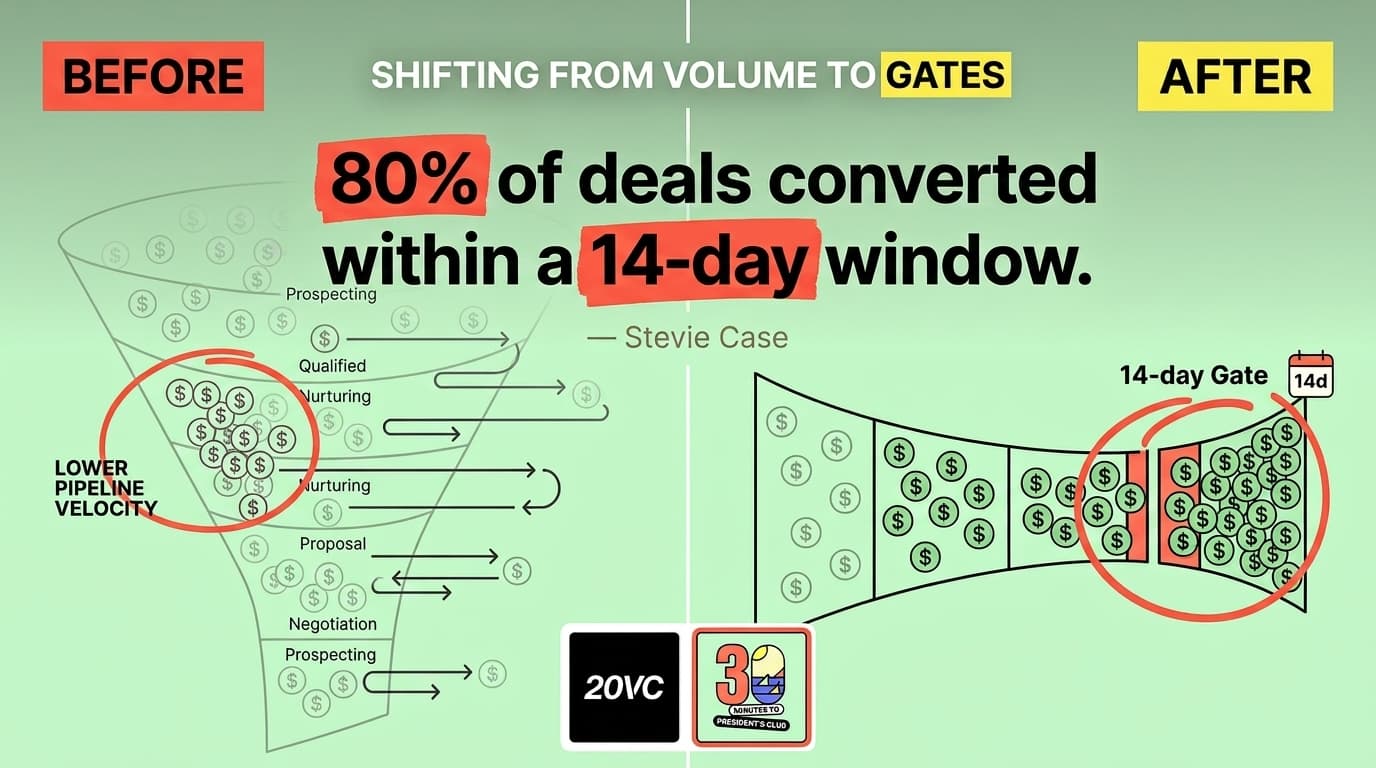
Vanta CRO Stevie Case found that 80% of winning deals convert within a strict 14-day window. Instead of letting reps hold stalled opportunities in commit, she automated a pipeline exclusion rule that strips aging accounts from coverage math entirely.
Today's Sales Plays (22)
Tactical moves operators are running right now, with verbatim source.
discovery
Multiple-choice menu of pain
Start outbound discovery calls by offering a multiple-choice list of common industry problems and asking the prospect to correct you.

Discussing: Running the first five minutes of an outbound-led discovery call where the prospect wasn't actively shopping.
“We want that correction because where they correct us, that's where the gold is... they are volunteering the information. Right. Because they are leaning forward.”
MechanismPresent a 'menu of pain' based on your research. Say: 'When I meet with [Title] from [Industry], they usually tell me [Pain 1], [Pain 2], or [Pain 3]. What did I miss that you guys are laser-focused on?' Let them correct your assumptions to reveal their actual deep pain.
OutcomeWhere they correct us, that's where the gold is.
CounterpointAvoids the interrogation feel of open-ended questions by giving the buyer something concrete to react to.
Tackling new territories, multi-threading, and more with Krysten Conner · Aug 31, 2026
icp_and_segment
Upfront data connection PLG paywall
Force free users to connect core data systems before accessing the product to enable personalized onboarding, accepting high initial churn for higher paid conversion.

Discussing: Converting free users to paid in a PLG motion when generic product experiences lead to low activation.
“If you ask people up front to connect their email on their calendar, you can know enough about them that you can suggest tasks that AI can do for them... The payment rate for us on acquisition is like more than 15%.”
MechanismImplement a 'hard paywall' for data during onboarding. Require users to connect their email and calendar before they can see the product interface. Use this ingested data to auto-suggest highly personalized workflows based on their actual daily tasks, rather than relying on them to figure out the tool's value from a blank state.
Outcome30% initial drop-off, >15% paid conversion rate
CounterpointAccepting a 30% immediate drop-off at onboarding goes against standard PLG advice to reduce friction, but drastically improves downstream monetization.
20VC: The $100 Billion AI Assistant Race: Town vs Instinct vs GrokBot | We Spend $75K Per Engineer on AI Tools | Why the AI Assistant Market Is Not a Bubble & AI Assistants Will Replace Every App on Your Phone with JD, Founder of Town · Sep 7, 2026
icp_and_segment
Competitor-displacement startup grants
Offer 3 months of free usage to small startups to pull demand from competitors and build an enterprise upsell pipeline.

Discussing: Competitors have market share among early-stage startups and developers.
“If we launch a grants program that allows the startups... to start using 11 labs for free for three months, then we could essentially move the demand from our competitors to us... over 10% of the enterprise revenues were essentially coming from the crunch program.”
MechanismLaunch a grants program targeting startups under 25 employees. Give them three months of free access to your platform to build their products on your infrastructure instead of competitors. Use this initial free period to lock them in, then upsell them to paid enterprise tiers as they scale.
OutcomeOver 10% of enterprise revenues came from upsold grant recipients.
CounterpointGiving away the product for free to startups is expensive, but it acts as a wedge to steal competitor demand and build long-term enterprise pipeline.
SaaStr 877 CRO Confidential: 0 to $600M in Under 4 Years. The ElevenLabs GTM Playbook with Carles Reina · Sep 9, 2026
outbound
Closed-Lost Revival Dial Block
Sit with reps to dial closed-lost deals from 6+ months ago using a direct re-engagement question.

Discussing: Reps are missing pipeline targets and complaining that cold outbound doesn't work.
“Call the closed loss from March. Call the closed loss from last year. Call people that you put into the pipeline and ghosted you... build the list for them, you hand it to them, and then you sit next to them.”
MechanismPull a list of 25 closed-lost deals from at least six months ago, or prospects who ghosted mid-pipeline. Hand the list to the rep and sit next to them while they dial. Use a direct script: 'Hey, you bought from us in the past. When do you think you're going to make your next purchase?'
Outcome11 dials yielded 10 answers and 4 pipeline opportunities in 20 minutes.
CounterpointReps naturally avoid closed-lost deals assuming the 'no' is permanent. Sitting with them forces the activity and proves the timing often changes.
How to Run a Sales Blitz and Revive Cold Leads (Ask Jeb) · Sep 2, 2026
outbound
Minimum viable cold call framework
Open with a peer reference, reverse pitch the problem, and agree with the objection before asking for a test drive.

Discussing: SDRs are struggling to convert cold calls into meetings and need a simplified script.
“Usually just like between those three things... nine times out of 10, the SDRs got like pretty damn good on the phones.”
Mechanism1. Opener: 'We work with [Peer Company], have you heard our name tossed around?' 2. Reverse Pitch: State the ridiculous problem they face before mentioning your solution. 3. Objection Handling: Agree with them ('I assume you are a spreadsheet wizard'), then ask if they are open to a test drive just to know what is out there.
OutcomeAverage meetings per SDR went from 4 to upwards of 8 per week.
CounterpointReplaces complex 17-step objection matrices with a simple 3-step flow that entry-level reps can actually memorize.
How To Build An Elite Outbound Sales Team (Get Reps Dialing Fast) · Sep 8, 2026
discovery
Early financial pre-qualification sequence
Ask a rapid-fire sequence of income and debt questions early in discovery to disqualify broke prospects before wasting a 45-minute call.

Discussing: High volume of inbound prospects who have the right problem but lack the budget to actually buy.
“If you're like I ain't telling you... how in the world am I supposed to lead you if I don't know what the destination is? Like Google Maps... I need to know where you are and where we're going.”
MechanismAsk: "Do you have a job? What do you do? Supplement or replace? How much do you make? Gross or net? How much debt (car, student loans, credit cards)?" If they resist, use the Google Maps analogy: "I need a point of origination and destination. If I don't know how much you make, I can't create a path to get there."
OutcomeSpeaker claims he is "batting perfect" with prospects accepting this framing.
CounterpointMost reps wait until the end of a call to discuss budget; this forces the financial reality check into the first few minutes.
Stop Selling and Help People Solve Their Next Biggest Problem | Keith Gillispie - 2035 · Sep 7, 2026
icp_and_segment
5-Filter Account Segmentation
Layer one demographic and four firmographic filters to narrow broad territories into highly targeted lists with a specific why-now signal.
Discussing: Broad territory definitions resulting in generic, feature-led outbound messaging.
“just changing it from all business executives or for them, like all IT executives to just the CIO... I've seen this increase reply rates like 12 plus percent.”
MechanismBuild lists using exactly five filters: one demographic (e.g., CIO instead of 'IT executive') and four firmographics (e.g., US only, hospitals only, $100M-$1B revenue, customer service headcount >100). Finally, layer on one negative or positive signal (e.g., 'did not make the US News Best Hospitals list') to anchor the messaging on a specific business outcome rather than product features.
Outcome12%+ increase in reply rates just from the demographic filter shift.
CounterpointStarting with firmographics is easier because they live natively in the CRM, unlike complex intent signals.
Relevance | Leslie Venetz - 2033 · Aug 31, 2026
forecasting
Time-bound pipeline exclusion
Exclude deals from your pipeline coverage ratio if they sit in a stage longer than your historical conversion window.
Discussing: Inflated pipeline coverage ratios caused by low-quality outbound deals that stall but remain open.
“What we found is that 80% of deals converted within a 14-day window. So what we started doing is if deals fell outside of that 14-day window, we excluded them from the coverage ratio.”
MechanismAnalyze historical win data to find the conversion window for a specific segment. If an active deal ages past that exact window, automatically exclude it from your coverage ratio calculations to prevent false confidence in your pipeline.
Outcome80% of deals converted within a 14-day window.
CounterpointInstead of relying on rep forecast categories, use historical time-to-close data to automatically disqualify stalled deals from coverage math.
#605 - How to Build a Cleaner Sales Pipeline in the Age of AI | Stevie Case · Sep 3, 2026
icp_and_segment
Where we win CRM report
Find your true ICP by running a CRM report on closed-won deals from the past two years to identify industry and company size patterns.
Discussing: Starting a new territory and needing to narrow down hundreds of accounts to a manageable, high-probability list.
“These are the people that have given us money. So this is what we should be looking for. So we start there and look for patterns.”
MechanismRun a CRM report on closed-won deals over the past two years. Filter by industry, employee count, and company age. Look for outliers—specific industries or sizes that buy big. Ignore marketing's ICP; focus strictly on the patterns of companies that have actually given you money.
OutcomeUsually there will be three, maybe four industries that stand out.
CounterpointMarketing's ICP often reflects aspirational targets; this relies strictly on historical closed-won data.
Tackling new territories, multi-threading, and more with Krysten Conner · Aug 31, 2026
icp_and_segment
Three-part composite lead scoring
Split lead scoring into three isolated sub-scores—ICP fit, product usage, and buying signals—to clarify exactly why an account is prioritized.
Discussing: Reps ignore lead scores because a single blended number doesn't explain why an account is actually ready to buy.
“I basically have it to where it's like 30% of our composite score is based off of ICP. 40% is based off of product usage. And then the other 35% is based off of signals.”
MechanismBuild a composite score using three distinct models: 30% ICP fit (firmographics), 40% product usage (specific in-app actions), and 35% buying signals (funding, hiring). This isolates whether an account is just a good fit, or actually in an active buying window.
Outcome30/40/35 scoring split
CounterpointStandard scoring blends firmographics and intent into one confusing number. This isolates the variables.
Building an AI-native sales motion with Heath Barnett · Sep 7, 2026
outbound
Four-sentence cold email framework
Strip cold emails down to an observation, a problem, a solution, and a low-friction CTA.
Discussing: Reps are sending long, jargon-filled, multi-paragraph emails that get ignored.
“You build your list of the top five things that tell you your prospect wants to buy your thing. And then you pop those into the first and second paragraph.”
MechanismWrite exactly four sentences: 1) What you noticed about them (the trigger). 2) The specific problem that trigger implies. 3) How you solve that problem. 4) An interest-based CTA ('Worth seeing an example program live?'). Add a brief, humanizing PS at the bottom.
OutcomeGot sequences to double-digit reply rates.
CounterpointAvoids over-engineered AI personalization matrices in favor of a single mobile-optimized scroll.
How To Build An Elite Outbound Sales Team (Get Reps Dialing Fast) · Sep 8, 2026
team_and_org
SDR coachability interview test
Test SDR coachability by having them rewrite a cold email and re-deliver a pitch based on your live feedback.

Discussing: Assessing SDR candidates for true coachability, not just polite acceptance of feedback.
“There's a difference between just handling the feedback well and actually then incorporating the feedback and coming back with a new draft that use the feedback.”
MechanismHave candidates write a cold email and deliver a 5-minute cold pitch on researched leads. Give direct feedback, then require them to rewrite the email and re-deliver the pitch. To prevent AI cheating on the email, require them to include a 'shared value' connecting their personal life to the buyer.
OutcomeSpeaker's word, separates candidates who just say thank you from those who actually incorporate feedback.
CounterpointMost candidates are trained to politely accept feedback; this forces them to actually apply it live.
Why AI Will NEVER Replace Real Sales with Jeff Kirchick · Aug 31, 2026
team_and_org
30-60-90 weakness slide
Force AE candidates to present a real professional weakness and their exact remediation plan during their 30-60-90 presentation.
Discussing: Vetting AE candidates during the interview process to see if they are genuinely self-aware and authentic.
“I explicitly call out, tell me something that is a professional development weakness of yours, how you identified it and what you're doing about it.”
MechanismRequire candidates to include a specific slide in their 30-60-90 presentation detailing a professional development weakness, how you identified it, and your exact steps to fix it. Reject candidates who give fake weaknesses like 'I work too hard'. Look for operational flaws like 'failing to implicate pain'.
OutcomeSpeaker's word, forces honesty and reveals if they can admit a real problem.
CounterpointCandidates usually hide weaknesses in interviews; making it a formal presentation requirement forces them to document a real flaw.
Why AI Will NEVER Replace Real Sales with Jeff Kirchick · Aug 31, 2026
closing
Paid pilot conversion contract
Charge for the pilot and write the specific conversion metrics directly into the week-zero kickoff contract.
Discussing: Prospects treating pilots as free, evaluative tire-kicking exercises with no commitment to buy.
“We charge for the pilots. So it's $10,000, four weeks... if we can show X, Y, and Z metric improvement over the four weeks, what would be the reason that you wouldn't move forward?”
MechanismCharge a flat fee for the pilot, such as $10,000 for four weeks, and deliver a tangible asset at the end regardless of conversion. At the week-zero kickoff, document the exact success metrics and ask: 'If we hit X, Y, and Z, what would be the reason you wouldn't move forward?'
OutcomeSecures $10,000 pilot fee and forces live agreement negotiation in parallel.
CounterpointCharging for the pilot forces the hard conversation upfront and filters out prospects without real buying intent.
#607 - How to Turn Every Sales Pilot Into a Closed Deal | Shaun Crimmins · Sep 10, 2026
team_and_org
Two-call mock interview test
Make SDR candidates do a mock cold call twice to test if they can actually apply live coaching.
Discussing: Interviewing SDR candidates to ensure they can think on their feet and take feedback.
“You do the first round through. That was awful. Hey, here's one thing you did great. Would you try this differently for the second one? If they don't change anything... that is a massive red flag.”
MechanismSend the candidate a podcast to prep. Have them run a mock cold call. The first attempt will be bad. Give them exactly one or two pieces of feedback (e.g., 'lead with the problem instead of the pitch'). Have them immediately run the call a second time to see if they apply the feedback.
OutcomeFilters out candidates who cannot process feedback or think on their feet.
CounterpointThe goal is not to see if they are good at cold calling, but to see if they can digest and apply a single piece of feedback under pressure.
How To Build An Elite Outbound Sales Team (Get Reps Dialing Fast) · Sep 8, 2026
discovery
The overcorrection discovery statement
Make a slightly exaggerated, incorrect statement about the prospect's world to trigger their natural urge to correct you.
Discussing: Prospects give short, guarded answers to standard discovery questions.
“If I purposefully get something wrong and I say it as a statement, there's almost this itchy desire in us as people to correct. And not only do we tend to correct, we tend to overcorrect.”
MechanismInstead of asking a direct question, make a purposefully incorrect statement. For example, say, "I read that your industry has the highest job satisfaction right now." Pause and let the prospect correct you. They will naturally overcorrect and reveal their actual problems.
Outcomespeaker's word, not measured
CounterpointStatements often pull more detailed answers than direct questions because people love correcting others.
How Two Sellers Turned Their Prospecting Calls Into Therapy Sessions · Sep 11, 2026
comp_and_quota
Zero commission on one-off POCs
Pay zero commission on one-off POCs, regardless of size, to force reps to close recurring revenue contracts.
Discussing: Reps are closing large, one-off proof-of-concept deals that don't increase the company's recurring revenue valuation.
“If you sign a POC and you pay for like two months... you will not get any commission on that. It didn't really matter if it was like a POC for like 20K or it was like a POC for like $20 million. You would just get zero.”
MechanismStructure the compensation plan so reps receive absolutely zero commission on one-off POCs, even if the POC is worth millions. Only pay commissions on recurring revenue contracts. Explain to the team that one-off revenue doesn't drive the company's valuation or equity story.
OutcomeForced reps to focus on long-term contracts; average quota attainment hit 167%.
CounterpointRefusing to pay commission on massive one-off POCs risks rep frustration, but it aligns sales behavior directly with company valuation metrics.
SaaStr 877 CRO Confidential: 0 to $600M in Under 4 Years. The ElevenLabs GTM Playbook with Carles Reina · Sep 9, 2026
discovery
Frontloading discovery call friction
Start discovery calls by listing the top reasons deals fail, including rough costs and time commitments.
Discussing: Kicking off a discovery call when the prospect is guarded against hidden pricing or pushy tactics.
“We start off with all the bad news first. All the objections, all the reasons not to work with us, we front load it right at the start of the call.”
MechanismOpen the call by sharing the top three reasons why your engagements usually fail. State the rough cost, the required time commitment, and warn them you will ask uncomfortable questions. Give them explicit permission to opt out immediately if any of those are red flags.
Outcomespeaker's word, not measured
CounterpointMost reps hide pricing and friction until the end of the cycle; frontloading it builds immediate trust.
How Two Sellers Turned Their Prospecting Calls Into Therapy Sessions · Sep 11, 2026
comp_and_quota
20x quota with expansion double-dipping
Set a 20x quota-to-base ratio, but pay uncapped commissions on both the initial land and all account expansion for 12 to 24 months.
Discussing: Setting quotas in a hyper-growth, product-led market where traditional 5x SaaS ratios are too low.
“If you want to have a base salary of 100K, you're going to need to bring $2 million in revenues... I will double compensate people because I do believe that if I'm incentivizing to go hunt deals then I want to give you commissions for that deal expansion.”
MechanismSet a 20x quota-to-base ratio. To make it achievable, double-compensate the AE: pay them for the initial new logo hunt, plus commission on any deal expansion driven by the CSM team for the first 12 to 24 months. Offer mid-quarter quota relief if market conditions shift.
OutcomeAverage quota attainment of 167%, with top reps hitting 300-600%.
CounterpointA 20x ratio sounds impossible compared to the SaaS 5x standard, but uncapped expansion commissions and mid-quarter relief valves make it highly lucrative.
SaaStr 877 CRO Confidential: 0 to $600M in Under 4 Years. The ElevenLabs GTM Playbook with Carles Reina · Sep 9, 2026
comp_and_quota
Human commission for AI agent upsells
Deploy AI agents to handle SMB upsells, but pay the full commission to the human account owner to drive internal AI adoption.
Discussing: Sales reps are pushing back against AI agent rollouts due to fears of job replacement.
“By having an AI customer success manager to focus on the upsells for the long tail account... we could actually automatically unlock revenues and we will pay commissions to like the account owner of those companies.”
MechanismRoll out AI customer success managers to handle upsells specifically for long-tail and SMB accounts. Automatically route the commission for any revenue unlocked by the AI directly to the human account owner. Use this to prove that AI enhances their productivity and paychecks rather than replacing them.
OutcomeNavigated initial team concerns and drove AI adoption.
CounterpointPaying humans for work an AI did seems inefficient, but it drives immediate team adoption and removes internal friction against AI rollouts.
SaaStr 877 CRO Confidential: 0 to $600M in Under 4 Years. The ElevenLabs GTM Playbook with Carles Reina · Sep 9, 2026
icp_and_segment
Enterprise-only ICP constraint
Halt sales to sub-$5K ACV accounts to avoid high churn and focus exclusively on $30K+ enterprise deals from day one.

Discussing: High churn in $2K-$5K ACV deals while $30K+ enterprise deals show strong retention.
“our tier five accounts, which were our, call them like our two to 5,000 ARR deals at a very, very high rate of churn. And then our tier one, which were 30K plus we had, you know, best in class retention around those.”
MechanismTier accounts 1 through 5 based on revenue bands. Identify the high-churn SMB tier (e.g., $2K-$5K ACV) and completely stop selling to them. Force the organization to build for and sell exclusively to Tier 1 accounts ($30K+ ACV) from day one, targeting senior executives at large, complex organizations.
OutcomeSigned 5 enterprise customers (Walgreens, Hershey, Apotex) in the first few months of the revenue motion.
CounterpointStartups usually take any revenue they can get early on; this play requires the discipline to reject early SMB cash to build an enterprise-grade product.
SPOTLIGHT: Skipping the SMB Trap and Building for Big Brands | Matt Allison, CEO & Founder @ Handraise · Sep 10, 2026
icp_and_segment
Student-Sourced Micro-ICP Lists
Hire college students to manually build prospect lists based on hyper-specific behavioral traits that standard data providers miss.

Discussing: Sales is pitching a generic ICP and seeing single-digit conversion rates.
“I fired a bunch of really smart people... I put them on the Internet. I said, go find me people that meet these categories... Three years later, their hit rate is 41% as opposed to 5%.”
MechanismTranslate your competitive advantages into highly precise, non-obvious customer traits. Instead of buying generic lists, hire college students to manually research and build lists of companies that fit these exact micro-criteria. Feed these manually vetted, highly targeted lists directly to the sales team to work.
OutcomeHit rate increased from 5% to 41% over three years.
CounterpointStandard data providers cannot filter for nuanced behavioral proxies. Manual research by cheap, smart labor bridges the gap.
Strategy That Teams Actually Execute with Dr. Chuck Bamford · Sep 3, 2026
From the Conversations
The Official SaaStr Podcast: SaaS | Founders | Investors
Competitor-displacement startup grants
SaaStr 877 CRO Confidential: 0 to $600M in Under 4 Years. The ElevenLabs GTM Playbook with Carles Reina
Sep 9, 2026 · 41m · 4 quotes pulled
▶ Listen“If we launch a grants program that allows the startups... to start using 11 labs for free for three months, then we could essentially move the demand from our competitors to us... over 10% of the enterprise revenues were essentially coming from the crunch program.”

30 Minutes to President's Club | No-Nonsense Sales
Minimum viable cold call framework
How To Build An Elite Outbound Sales Team (Get Reps Dialing Fast)
Sep 8, 2026 · 46m · 3 quotes pulled
▶ Listen“Usually just like between those three things... nine times out of 10, the SDRs got like pretty damn good on the phones.”
Multiple-choice menu of pain
Tackling new territories, multi-threading, and more with Krysten Conner
Aug 31, 2026 · 1h 12m · 2 quotes pulled
▶ Listen“We want that correction because where they correct us, that's where the gold is... they are volunteering the information. Right. Because they are leaning forward.”
Sources
 ▶ Listen
Outbound Squad
Tackling new territories, multi-threading, and more with Krysten ConnerIn this episode, Jason and Krysten Conner, sales coach at krystenconner.com, talk about the where-we-win report every new AE should run, the ship jumper move and other warm-path openers, ghost-writing a referral email your champion will send, and running EMT discovery on outbound-led calls. Check out more free content and get help with outbound at https://outboundsquad.com.
 ▶ Listen
Sales Gravy: Jeb Blount
How Two Sellers Turned Their Prospecting Calls Into Therapy Sessions<p>It sounds unusual, modeling an entire sales methodology off the principles of therapy. But it’s exactly what Jack Frimstone and Zac Thompson did, and it works. Jack and Zac, co-founders of the UK sales consultancy We Have a Meeting, sat down with Jeb Blount Jr. to break down this idea, which they discuss in their book, Sales as Therapy. They go over prospecting techniques that uncover real, often personal stakes behind a buying decision. They also discuss two tools that get more guarded prospects to open up.</p><p><br></p><p>📖 Purchase Jeb Blount's book, <a href="https://a.co/d/0hneYtLq" rel="nofollow">90 Days to Level Up Your Sales Skills</a></p><p>👉 Download our free <a href="https://salesgravy.com/resource/aced-buyer-style-playbook/" rel="nofollow">A.C.E.D. Buyer Style Playbook for Sales Professionals</a></p><p>🔗 <a href="https://www.linkedin.com/company/salesgravy/" rel="nofollow">Follow us on LinkedIn!</a></p><br/><br/>Our Sponsors:<br/>* Check out Plaud AI and use my code JEB for a great deal: https://www.plaud.ai/jeb<br/>* Check out TruDiagnostic and use my code SALESGRAVY for 20% off your entire order: https://www.trudiagnostic.com<br/>* Go to https://OmahaSteaks.com and use promo code BEEF at checkout for $35 off. Minimum purchase may apply. <br/><br/><br/>Advertising Inquiries: <a href='https://redcircle.com/brands'>https://redcircle.com/brands</a><br/><br/>Privacy & Opt-Out: <a href='https://redcircle.com/privacy'>https://redcircle.com/privacy</a>
 ▶ Listen
The Twenty Minute VC (20VC): Venture Capital | Startup Funding | The Pitch
20VC: The $100 Billion AI Assistant Race: Town vs Instinct vs GrokBot | We Spend $75K Per Engineer on AI Tools | Why the AI Assistant Market Is Not a Bubble & AI Assistants Will Replace Every App on Your Phone with JD, Founder of Town<p>Jean-Denis "JD" Grèze is the Co-Founder and CEO of Town, the AI work assistant reportedly in talks to raise funding at a $1BN valuation. Before founding Town, JD spent seven years as CTO of Plaid. Before Plaid, he was Director of Engineering at Dropbox. He is also a prolific angel investor backing companies including Modal, BaseTen, Merge and NexHealth.</p> <p>AGENDA:</p> <p>00:00 Why AI Assistants Are Silicon Valley's Hottest Market<br data-start="122" data-end="125" /> 07:00 How Does Town Compete With Grokbot, Instinct and Big Tech?<br data-start="189" data-end="192" /> 11:00 Will We Have One AI Agent or Different Agents for Every Part of Our Lives?<br data-start="272" data-end="275" /> 17:00 How Many Mistakes Can AI Agents Make Before We Stop Trusting Them?<br data-start="347" data-end="350" /> 20:00 How Does Town Choose the Best Models Without Destroying Its Margins?<br data-start="424" data-end="427" /> 29:00 Is the AI Assistant Market Already Too Crowded?<br data-start="480" data-end="483" /> 37:00 Can Apple Win the Agent Race—and Are We Entering a Cybersecurity Nightmare?<br data-start="564" data-end="567" /> 41:00 What Does a Successful Town User Look Like—and Which Pricing Tier Makes Money?<br data-start="651" data-end="654" /> 47:00 What Will AI Agents Be Able to Do in Three Years That They Cannot Do Today?<br data-start="735" data-end="738" /> 54:00 Is the Skepticism Around Billion-Dollar AI Assistant Companies Justified?<br data-start="817" data-end="820" /> 58:00 What Needs to Happen for Town to Become a $100BN Company?<br data-start="883" data-end="886" /> 1:02:00 How Has AI Changed Hiring—and Why Does Town Spend $75K Per Engineer on AI Tools?<br data-start="974" data-end="977" /> 1:06:00 What Is JD Most Excited About Over the Next Decade?</p>
 ▶ Listen
The Official SaaStr Podcast: SaaS | Founders | Investors
SaaStr 877 CRO Confidential: 0 to $600M in Under 4 Years. The ElevenLabs GTM Playbook with Carles Reina<p>CRO Confidential: 0 to $600M in Under 4 Years. The ElevenLabs GTM Playbook with Carles Reina (Partner @ Baobab Ventures and Former VP of Revenue at ElevenLabs). Hosted by Sam Blond, CEO and Co-Founder of Monaco<br /> <br /></p> <p dir="ltr">Carles Reina was the fourth employee and first GTM hire at ElevenLabs. Four years later, the company hit $600M ARR and an $11B valuation. In this episode of CRO Confidential, Carles breaks down exactly how they built it.</p> <p dir="ltr">He covers the distribution-first strategy that drove 0 to $100M in 20 months, the grants program that pulled demand away from every competitor in the market, and the 20X quota model that had reps hitting 300-600% attainment. He also gets into what he'd do differently — why sales enablement and senior sellers should come earlier than most founders think — and how ElevenLabs wired AI into their GTM motion before most companies were even asking the question.</p> <p dir="ltr">If you're building go-to-market from scratch or trying to figure out what "AI-native" revenue looks like in practice, this one is required listening.</p>
- ▶ Listen
Sales Gravy: Jeb Blount
How to Run a Sales Blitz and Revive Cold Leads (Ask Jeb)<p><strong>How do you run an effective sales blitz, and what's the fastest way to reconnect with cold leads you've already written off? </strong></p><p>In this episode of Ask Jeb on the Sales Gravy Podcast, Jeb Blount answers two questions: Chris asks how to structure a sales blitz across existing customers and new logos, and Lindsay asks for Jeb's number one piece of advice for reconnecting with cold leads.</p><p>Jeb's answer to Chris starts with a simple truth: a blitz on existing customers should take about 30 days, no longer. You already know who they are and where they are, so the only thing standing between you and results is picking up the phone. New logos take more structure: build a targeted list by persona, company size, and likelihood to buy, assign a closing goal per rep, and run a focused 30 day sprint with daily call targets and twice weekly accountability check ins before rotating to the next product. </p><p>For Lindsay, Jeb's advice is easy: you revive dead leads by calling them. He backs it up with real numbers, including a rep who made 11 dials, reached 10 people, and turned four into pipeline opportunities from a completely random list, plus a story about a commercial kitchen equipment company that revived a dead deal into a multi restaurant order just by calling to check in.</p><p>What You'll Learn:</p><ul><li>Why a 30 day blitz outperforms a 90 day blitz for existing customer campaigns</li><li>How to build a targeted new logo list using persona, company size, and buying likelihood</li><li>Why leaders need to give reps the exact list, exact script, and exact call target instead of a vague directive to "go blitz"</li><li>How twice weekly accountability check ins keep a blitz from losing momentum</li><li>Why picking up the phone still outperforms every other reactivation tactic for cold and closed lost leads</li><li>How one rep turned 11 random dials into 4 pipeline opportunities in 20 minutes</li><li>Why you should be calling closed lost deals from months or years ago, not just recent ones</li><li>How a single reactivation call turned an old dead deal into a multi location order</li></ul><p><br></p><p>Whether you're planning a product launch blitz or sitting on a pile of cold leads you've written off, this episode gives you a clear, practical framework for turning both into revenue.</p><p>-</p><p><a href="http://salesgravy.com/ask" rel="nofollow">Submit</a> your question: <a href="http://salesgravy.com/ask" rel="nofollow">salesgravy.com/ask</a></p><p><a href="https://a.co/d/00b8wZYQ" rel="nofollow">Purchase</a> Jeb Blount's new book: <a href="https://a.co/d/00b8wZYQ" rel="nofollow">90 Days to Level Up Your Sales Skills</a></p><p>Grab your tickets for <a href="https://outboundconference.com/" rel="nofollow">OutBound Conference</a></p><p><a href="https://www.linkedin.com/in/jebblounthttps://www.linkedin.com/in/jebblount" rel="nofollow">Follow</a> Jeb Blount on <a href="https://www.linkedin.com/in/jebblount" rel="nofollow">LinkedIn</a></p><br/><br/>Our Sponsors:<br/>* Check out Plaud AI and use my code JEB for a great deal: https://www.plaud.ai/jeb<br/>* Check out TruDiagnostic and use my code SALESGRAVY for 20% off your entire order: https://www.trudiagnostic.com<br/>* Go to https://OmahaSteaks.com and use promo code BEEF at checkout for $35 off. Minimum purchase may apply. <br/><br/><br/>Advertising Inquiries: <a href='https://redcircle.com/brands'>https://redcircle.com/brands</a><br/><br/>Privacy & Opt-Out: <a href='https://redcircle.com/privacy'>https://redcircle.com/privacy</a>
 ▶ Listen
30 Minutes to President's Club | No-Nonsense Sales
How To Build An Elite Outbound Sales Team (Get Reps Dialing Fast)Armand Farrokh breaks down the system he used to build a high-performing SDR organization, fixing culture, installing operating rhythms, sharpening targeting, and creating repeatable hiring and messaging processes. ⚡ Fix the energy first: Create buy-in, make tough personnel decisions fast, and build visible momentum. 📅 Install five weekly rhythms: Use Monday commitments, Tuesday and Thursday teardowns, Wednesday 1:1s, and Friday team dials to drive accountability, coaching, and culture. 🎯 Fix targeting before activity: Get reps focused on the right accounts and personas before demanding more calls, emails, or better copy. 🧠 Build simple systems that compound: Standardize calls, emails, sequences, and hiring, then improve them through real market feedback. You’re one step closer to President’s Club!: 🚀 The SDR Leader Pack: https://hubs.li/Q04nGgrk0 🏋 30MPC Training: https://www.30mpc.com/course/team-training 🛠 Weekly Newsletter: https://hubs.li/Q02NJQ8p0 📚 Things you can steal and use today: https://linktr.ee/30mpc_youtube
 ▶ Listen
The Sales Evangelist
Stop Selling and Help People Solve Their Next Biggest Problem | Keith Gillispie - 2035<p>A former Marine who did eight combat deployments in eight years now spends his time teaching people to stop pitching and start asking better questions.</p><p><u><a href="https://www.linkedin.com/in/keithgrei/" rel="noopener noreferrer" target="_blank">Keith Gillispie</a></u>, founder of REI Automated, left the Marines in 2020 to build a real estate investing and coaching business that's helped more than 1,200 people, with close to 580 of them closing their very first deal. He broke down exactly how he qualifies, questions, and consults his way to the close.</p><p><strong>Why "Selling" Is the Wrong Mindset (Stop Being House Horny)</strong></p><ul><li>Keith's blunt term for pushy sellers: house horny, chasing the deal so hard that they force the wrong solution onto someone just to close it.</li><li>His fix is simple: stop selling, and start asking great questions that guide the prospect to the answer on their own.</li><li>He reviews sales calls with his own team every week, and the biggest issue he catches with newer reps is a used-car-salesman energy that shows up the moment they stop asking and start pitching.</li></ul><br/><p><strong>Qualify for the Right Industry First</strong></p><ul><li>Keith gets over a hundred Facebook messages a day, and his team has to pre-qualify people before he ever gets on a call.</li><li>A recent example: a rep flagged someone as "qualified" who actually wanted coaching on commercial real estate, which Keith doesn't teach at all. Same broad label, completely wrong fit.</li><li>Even inside a niche that sounds close enough, being in the wrong specific industry wastes everyone's time.</li></ul><br/><p><strong>Qualify for the Right Problem: Your Core Competency Must Match Their Core Constraint</strong></p><ul><li>Keith's rule: everyone has problems, but that alone doesn't make someone a fit. What he's good at has to be exactly what the prospect is bad at.</li><li>He calls this matching your core competency to their core constraint. If there's no real gap for him to fill, there's no real reason for the two of them to work together.</li><li>This is what separates a win-win engagement from a sale that shouldn't have happened in the first place.</li></ul><br/><p><strong>Qualify for the Right Money (Or Every Call Becomes Charity)</strong></p><ul><li>Even with the right industry and the right problem, a prospect still has to be able to afford the solution, or the call turns into free coaching.</li><li>Keith shared a recent example of two prospects who badly wanted to join his program but couldn't spend even $300, when his coaching runs into the thousands.</li><li>He's direct with his own team about this: sending him financially unqualified leads turns every call into charity work, which isn't sustainable as a business, even though he's genuinely happy to hand out free value when it makes sense.</li></ul><br/><p><strong>Diagnose Before You Prescribe</strong></p><ul><li>Keith estimates that more than half of the people who come to him think they know what they need, and they're wrong.</li><li>His example: prospects ask for automation when they don't even have leads coming in yet, or don't know how to structure a deal. Automating a broken process just scales the chaos faster.</li><li>He compares it to a patient self-diagnosing before seeing a doctor. The seller's job, like a doctor's, is to ask enough questions to find the real issue before recommending anything.</li></ul><br/><p><strong>Get Comfortable Asking Uncomfortable Financial Questions</strong></p><ul><li>Keith walks straight into questions like current income, whether that number is gross or net, and total debt, early in a call, because he can't build a plan without knowing where someone actually stands.</li><li>He compares it to Google Maps: you need a point of origin and a point of destination before you can build the route in between.</li><li>Roughly one in twenty-five or thirty people push back on how direct these questions are. Keith's response is straightforward: if they can't handle these basic questions now, the program itself is going to be a rough fit.</li></ul><br/><p><strong>Build Yes Momentum With Small Asks</strong></p><ul><li>Keith structures his qualifying questions to build what he calls yes momentum: each small, reasonable question makes the next one easier to answer.</li><li>He starts broad, what do you do, how long have you done it, before narrowing into income, debt, and financial specifics, so the conversation earns its way to the harder questions instead of opening with them.</li><li>That same sequence doubles as training. The financial questions he asks on a discovery call mirror the exact questions his students will later need to ask sellers and private lenders.</li></ul><br/><p><strong>Ask Questions, Don't Make Statements</strong></p><ul><li>Keith's rule for himself: don't make a statement for the first 60 percent of any sales call, aside from short softening statements like "I'm glad you asked that."</li><li>The only exception is a brief acknowledgment before turning right back around and asking another question.</li><li>Whoever is asking the questions is steering the conversation, and Keith treats that as true for the entire first half of every call he runs.</li></ul><br/><p><strong>Never Fully Answer a Question Without Asking One Back</strong></p><ul><li>Keith borrows from Socratic questioning: when a prospect asks a direct question, like how fast he can close on a house, answering too quickly and too specifically can blow up the deal in either direction.</li><li>Instead, he gives a partial, honest answer, then asks a question that uncovers the real reason behind their question, like whether they need to move fast or need more time.</li><li>That extra step means his eventual answer is actually calibrated to what the person needs, instead of a generic response that might scare them off or fail to meet an urgent situation.</li></ul><br/><p><strong>Become a Lifelong Student of Your Craft</strong></p><ul><li>Keith has taken more than ten thousand sales calls over eleven years and still says the more he learns about sales psychology, the more he realizes he doesn't know.</li><li>His advice for anyone serious about improving: invest in a coach or mentor who can review real calls and point out specific gaps, rather than trying to learn everything for free through trial and error.</li><li>His framing: you'll pay for the lesson either way, either in money to a mentor, or in wasted time and missed opportunity learning the hard way.</li></ul><br/><p>"People don't care how much you know until they know how much you care." — Keith Gillispie</p><p><strong>Resources</strong></p><ul><li><u><a href="https://www.linkedin.com/in/keithgrei/" rel="noopener noreferrer" target="_blank">Connect with Keith Gillispie on LinkedIn.</a></u></li><li><u><a href="https://www.reiautomated.io/" rel="noopener noreferrer" target="_blank">Visit REI Automated to learn more about Keith's education, software, and coaching community for real estate investors.</a></u></li><li><u><a href="https://thesalesevangelist.com/linkedin-prospecting-course/" rel="noopener noreferrer" target="_blank">Join our LinkedIn cohort and learn to prospect the right way.</a></u></li><li><u><a href="https://bluemangostudios.com/" rel="noopener noreferrer" target="_blank">Visit Blue Mango Studios for help creating podcast production content.</a></u></li></ul><br/><p><strong>Sponsorship Offers</strong></p><ol><li><strong>This episode is brought to you in part by Hubspot.</strong></li></ol><br/><p>With HubSpot sales hubs, your data tools and teams join a single platform to close deals and turn prospects into pipelines. Try it for yourself at <u><a href="https://www.hubspot.com/products/sales" rel="noopener noreferrer" target="_blank">hubspot.com/sales</a></u>.</p><ol><li><strong>This episode is brought to you in part by the TSE Sales Foundation.</strong></li></ol><br/><p>Improve your connection on LinkedIn and land three or five appointments with our LinkedIn prospecting course. Go to the <u><a href="https://tsesales.typeform.com/to/UCMfjZbX" rel="noopener noreferrer" target="_blank">salesevangelist.com/linkedin</a></u>.</p><p><strong>Credits</strong></p><p>As one of our podcast listeners, we value your opinion and always want to improve the quality of our show. Complete our two-minute survey here: <a href="http://thesalesevangelist.com/survey" rel="noopener noreferrer" target="_blank">thesalesevangelist.com/survey</a><a href="https://tsesales.typeform.com/to/lc5yAa8P" rel="noopener noreferrer" target="_blank">.</a> We’d love for you to join us for our next episodes by tuning in on <a href="https://podcasts.apple.com/us/podcast/the-sales-evangelist/id788738885" rel="noopener noreferrer" target="_blank">Apple Podcast</a>, <a href="https://podcasts.google.com/feed/aHR0cDovL3RoZXNhbGVzZXZhbmdlbGlzdC5saWJzeW4uY29tL3Jzcw?sa=X&ved=2ahUKEwj5kaXI3Pj2AhVKcjABHW5PDVwQ9sEGegQIARAC" rel="noopener noreferrer" target="_blank">Google Podcast</a>, <a href="https://www.stitcher.com/show/the-sales-evangelist-sales-trainingspeakingbusiness-marketingdonald" rel="noopener noreferrer" target="_blank">Stitcher</a>, or <a href="https://open.spotify.com/show/1NjzsFjQwVrgboUfDvbzd5?si=LdQOJDc1T-WBPMxr1h3RsA" rel="noopener noreferrer" target="_blank">Spotify</a>. Audio provided by <a href="https://freesfx.co.uk/" rel="noopener noreferrer" target="_blank">Free SFX,</a> <a href="https://soundstripe.com/" rel="noopener noreferrer" target="_blank">Soundstripe</a>, and <a href="http://www.bensound.com/" rel="noopener noreferrer" target="_blank">Bensound</a>. Other songs used in the episodes are as follows: The Organ Grinder written by Bradley Jay Hill, performed by Bright Seed, and produced by Brightseed and Hill.</p>
- ▶ Listen
- ▶ Listen
30 Minutes to President's Club | No-Nonsense Sales
#605 - How to Build a Cleaner Sales Pipeline in the Age of AI | Stevie CaseStevie Case breaks down how modern sales leaders can use AI, clean CRM data, and human judgment to inspect pipeline, improve sales forecasting, and rethink outbound strategy. Learn how to separate real pipeline from automated outreach “slop,” uncover what your best reps are doing differently, and build practical AI sales workflows without waiting on engineering. 🧱 Clean your data before layering on AI. Put governance around accounts, contacts, and opportunities so your AI systems are analyzing reality instead of CRM slop. 🔍 Inspect before you correct. When a rep misses activity benchmarks, figure out what they’re actually doing and whether they’ve discovered a better play before simply demanding more calls or emails. 🤖 Use AI to inspect deals, not replace sales leaders. Pull qualification evidence directly from call transcripts, surface gaps automatically, then use human-led forecasts to investigate the areas that need judgment. 🛠️ Start building instead of waiting for engineering. Block a few hours to create a simple Clay signaling or pipeline workflow yourself. The fastest way for sales leaders to become competent with AI is to actually use it. You're one step closer to President's Club! 🏋 30MPC Training 🛠 Weekly Tactical Breakdowns 📚 Things you can steal and use today
- ▶ Listen
Outbound Squad
Building an AI-native sales motion with Heath BarnettIn this episode, Jason and Heath Barnett, formerly of Mixmax, talk about why PLG and product-led sales aren't the same thing, the three layers of a real ICP, account scoring with sub-scores that stack, and why AI investment flops without rep skill investment. Check out more free content and get help with outbound at https://outboundsquad.com.
 ▶ Listen
Make It Happen Mondays - B2B Sales Talk with John Barrows
Why AI Will NEVER Replace Real Sales with Jeff Kirchick<p>AI is not going to replace real sales. It's going to expose who was never really selling in the first place.</p><p>In this episode, John sits down with Jeff Kirchick, author of Authentic Selling and a sales leader who has closed multi-million dollar contracts without ever going through formal sales training, to talk about why AI made personalization easier to fake and easier for buyers to spot, why authenticity is not the same as being liked, and why disqualifying the wrong buyer matters more than qualifying the right one.</p><p>If you are in sales, sales leadership, enablement, or RevOps, this conversation gives you a practical way to think about AI-generated outreach, hiring for coachability over polish, the give and get scorecard behind real qualification, and why a smooth call is not always a good sign.</p><p>Want to build a sales team that stays authentic as AI changes the job? Visit<a href="http://www.jbarrows.com" rel="noopener noreferrer" target="_blank"> </a><u><a href="http://www.jbarrows.com" rel="noopener noreferrer" target="_blank">www.jbarrows.com</a></u> and learn how you can Make It Happen.</p><p>What You'll Learn</p><ul><li>Why AI made personalization easier to fake, and easier for buyers to spot</li><li>Why authenticity is about being trusted, not being liked</li><li>Why Jeff hires SDRs on exactly two traits, work ethic and coachability</li><li>Why a smooth sales call without objections is a warning sign, not a good sign</li><li>Why disqualifying the wrong buyer matters more than qualifying the right one</li></ul><br/><p>Jeff Kirchick is the author of Authentic Selling and a sales leader who built his career without formal sales training, closing multi-million dollar enterprise contracts through intuition, empathy, and direct relationship building. He hires his team on two filters, work ethic and coachability, and has built his own sales org's AI infrastructure in house, including deal scoring and call coaching.</p><p>Visit <u><a href="http://jeffkirchick.com" rel="noopener noreferrer" target="_blank">jeffkirchick.com</a></u> to read more of Jeff's writing on sales, authenticity, and AI.</p><p>Connect with Jeff Kirchick:</p><p>LinkedIn: <u><a href="http://linkedin.com/in/jeffkirchick" rel="noopener noreferrer" target="_blank">linkedin.com/in/jeffkirchick</a></u> </p><p>Website: <u><a href="http://jeffkirchick.com" rel="noopener noreferrer" target="_blank">jeffkirchick.com</a></u> </p><p>John Barrows is a sales trainer, speaker, and founder of JB Sales with over 25 years of experience in the industry. He has made hundreds of cold calls a week, led startups to acquisition, and trained high-performing teams at companies like Salesforce, LinkedIn, Amazon, and Okta. Through JB Sales, John focuses on practical sales execution, helping reps fill pipeline, close deals, and build trust with buyers in today's AI-driven sales environment.</p><p>Connect with John Barrows:</p><p>LinkedIn: <u><a href="http://linkedin.com/in/johnbarrows" rel="noopener noreferrer" target="_blank">linkedin.com/in/johnbarrows</a></u> </p><p>Instagram: <u><a href="http://instagram.com/johnmbarrows" rel="noopener noreferrer" target="_blank">instagram.com/johnmbarrows</a></u> </p><p>TikTok: <u><a href="http://tiktok.com/@johnmbarrows" rel="noopener noreferrer" target="_blank">tiktok.com/@johnmbarrows</a></u> </p><p>Check out John's Membership:<a href="https://learn.jbarrows.com/pages/individual-packages" rel="noopener noreferrer" target="_blank"> </a><u><a href="https://learn.jbarrows.com/pages/individual-packages" rel="noopener noreferrer" target="_blank">https://learn.jbarrows.com/pages/individual-packages</a></u></p><p>Join John's Newsletter:<a href="https://www.jbarrows.com/newsletter" rel="noopener noreferrer" target="_blank"> </a><u><a href="https://www.jbarrows.com/newsletter" rel="noopener noreferrer" target="_blank">https://www.jbarrows.com/newsletter</a></u></p>
- ▶ Listen
30 Minutes to President's Club | No-Nonsense Sales
#607 - How to Turn Every Sales Pilot Into a Closed Deal | Shaun CrimminsShaun Crimmins breaks down how to run pilots and POCs that prove measurable value and actually convert into paid contracts. Learn how to define success upfront, build the right champions, and engineer value throughout the entire pilot. 📈 Pick metrics you can move: Start with measurable upstream metrics you can impact during the pilot, then connect them to larger business outcomes. 🤝 Build two champions: Win over both the business champion responsible for the outcome and the technical champion living in the workflow every day. 🎯 Agree on the conversion upfront: Define success criteria before the pilot starts and establish that hitting those outcomes should lead to a paid agreement. You're one step closer to President's Club! 📝 Build vs Buy w/ Jen Allen-Knuth 🏋 30MPC Training 🛠 Weekly Tactical Breakdowns 📚 Things you can steal and use today
 ▶ Listen
Topline
SPOTLIGHT: Skipping the SMB Trap and Building for Big Brands | Matt Allison, CEO & Founder @ Handraise<p>Matt Allison, CEO and Founder of Handraise, joins us to share why he's skipping the SMB trap and building an AI-powered media intelligence platform for enterprise from day one. Drawing on hard-won lessons from scaling TrendKite, Matt breaks down how Handraise is targeting $30K+ deals with brands like Walgreens and Hershey, the importance of patience in early go-to-market, and how AI is helping them build a more thoughtful, scalable, and enterprise-ready product from the start.</p> <p>Matt also talks about:<br /> - Why Handraise is skipping the SMB trap and going enterprise from day one<br /> - What TrendKite taught him about building for high-value, high-retention customers<br /> - Why patience and discipline matter when you're building an enterprise GTM motion<br /> - How AI is helping Handraise build a more sophisticated product with a lean team<br /> - Why being AI-first changes what's possible in product development<br /> - How to build a sustainable business without chasing hypergrowth at all costs<br /> <br /> Chapters:<br /> 00:00 Introduction to Matt Allison and Handraise<br /> 01:15 Why Handraise Is Going Enterprise From Day One<br /> 08:46 The Challenge: Building for $30K+ Enterprise Deals<br /> 11:56 Why Patience Matters in Enterprise GTM<br /> 15:17 How AI Is Changing Product Development<br /> 19:02 Building an AI-First, Enterprise-Ready Product<br /> 22:43 Why Handraise Isn't Chasing Hypergrowth<br /> 26:00 Matt's Favorite Book and Podcast<br /> 28:00 Where to Find Matt and Handraise<br /> Try Handraise: handraise.com</p>
 ▶ Listen
Revenue Builders
Strategy That Teams Actually Execute with Dr. Chuck BamfordDr. Chuck Bamford walks through how to align strategy from the boardroom all the way down to compensation plans, daily activities, and the conversations your reps have with customers. He covers what separates strategy that gets executed from strategy that sits on a shelf, and why most execution failures have nothing to do with the strategy itself.
Your own newspaper
Want this about your world?
This is what tracking one topic looks like — done for everyone. Build your own newspaper: pick the people, companies and podcasts you follow, and we'll brief you on exactly what was said about them.
Start your scoopYour own newspaper
Want your own Sales edition?
Pick the people, companies and podcasts you follow. We'll brief you once a week on exactly what was said about them.
Start your scoopFree in early access · Set up in minutes
Sourcing from these great podcasts








+ 19 moreShow fewer









Listen
Subscribe as a podcast
The episodes we feature, delivered to your podcast app.