The SaaS desk
Tracking SaaS, seat-based pricing, net revenue retention + 10 more
- SaaS — The category conversation: who says it is dying, who says it is fine, and on what evidence.
- seat-based pricing — The pricing argument AI forces — per-seat, per-usage, per-outcome.
- net revenue retention — The number operators actually run on, and what is happening to it.
- churn — Retention pressure: who is losing customers and to what.
- vertical SaaS — Where software money is moving as horizontal tools commoditise.
- AI-native software — The challengers rebuilding categories, and how incumbents answer.
- ARR — The growth number operators benchmark against, and what is happening to it.
- The Official SaaStr Podcast: SaaS | Founders | Investors
- Lenny's Podcast: Product | Growth | Career
- The SaaS Podcast - SaaS, Startups, Growth Hacking
- Run the Numbers
- The SaaS CFO
- SaaS District
SaaS pricing pivots as AI exposes structural growth flaws






~48 hrs of podcasts, listened to for you. This is the 2-minute version.
149 search results → 71 episodes scanned → 24 made it in · 25 analyzed in full
This briefing covers your first week on watch, highlighting a fundamental pivot in SaaS pricing as operators move from seat-based models to outcome-based billing. The consensus is shifting: AI is not killing SaaS, but it is exposing structural weaknesses in inbound-dependent growth and forcing a transition from revenue-based to EBITDA-based valuation models. You will find that the most successful operators are treating AI as an opportunity to embed intelligence into operational workflows rather than just a feature add-on.

Sep 16 · 53 min · Top 50 technology
Hybrid pricing models replace pure seat-based strategies
- Lightfield initially tested pure seat-based pricing but abandoned it because consumption levels varied drastically across their user base.
- The company transitioned to a hybrid model using platform fees and per-seat pricing for core CRM functionality.
- They now apply consumption-based pricing specifically for pipeline generation, workflow automations, and advanced AI-driven intelligence and forecasting features.
Why this matters to you
Shifting from seat-based to hybrid consumption models validates the difficulty of maintaining traditional SaaS margins when AI agents perform the bulk of user work.
We started with pure seat pricing because it just matched the sort of Salesforce HubSpot world. It was I think it was received really well by our customers, but then the head was using 10,000x more than the tail. Using in terms of consumption. Yeah, in terms of consumption, and we weren't going to be in business for a long time with per seat pricing.”
— Keith Perez
Listen Deep dive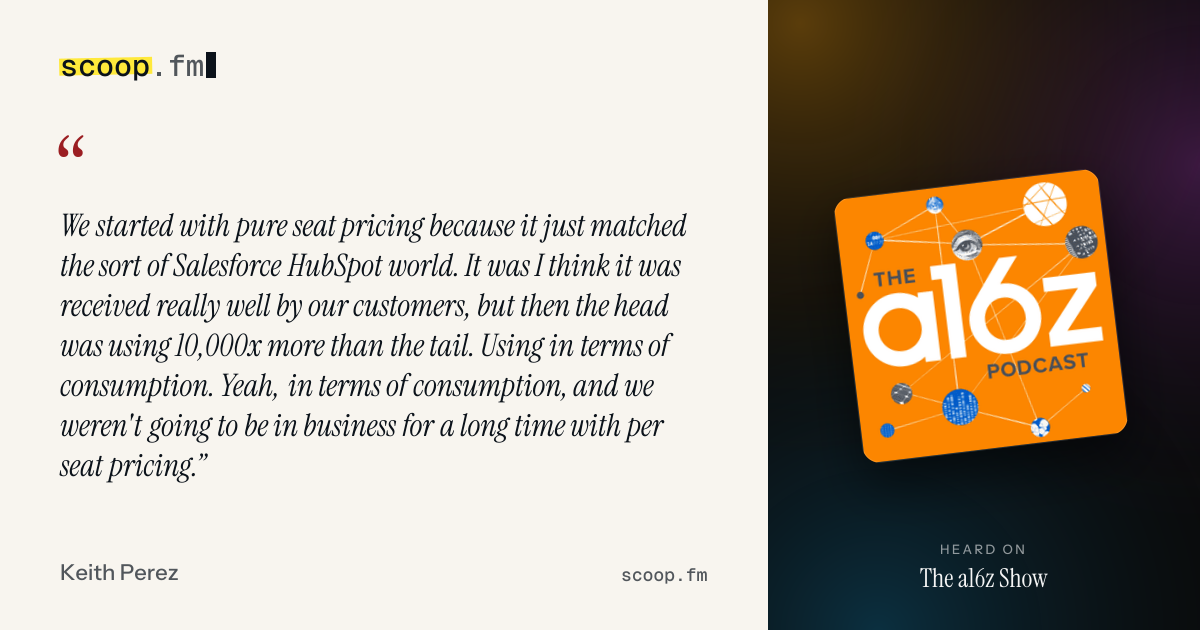
seat-based pricing
2 episodes · 2 of 3 mentions
"The Cognitive Revolution" | AI Builders, Researchers, and Live Player Analysis
Sep 17 · 67 min · Top 100 technology
Outcome-based billing gains traction over seat licenses
- Wade Foster argues that per-seat pricing models are dying as AI makes usage-based or outcome-based pricing necessary.
- Zapier observes that 80% of tasks delegated to AI agents should actually be handled by deterministic code.
- The company is moving toward outcome-based billing, such as charging customers specifically for resolved support tickets.
Why this matters to you
Shifting from per-seat to outcome-based pricing directly impacts how SaaS operators capture the value created by AI automation in their workflows.
“I think it may still make some sense in some small areas, but by and large, when intelligence is such a core part of these product experiences, I don't see how a fixed seat-based pricing mechanism really makes much sense for that at all.”
— Wade Foster
Listen Watch Deep dive
SaaS
12 episodes · 12 of 22 mentions
The Twenty Minute VC (20VC): Venture Capital | Startup Funding | The Pitch
Sep 17 · 76 min · Top 100 business
Valuation multiples shift from revenue to EBITDA
- The SaaS ecosystem is experiencing a shift where companies like Miro and Airtable face inevitable exits due to stale valuations.
- Bending Spoons acquired Miro for $1.35 billion, a significant decrease from its previous $17.5 billion valuation in 2021.
- Investors note that SaaS companies with slowing growth must transition from revenue-based multiples to EBITDA-based valuation models.
Why this matters to you
The transition from revenue to EBITDA multiples forces founders to prioritize cash flow over growth, fundamentally altering SaaS pricing and operational strategy.
“Death comes for us all in Sassland, right? And it was exactly right. It was just an inevitable cleanup operation because it was just so far wrong in terms of pricing.”
— Rory O'Driscoll
Listen Deep dive

Sep 18 · 27 min
AI exposes existing structural flaws in SaaS
- Jacco van der Kooij claims AI did not cause current SaaS industry problems but simply exposed them.
- The speaker warns that AI companies are repeating the same failed SaaS growth mistakes at higher speeds.
- Van der Kooij argues that inbound-dependent models are failing as SEO, email, and social channels stop contributing.
Why this matters to you
Understanding that AI exposes existing structural flaws rather than creating new ones helps identify which growth strategies are fundamentally broken and need immediate replacement.
“AI did not cause the problem that the SaaS industry is in. It simply exposed it.”
— Jacco van der Kooij
Listen Deep dive
Also mentioned

Why AI doesn't create demandProduct-market fit remains the primary AI failure point · In Demand: How to Grow Your SaaS and Stay In Demand · Listen
Founders report that failed AI tools often suffer from poor market fit rather than technical issues, emphasizing the need for specialized client portals.
AI for Logistics: Inside 5U AI’s Journey to Transform OperationsAI-native models challenging 80% SaaS margins · The SaaS CFO · Listen
AI-native logistics SaaS is shifting from token-based pricing to per-task models to align with value and maintain margins against inference costs.

How to Increase Your Website Conversion Rate (3 Free Fixes Anyone Can Make)Marketing versus conversion optimization in B2B SaaS · Pitch Me · Listen
Spiralize notes that B2B SaaS companies under $50M often suffer from marketing failures rather than conversion issues, advising a shift toward product-focused website assets.

The State of Startups in 2026SaaS system-of-record moats remain highly valuable · Y Combinator Startup Podcast · Listen
YC partners report that SaaS is not dead but transforming into AI-driven autonomous agents, with systems-of-record moats continuing to drive stock recovery.

Greypoint: Building Hardware in an AI BatchVC appetite shifts away from pure software models · Year One · Listen
SaaS startup representation in the current YC batch dropped to 12%, with founders increasingly pivoting toward hardware and industrial technology.
Why customer research should never be fully automatedNiching versus strategic beachhead focusing · In Demand: How to Grow Your SaaS and Stay In Demand · Listen
Asia Orangio advises founders to avoid permanent niching, suggesting instead a strategic focus on a beachhead that allows for long-term expansion.

424 | The Truth About B2B Marketing - Why Sales Needs Content | Shiv NarayananBuyer behavior shifts from SEO to AI shortlists · Futureproof Founder Podcast · Listen · Watch
Shiv Narayanan warns that B2B buyers are bypassing websites entirely, forcing SaaS founders to build a training data footprint to remain visible to AI.

Autonomous Computer Agents, Toke Economics, and Dual Use-case of LLMs with Simular AI Ang LiScreen-based agents versus API-based automation · AI Proem Podcast · Listen
Simular AI suggests that SaaS companies acting as systems of record will survive, while portal-based startups face disruption from autonomous screen-based agents.


How I'd Scale an AI SaaS to $1M/mo in 2027 (Full Guide)The margin tension in high-ticket service upsells · The Ravi Abuvala Show · Listen · Watch
Ravi Abuvala cautions that adding service-heavy, high-ticket packages to fix SaaS acquisition can dilute the high-margin leverage of the core product.
She Left Audit at KPMG and RSM to Rebuild How Finance Works | Esther Adeogun | Diary Of A CFOEmbedding financial intelligence into operational workflows · Diary of a CFO | Financial Strategies for Smart Business Growth · Listen
Esther Adeogun argues that modern SaaS must move beyond transaction recording to embed financial intelligence directly into the operational heart of the business.
churn
7 episodes · 8 of 13 mentions
The End of Cheap Growth: Why Scaling a Business Costs More Than EverPerceived neglect as the primary driver of churn · The CEO Growth Podcast by Empire Growth Media · Listen
68% of customer churn is attributed to users feeling unappreciated, highlighting the need for support-led retention over aggressive acquisition.

How to Sell Your Company: A Multi-Time CFO's Full Playbook | Rick SmithChurn as a major purchase price adjustment factor · Run the Numbers · Listen
Rick Smith warns that customer churn during a sale process can lead to significant valuation discounts and purchase price adjustments.
518. Inside AI-Native VC DiligenceData scarcity in AI-native churn measurement · Transform NOW · Listen
Investors note that many AI startups lack the historical data required to accurately measure churn, making SMB-focused revenue growth appear deceptively sustainable.

Episode 450: How to Improve Client Retention in Your Online Coaching BusinessChurn benchmarks for client-based business models · Mastery Podcast with Mark Coles · Listen
Mark Coles identifies a 4-5% monthly churn rate as a healthy benchmark, noting that higher attrition directly erodes total business income.

What if your business could revolve around your life instead of the other way around?Industry average churn for monthly memberships · Wellness Pro Show · Listen
Brenda Rigney notes an industry average churn rate of 30% for monthly memberships, necessitating annual VIP plans to stabilize revenue.

Why Your Biggest Customers Can Be Your Biggest Risk: The Hidden Economics of Customer ConcentrationCompounding impact of retention on profitability · The CEO Growth Podcast by Empire Growth Media · Listen
Increasing customer retention by 5% can boost long-term profitability by up to 95%, making churn reduction the most efficient growth strategy.

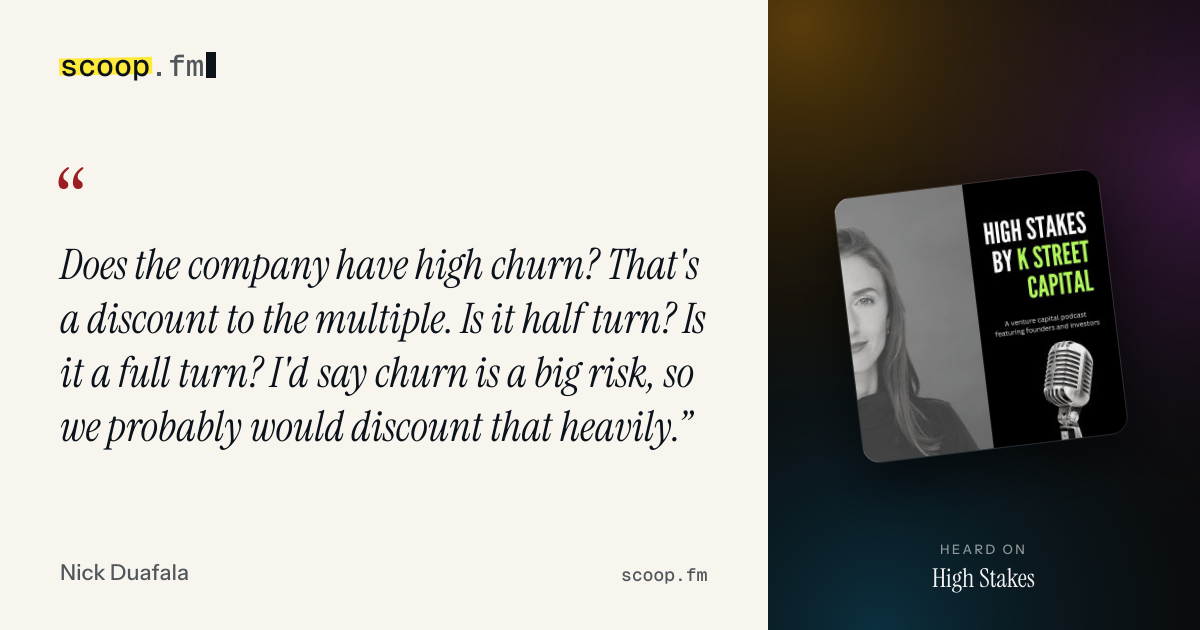
How VCs Actually Think About Startup Valuations? | Paige Soya, Nick Duafala & K Street CapitalInvestors discounting valuations based on high churn · High Stakes · Listen · Watch
Investors view high churn as a direct risk that forces them to discount revenue multiples, regardless of growth rates.
vertical SaaS
2 episodes · 2 of 5 mentions
The AI Daily Brief: Artificial Intelligence News and Analysis
Sep 18 · 30 min · Top 10 technology
Voice-first interfaces redefine vertical SaaS interaction
- Greg Eisenberg predicts over 90% of vertical SaaS will adopt a voice-first interface for user interactions.
- Jaya Gupta argues software companies should become model factories by post-training open-weight models for their specific vertical.
- Vertical software becomes invisible as agents handle admin tasks like CRM updates and quoting via voice inputs.
Why this matters to you
Voice-first interfaces represent a fundamental shift in how vertical SaaS products are built, priced, and consumed by non-technical end users in the field.
“I think 90% plus of vertical SaaS will need a voice front door. By that, I mean the way you use the software becomes talking to it.”
— Greg Eisenberg
Listen Watch Deep dive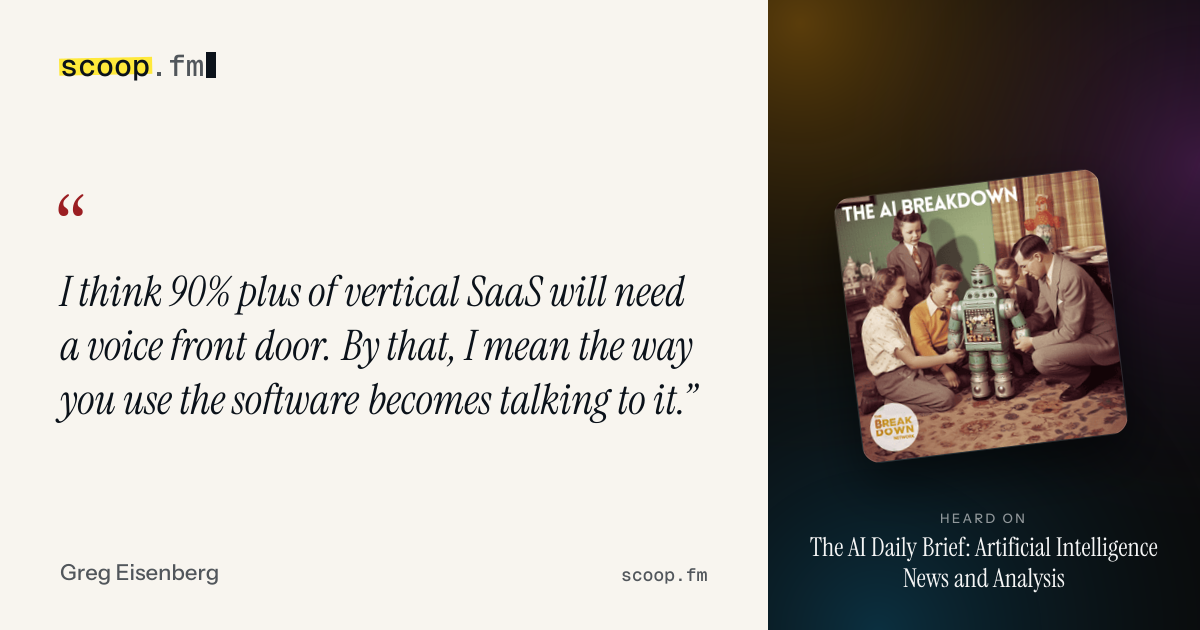
Also mentioned

Embedded Finance Special Series: Embedded Accounting, the Next Big Fintech Product with Justin Meretab, Layer | Episode 527Vertical SaaS commoditizing horizontal accounting tools · Leaders In Payments · Listen · Watch
Vertical SaaS platforms are capturing significant customer spend by embedding accounting tools and automating reconciliation using existing payment data.
net revenue retention
1 episode · 1 of 3 mentionsThe CEO Growth Podcast by Empire Growth Media
Sep 12 · 53 min
Net revenue retention as the ultimate valuation driver
- Net revenue retention is described as the single most unforgiving metric for measuring recurring revenue models.
- Top quartile companies like Snowflake achieve net revenue retention rates between 135% and 150% or more.
- McKinsey analysis shows companies with top quartile net revenue retention command enterprise valuation multiples of 24x.
Why this matters to you
High net revenue retention directly correlates to a 24x revenue valuation multiple, separating sustainable growth engines from those decaying from within.
“NRR is the crucible. It is the single most unforgiving metric in recurring revenue models.”
— Host
Listen Deep dive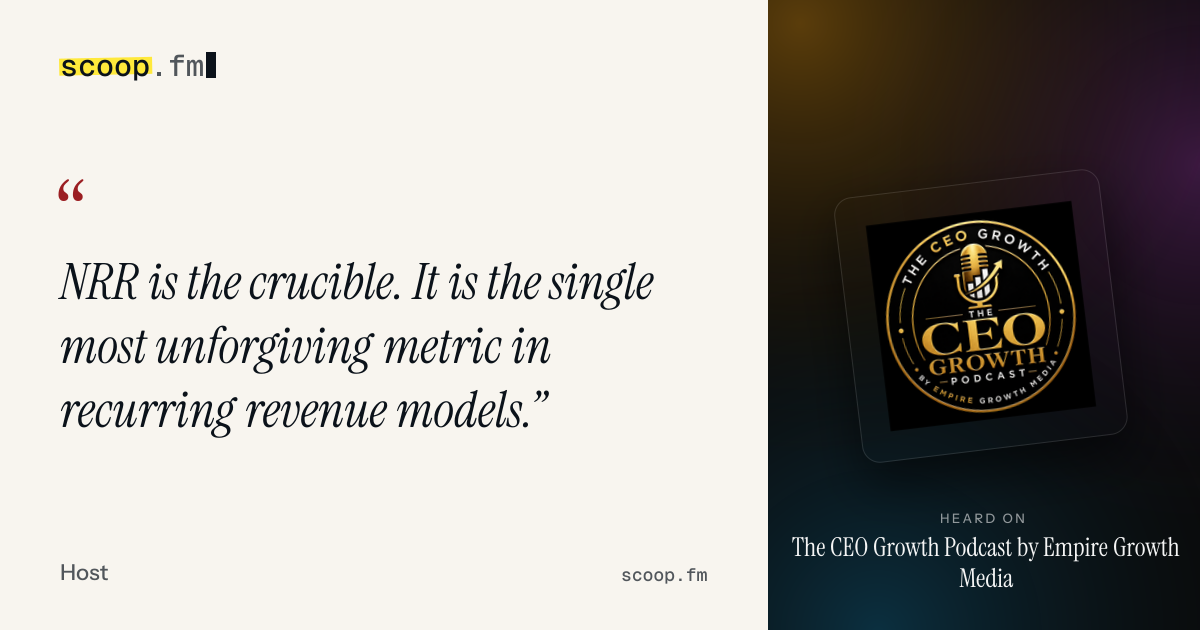
Make it yours
Start from these trackers
Copy its trackers, shows and tone into a page of your own. Change anything — this page isn’t touched.
Make it mine